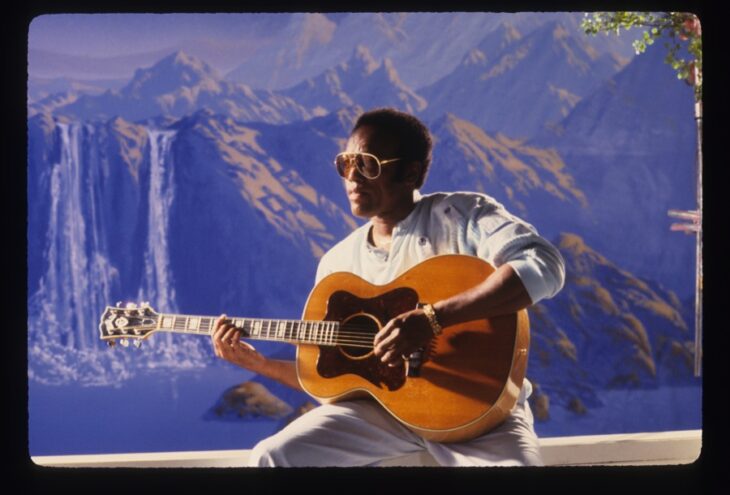
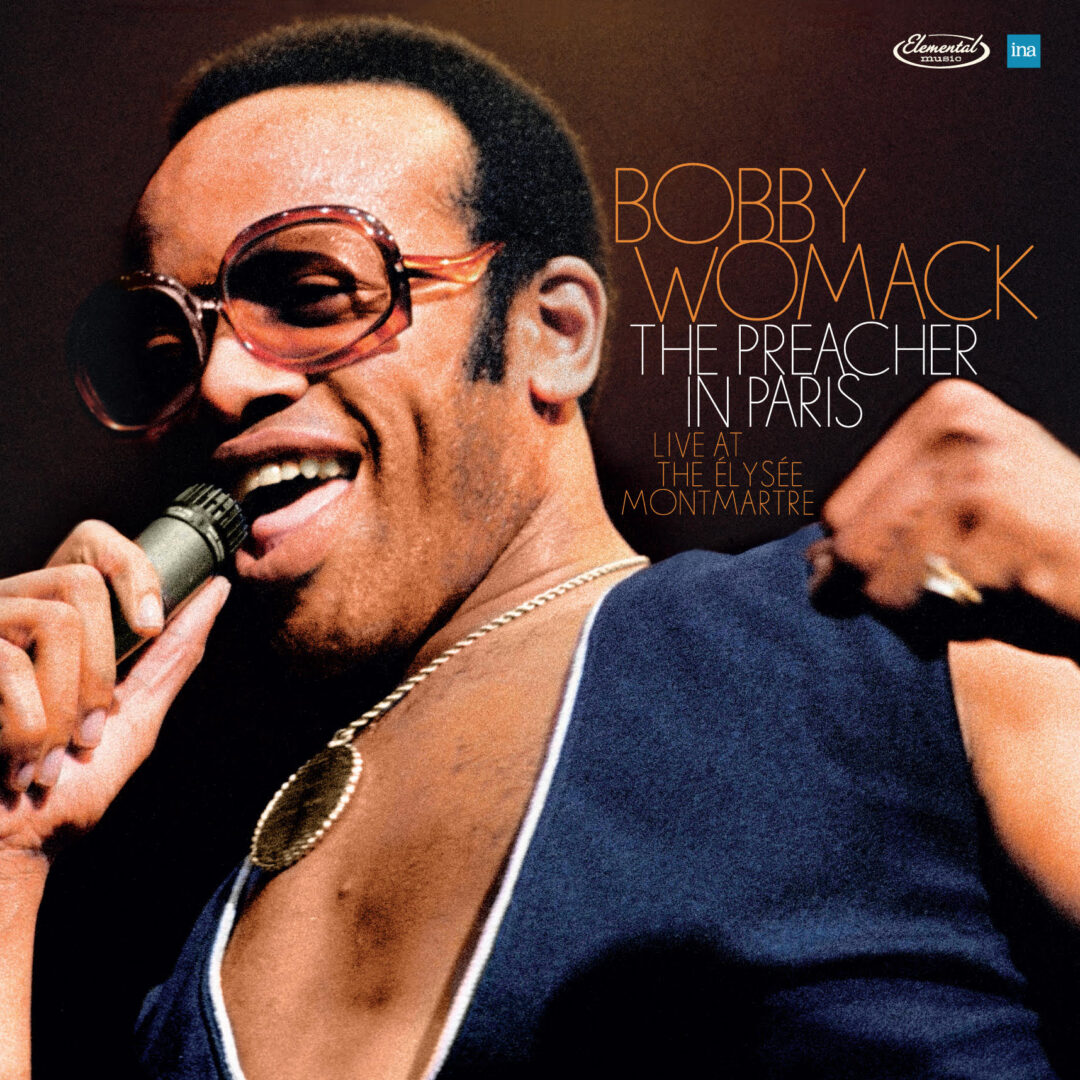
On November 27, 2026 – Bobby Womack – The Preacher in Paris will be available on Elemental Music.
An announcement from Braithwaite & Katz Communications touts the upcoming release.
"RSD Black Friday is getting a heavy dose of gritty vintage soul thanks to Bobby Womack: The Preacher In Paris: Live At The Elysee Montmartre.
“The two-LP set, out November 27, 2026 on Elemental Music (in cooperation with L'Institut National de L'Audiovisuel, a/k/a INA), captures this Rock & Roll Hall of Fame titan and his fiery touring band as they blaze through a set of soul/funk classics in one of Paris’ most historic venues on March 15, 1976.
A CD version will be released December 4, 2026.”
This is Bobby Womack in his primetime era. A hot band and a career-spanning repertoire.
To the people who knew Bobby Womack, March 4, 1944-June 27, 2014, or bought his records, heard his tunes covered over a seven-decade career, or caught his stellar live performances, this left-handed guitarist was a melodic and lyrical force of nature.
Womack played guitar on recordings by the Box Tops, Joe Tex and on Aretha Franklin’s Lady Soul. The J. Geils Band, Janis Joplin and Wilson Pickett have covered his tunes, and the Rolling Stones’ first hit single in the Us was their rendition of Womack’s “It’s All Over Now,” which Bobby first did in the Valentinos.
Bobby’s partnership with guitarist George Benson yielded the instrumental “Breezin’” which became a hit single for Benson. Womack’s guitar work and contributing vocals are on Sly and the Family Stone’s There’s a Riot Goin’ On. He’s been sampled by numerous recording artists.
Over the last 40 years around Hollywood, at least a few times a year, I would encounter Bobby inevitably at his concerts, a recording studio, a band rehearsal room, jams in clubs and various venues, LP preview listening events, a restaurant, usually Thai, and in several record company lobbies. I’d also catch him at a dentist or post office, supermarkets, sometimes at the midnight hour or even six in the morning, either backstage or in dressing rooms of English rock royalty.
My very first Womack sighting was decades ago at the Hollywood Boulevard law offices of Walter E. Hurst, who represented Sam Cooke, the Valentinos, J.W. Alexander, Lou Rawls, Eddie Cochran, and Jack Nitzsche, among others. Bobby kept his pit bull dog in one of Hurst’s vacant spaces.
I remember in 1983 at the Chan Dara Thai restaurant in Hollywood, I was, shall we say, unhappy after a romantic breakup. While I was nursing two Thai iced coffees, in walked Bobby Womack. He was just down the street at United Artists Records.
I told him my situation. Behind his big aviator glasses, he smiled, took a long puff from a menthol Cool cigarette, and then explained to me some facts of life, while adding, “Man, where do you think all my songs come from?”
In 2004. I mentioned Bobby in my first book, This is Rebel Music, where I cited him in the text. It was a moment just after we were waiting in line at a Sam Woo’s Korean BBQ on Sepulveda Boulevard in the San Fernando Valley. He had just parked his Buick Electra 225 deuce quarter and strolled into the joint beaming. “BW” had the title theme and ending credits cue on Quentin Tarantino’s Jackie Brown with his “Across 110th Street.” Bobby had just gotten paid.
Womack happily offered to buy me a head of a pig on a split at the take-out counter. It sure looked scary, but it tasted awfully good.
One time during a 2009 interview, I pressed him for a revealing music business tale. He laughed, “I can’t tell you the wildest crazy shit I saw in a studio because I would need an aspirin,” he coyly confessed.
I bumped into him that same year at a bakery. Bobby proudly stated that one of the last business transactions Allen Klein’s ABKCO did on his behalf was to administer the licensing request when Mariah Carey sang “We Belong Together” and sampled his “If You Think You’re Lonely Now.”
In May of 2013, I was an on-screen interview subject, along with Damon Albarn of Blur and the Gorillaz, Chuck D. of Public Enemy, Barney Hoskyns, Bill Withers, Regina Womack, actor Antonio Fargas, and the Rolling Stones’ Ronnie Wood in the BBC-TV documentary on Womack that James Meycock directed.
Bobby Womack himself remarked a few years ago, “As long as I’ve got that breath and God-given talent, every time someone thinks of soul music will remember me and say, ‘that’s one mother fucker who wouldn’t die.’”
During one of our interviews last decade, Bobby ruminated on “Across 110th Street.”
“I used to live in Westwood and wrote ‘Across 110Th Street’ in an apartment there. That was very spiritual to me. When I was going through my divorce, Rosy Grier said, ‘Come on out here, man, It’s cool. There is an available apartment. I felt comfortable because he was a very level-headed guy.
“I remember when I was about to start ‘Across 110Th Street’ and United Artists would always go outside the label to get things. I approached them one day, Nik Venet, and told him, ‘The next movie I want to do.’
He was definitely involved, because I told him, ‘If they don’t do this, they are definitely gonna have problems with me.’ So, they brought me this movie. I saw it one time, and I was getting ready to go on tour 3 or 4 days later. And they said, ‘You got to have it done and finished in two weeks.’ ‘Two weeks?’ I stayed up 24 hours a day, and when I brought it back with ‘If You Don’t Want My Love’ and all the songs I had written, it fitted. ‘Man, it was easy to write those songs. I was born in the ghetto. That’s what this whole story was about.”
One time in a 2009 interview, I asked Bobby to discuss Janis Joplin. Record producer Paul Rothchild was a neighbor of Bobby in Laurel Canyon. Paul did Pearl, the last Joplin album.
“I loved Paul. Rothchild was at the studio, and he said, ‘Man, she loves you. You guys should hang out. She’ll be good.’
“All I know is that Janis Joplin called me. I didn’t know how she got my number. ‘This is Janis.’ ‘What are you calling about?’ I didn’t think it was her. ‘Well, everybody else has recorded your songs, and I just want to do one of your songs.’
“She was a person who joked all the time. ‘Why don’t you come to the studio? It’s on Sunset. Come to the studio and bring me some songs.’
“So, I brought her every song I had ever written that were recorded and not recorded. And she said, ‘When I push the button that means I like it. If I don’t push the button then you gotta quit and go to another song.’ Janis did my tune ‘Trust Me.’
“So as soon as I hit the first song ‘Trust Me,’ she pushed the button. ‘Shit, this is gonna be easy. I’m gonna have the whole album,’ I said to myself. She never pushed the button again…I kept on singing and ran out of songs. And Janis said, ‘Don’t you get it? The first song you gave me, I loved it. That’s it. Let’s cut it.’ And I played on it.
“In a little short time, we became very close. I remember her coming to the studio the next day and she was very upset because she was sayin’ Jimi Hendrix passed. She was very upset. ‘Oh baby, I know you feel bad…’ And I shared my own experiences about meeting him.
“The first time I saw and met Jimi Hendrix to really know him when he was with a guy named Gorgeous George, who was a guy who made clothes and always thought he could be a Sam Cooke or Jackie Wilson. It was on a show when I was playing guitar for Sam, on a bill with Jackie Wilson and James Brown.
“She then joked about ‘Oh, I plan to kill my own self. Now with Jimi just leaving I ain’t gonna get no publicity.’ She was joking like that all the time.
“She liked my car. [“Mercedes Benz,” written by Joplin with Michael McClure and Bob Neuwirth, was subsequently recorded for Janis’ Pearl sessions after she took a ride in Womack’s vehicle].
“So, she told me to come by the Hollywood Landmark Hotel. I go to the hotel, and we were partying…
“She was very respectful. I found out a lot about her in a short time. The thing that blew me away about Janis was when she asked, ‘What bothers you the most in this business as far as the black and white thing?’ And I told her, ‘Every time I cut a record, I try and cut a record so I can cross over to appeal. I just don’t cut the record. I just want to be able to cut a record, and that’s it.’
“And I said, ‘What about you?’ ‘Everybody keeps saying I’m trying to be Tina Turner.’ That blew me away. ‘You don’t sound nothin’ like her.’ And jokingly I added, ‘You don’t look anything like Tina. Well, we both got this problem. So why don’t we do something together like a tour? You go out there and let them know.’
“I hadn’t heard this Tina thing and told her it was in her head. She was very serious. Janis loved Tina Turner.
“And she ran down how she went to high school and blew the school that used to think she was ugly. And she was talking about the problems she had. And then I left before her heroin dealer showed up.
“Paul Rothchild then called me early that morning, and he says ‘She OD’d.’ And I said, ‘You got to be joking me…’
“That just broke my heart. Broke my heart…
“Talking about that was something I could never adjust to. Is seeing somebody today and losing them tomorrow.”
During a supermarket visit with Bobby, he reflected on some of the R&B greats he personally knew and played with.
“Lou Rawls picked up his rap thing, the monologue, from Johnny Guitar Watson. A record Johnny put out about Chicago, and then Lou Rawls went and cut it, and it became a hit. To me, nobody sounded like Lou Rawls. He had his own style. Totally different and very comfortable in that.
“Curtis Mayfield was a hell of a talent. Everybody knows that. He was before his time, really. He wrote some great stuff with the Impressions to Jerry Butler and for so many artists. He controlled the East Coast. I met Dee Clark when we did tours together with Sam. He had a beautiful voice.
“I met up with Larry Williams later in my career through Johnny Watson. I was having a birthday party, and he came down, and we sat and talked a long time.
“Hey, he was a beautiful guy and knew so much about the business. ‘I was the one who started this. I did this.’ But he and Johnny were really tight. And he could never make up his mind about being a songwriter or a pimp. And he was caught up in the middle, and I heard he was a hell of a performer. I never really saw him perform. I heard the gossip, ‘Larry has got all these women.’ I really didn’t know that personally. And Sam Cooke used to say, ‘Johnny and Larry. Johnny has got a lot of talent, but he said Johnny is caught up in that hustle game.’ Sam would say, ‘Nobody sounds like Johnny.’
“It’s easy on one side and very complicated. Sam was the first guy who introduced me to Nat King Cole at RCA on Sunset. And Nat was coming down the stairway, and Sam was a very likeable guy, and he knew everybody. ‘Hey Nat, I want you to meet Bobby Womack. He’s gonna be big one day. This is my new artist, Bobby Womack, who sang with a group called The Valentinos.’ They were talking like they knew each other for 100 years. ‘Pleasure meeting you, man.’ Then I walked away thinking about it. ‘Man, I just met Nat King Cole…’
“Earl Palmer was always on the Sam Cooke sessions. He was a hell of a drummer. I knew Rene Hall. He was a hell of a soulful arranger. We worked with Sam together. Sam had a big influence on anybody. I mean, to me, cancer would be good if Sam gave it out. I’m serious. Damn, I’ve seen artists who have their own styles, but if they hung around Sam a minute, they are gonna make some of his runs. Just rubs off on you. Sam was a natural.
“He would always say, ‘Bobby, you could listen to a person talk and know what they sound like. They sound the same way they talk.’ Listen to Louie Armstrong. Listen to Jackie Wilson. Go listen to Ray Charles. All these guys have different styles and don’t try and sound like each other. When you are born a certain way, you can’t even think about tryin’ to sound like somebody else. It would be hard to do.”
Often when the musical legacy of Laurel Canyon is chronicled, the former Laurel Canyon resident and homeowner Womack, a fellow Pisces, is never really mentioned or cited about the area’s singer/songwriters and bands that have been examined in articles, books and documentaries.
Bobby logged many years in the heralded region. I made it well known in my book, Canyon of Dreams: The Magic and the Music of Laurel Canyon. In the pages, hewas delighted to reminisce about his world in Laurel Canyon. After publication, at a soul food restaurant, he came to my table and gave me praise, “Black Santa is gonna take care of you this Christmas!”
“You could be anywhere in Laurel Canyon, and something would be goin’ on. It was like a nightclub in a sense to me. You’d hear ‘so and so is cuttin’ over on Sunset you wanna go by?’ I did a song called ‘Daylight’ that Leon Russell wanted to record.
“So, we stopped by his studio. And if you had something to offer, you know you were in. It was just hanging around buddies and guys doing the same thing they’ve been doin’ all their lives.
“It’s very hard to put the racial thing in the mix with musicians all over town and when I was in Laurel Canyon,” emphasized Bobby.
“See, everybody looked out for everybody. So that never came up, but only to the outside people. And that’s just the way it was. We would joke about it and talk openly about it. Anything. See, Laurel Canyon was where I lived and decided where I was gonna hang. Yes, there were recording studios on Sunset Blvd. and record labels, but I never looked at it as ‘there’s a lot of musicians up here.’
“Like, when I heard Mama Cass passed. I didn’t know she lived right around the corner from me. I mean, right around the corner and I didn’t know it. And I was shocked, but you know I was never riding around lookin’ for Mamas Cass. But I did do ‘California Dreamin’. ‘Cause I was just knocked out by the Mamas and Papas. They blew me away with it, and it was such a cool song.
“Plus, everybody was covering a good song. The song reached me because I loved California. I didn’t have to hear it to pack my bags and come to town. I’d been here years before I heard that tune,” he underlined.
“Anybody would always go up on somebody’s show and grab a guitar or whatever. I’ll never forget I was on the stage at the Troubadour. Donny Hathaway gig. I walked on the stage, and John Lennon grabbed the piano, and I grabbed a guitar, the only thing I saw ‘cause I didn’t want to be up there on stage doin’ nothing.
“When Lennon grabbed the piano, it was out of tune. And he turns around, and at the time I didn’t know who he was. ‘Cause I’m caught up in all these people bein’ on stage.
“Lennon asks for me to give him the guitar. ‘The piano is out of tune.’ ‘I don’t play no piano, man. I’m left-handed. It would be out of tune worse than that if I played it.’
“So, Lennon got real hot and said, ‘Give me the fuckin’ guitar.’ And I said something back. Afterwards he came up to me to give me an apology. ‘We were just on the spot.’ ‘Ah man, forget about it.’ And we took a photo together. I still have the picture. It was amazing.
“I ran into Arthur Lee of the band Love in Laurel Canyon. I’ll never forget when Woody (Ronnie Wood) brought Keith Moon, the Who drummer, up to my place. I said, ‘This guy is crazy.’ Because I just got my house with my new furniture and everything, and Woody and them came by with him. And Moon came in, and he was so wild, and jumped on top of my couch and started running all over it and the counter. Everywhere. So, I said, ‘Who in the fuck is this?’
“So, Woody started laughing and said Keith was OK. ‘Yeah, but I just bought these couches, and I had never seen a guy this wild.’ He fell on the floor, started pouring water on himself. He was just crazy.’ But when I saw him play, I knew that was a place where he could be himself. He looked normal. (laughs).
“Frank Zappa lived right around the corner from me. The strange thing about Frank is that he didn’t invade my space and I didn’t invade his space. He was always to himself.
“What happened was that he admired Johnny ‘Guitar’Watson. He was a hero of his, and I didn’t know that. Johnny came up to see me one day, ‘Man, I’m going around to Frank’s house ‘cause he wants to see me and ask me about the business.’ Man, this guy is crazy about Johnny.’ And, I never did that thing, ‘Hi, I’m Womack. I live around the corner.’ And this was like a couple of years before Frank passed. Johnny had mentioned that Frank wanted to take him on tour. A big thing. ‘Man, go do that.’ Then Johnny Watson went to Japan, and took my horn section ‘cause I wasn’t working, and I was in the studio. ‘OK, I need to use your horn section.’ And he goes there and never comes back. Never comes back...
“Damn, I keep losing people. I keep losing people I love and didn’t know I loved them this much until they aren’t around. Maybe we become messengers for some people who aren’t here. But boy, sometimes I’m telling you I need some help with these messages. Sometimes they go too fast.
“So, you got to have passion for this business and love it. Because anything can disappoint you. And the strongest thing can take you out, but if you have a passion for the music, so when I look at new generations makin’ it. I join them. ‘Mr. Womack. I love your music and what you do.’
“But what separates everything is the music that reached people’s hearts. And the stories that will live on forever, and they are bein’ told over and over again.”
(Harvey Kubernik is the author of 20 books, including 2009’s Canyon Of Dreams: The Magic And The Music Of Laurel Canyon, 2014’s Turn Up The Radio! Rock, Pop and Roll In Los Angeles 1956-1972, 2015's Every Body Knows: Leonard Cohen, 2016's Heart of Gold Neil Young and 2017's 1967: A Complete Rock Music History of the Summer of Love. Sterling/Barnes and Noble in 2018 published Harvey and Kenneth Kubernik’s The Story Of The Band: From Big Pink To The Last Waltz. In 2021, the duo wrote Jimi Hendrix: Voodoo Child for Sterling/Barnes and Noble.
Otherworld Cottage Industries in 2020 published Harvey’s Docs That Rock, Music That Matters. His Screen Gems: (Pop Music Documentaries and Rock ‘n’ Roll TV Scenes) was published in 2026 by BearManor Media.
Harvey Kubernik wrote the liner notes to CD re-releases of Carole King’s Tapestry, The Essential Carole King, Allen Ginsberg’s Kaddish, Elvis Presley The ’68 Comeback Special, The Ramones’ End of the Century and Big Brother & the Holding Company Captured Live at The Monterey International Pop Festival.
During 2006, Kubernik appeared at the special hearings by The Library of Congress in Hollywood, California, discussing archiving practices and audiotape preservation. In 2017 he lectured at the Rock and Roll Hall of Fame in Cleveland, Ohio, in their Distinguished Speakers Series. In 2023, Harvey spoke at The Grammy Museum in Los Angeles discussing Martin Scorsese's The Last Waltz documentary on The Band.)