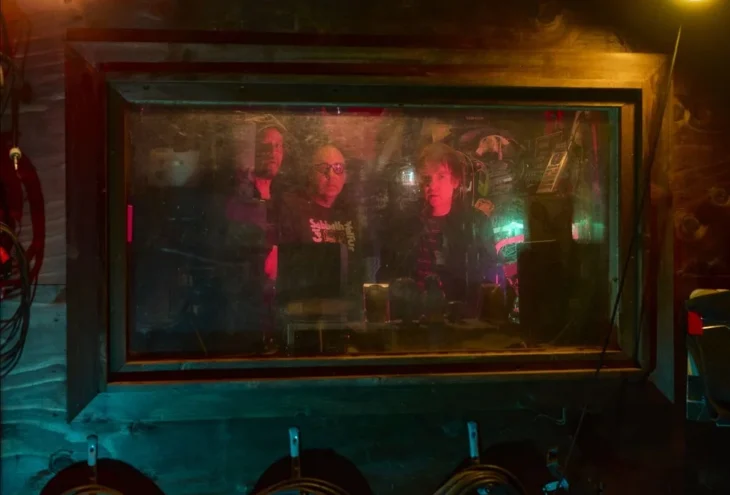
The Members: Al Cisneros, bass, vocals; Bubba Dupree, guitar; Dale Crover, drums
The Album: Hempispheres
Produced by: Sleep
Engineered and mixed by: Toshi Kasai
Recorded at: Melvins HQ, Sound of Sirens
Mastered by: JJ Golden
The Origin: Incanting acolytes with sacred sonic compositions, immovable basslines, and uber-thick riffs heavily downtuned to a crushing C standard, the members of Sleep lured listeners into their cosmic Somniverse with maelstroms of colossal sounds. Within this deafening, hazy expanse, their music has been increasingly met with mythical lyrics that explore cannabis as a metaphorical holy sacrament.
While the then-San Jose, CA-based band’s debut, Volume 1, channeled the sludgy depths of doom with help from metal-to-monk Justin Marler, it was their sophomore release, Sleep’s Holy Mountain, that placed early core trio Al Cisneros, Matt Pike, and Chris Hakius on the precipice of becoming the godfathers of stoner-centric sci-fi sagas. Through this landmark album, the band continued to craft an alchemical sonic archetype where heavy-hitting, slow-swinging rhythms and hypnotic riffs slipped minds into states of meditative subconsciousness.
After several years of songwriting and perfecting their fuzz-drenched sounds and shamanic-leaning lyrics, Sleep ultimately returned with a staggering, hour-plus-long odyssey— a holy-smoke-filled symbolic pilgrimage known as Dopesmoker.
Shelved and left in a state of legal limbo due to label disquietude, the epic wouldn’t be heard in its full sonic glory until years later. It first surfaced in 1999, as a truncated unauthorized edit titled Jerusalem, before the uncut, sixty-three-minute and twenty-nine-second opus finally emerged in its entirety in 2003 — eventually finding its definitive, remastered home decades later in 2022 via Third Man Records.
This strange stasis of silence — which included an extended disbanding of the group — only amplified their legendary status. As their immense maw of massive chords from the sonic masterpiece Dopesmoker reverberated then dissipated through the great haze, Sleep ultimately ascended as stoner doom deities.
Reuniting on stage in the mid-2000s for a series of sets, this revered riff institution continued to fuel their legendary mystique. Cut to 2018, when Sleep awoke from a prolonged studio silence — delivering another critically acclaimed super-doom testament, The Sciences, on Jack White’s imprint. After several live shows and a historic live-direct-to-acetate performance in the label’s Blue Room, the band continued their sonic pilgrimage.
Following the whirlwind of their return, a subsequent hibernation, their self-proclaimed ‘hypersleep,’ took hold. Yet beneath the surface, a period of subterranean creativity carried on. Despite the sudden departure of founding member and guitarist Matt Pike, Sleep snapped back to full awakening when bassist and vocalist Al Cisneros returned alongside Melvins’ legendary drummer Dale Crover and Void’s revered guitarist Bubba Dupree for the monumental 2026 space-psych odyssey, Hempispheres. Below, Crover and Dupree break open this new esoteric zenith, describing how they assemble the towering heft that lies behind their historic wall of sleep.
The Production: The original doom scrollers of sound stepped back into the studio to cultivate a super-heavy, sub-harmonic soundscape designed to accompany Al Cisneros’ debut graphic work through Third Man Books, The Sleep Comic Book. Intended as a thematic companion source to the cosmic saga under the label’s umbrella — this music drifted into full form from the hazy, decades-long kinship Al shares with a trusted peer. New Sleep drummer Dale Crover details this early alignment:
“I've known Al since he was a teenager, you know, probably 30 years,” Crover explains. “He asked me a while ago to do some recording with them, including Matt Pike. It started with the comic book Al was writing — originally it was one song, but we ended up doing two, and from there the excitement started to build, with Al wanting more music to go along with the book.”
Crover notes that the creative spark quickly rolled into something much larger. “I think he said that he hadn’t been this excited about something since they recorded Sleep’s Holy Mountain — and that was a long time ago,” Crover continues. “He would say, ‘I’m going to go home and write more... we need to do a whole album.’ That led to talking about officially rebooting the band.”
However, the momentum ground to a sudden halt when Matt Pike departed the fold. To keep the cosmic vision from dissolving, Cisneros leaned on a connection that would completely reshape the band’s next chapter. Crover explains:
“Al was looking for somebody else to play guitar, and while I was on tour with the Melvins in Seattle, I knew I was going to see Kim [Thayil] from Soundgarden. I asked Kim if he knew someone for the project. He suggested that we try Bubba out for the band. And so that's kind of how we got Bubba. It was like, ‘Okay, that sounds great.’ And then next thing we know, we're in the studio together. It was ‘Whoa!’ We went from a comic book to a full-blown record and now tour.”
Once Dupree plugged into the mix, it was an instant hit. Decades of mutual respect meant there wasn’t any awkward adjustment period, as Dupree details:
“It was quick. I met Al and Dale before, but this was the first time we were literally in a tracking room together making a record. Basically, from the start I began figuring out how to interpret Al's demos, and we just pressed record. I think we might have actually started recording that first day.”
Making the transition even smoother, the three decamped directly into the Melvins’ recording sanctuary where Toshi Kasai handles the desk.
“We tracked at the Melvins’ studio that we have with our longtime engineer, Toshi Kasai,” Crover explains. “We basically sat in there and worked out the songs. We knew what sound we wanted, so once we had a good take, we moved on. The process in general is pretty seamless from the initial concept.”
This relaxed atmosphere was the ideal incubator for capturing the album’s dense, smoke-hewn frequencies. For Crover, mapping the physical nuances of a familiar room alongside Kasai — while unleashing a legendary piece of his own musical history — unlocked the band's hypnotic, heavy cadences.
“I've worked with Toshi for a long time now, and he just gets the sound dialed in fast. You can trust him to get the sound that you want and move on,” says Crover. “Also, I have this drum kit that I bought back when the Melvins did the HOUDINI recording session. It’s an old 1948 Gretsch Broadcaster kit that I bought specifically for recording, and it sounds amazing. I've used it on hundreds of recordings, and it works the best for me.”
To channel the slow, hypnotic roll of the band's history, Crover locked into the jazz-inflected swing left behind by original drummer Chris Hakius, matching that pocket with his own heavy power.
“The original drummer of the band, Chris Hakius, was a really great drummer. He had this swing that you don't really hear with a lot of drummers today,” Crover reflects. “It’s almost like a savage jazz influence. He was a jazz drummer playing rock and roll, drawing from one of my favorite eras of drumming — all the English drummers from the late 70s.”
Crover notes that dialing into that Anglo style helped shape his mindset when tracking the new material. “They all had this influence that was something from before rock and roll. And there's a swing to it. For me, I try to be true to that and keep that swing in there. It's nice to keep those thematics going. It's something you try to emulate, and if you can, you still put your own style into it, but you build upon it.”
For Dupree, stepping into his role as Sleep’s guitarist on short notice cast its own psychological shadow — a reality where Matt Pike’s legacy loomed. Dupree decided the best approach was just to pack his basic gear and go.
“I didn't really plan too far in advance. I couldn't really do any preliminary rabbit-holing because I was going in blind basically. I was just showing up with a guitar and some pedals.”
Instead of trying to mirror Pike’s iconic ultra-weighted sound, he trusted his instinct. He explains, “I didn't want to try to imitate his style. He's got such a distinctive sound. I wouldn't have been able to go in blind and just come up with that sound. So, I figured I'd take the pedals I usually use and the guitar I usually use. And I know they’ve got a bunch of amps, so I'll find one that just works.”
Even so, despite being a seasoned veteran well-versed in heavy tones, the tracking process isn’t always simple when it comes to balancing influence with identity.
“It can be tricky," Dupree says. "It’s not necessarily imitation but honoring their style. To learn somebody else's style or feel without compromising your own is delicate.”
Because he arrived without an array of gear, the bare-bones setup naturally stopped him from trying to chase a hyper-specific sound by using a certain amp or following a specific signal chain.
“I think I might have spent a half hour, tops, deciding what amp to use and I also tried a couple of pedals. It was nice to not obsess for weeks as I would normally do… to just walk in and start working,” Dupree notes. “It saved me from wasting time overthinking things that I'm not in control of anyway. It pays off to not overthink. There was no wasted time.”
Free from any studio hesitation, the entire tracking process moved quickly. Dupree details the timeline of the recording blocks.
“I think it was two sessions, about a week each. For the most part, the second session was fine-tuning and getting Al's vocals down. So, it was fast, especially considering not having time to kind of get warmed up, instead just diving right in,” Dupree summarizes.” Actually, that's about as quick as I've ever tried to pull it off.”
The super-quick tracking sessions ultimately created an expansive piece of space-psych art rock.
“To me, it sounds like Sleep,” Crover says. “It’s different, but I think what we did is really cool. It's a progression. It still sounds like the same band. You'll know there are some new people, but it's definitely a progression.”
For Dupree, the true validation of this new chemistry lies on the stage, where the studio can also be a launchpad for heavy, open-ended exploration:
“It's going to be really a lot of fun to play this stuff live. I'll be nervous as hell, but it'll be a treat for that alone. I look at the record as being the ground we will build off of for live versions. I'm hoping that we get comfortable quick enough to improvise stuff, just jam, let loose, and not really stick too strictly to the script.”
Ultimately, the mutual respect between Crover and Dupree as veteran musicians grew exponentially. This powerful, creative alignment between all three members solidified an undeniable creative kinship that will hopefully bring forth another chapter in Sleep's musical chronology.
For Crover, the excitement is palpable: “We're really excited. Getting to know Bubba has been really great. I've been a fan of his in Void for a long time. The band had a pretty heavy influence on a lot of people. It's crazy to think that I get to play in a band with him.”
For Dupree, the sentiment is shared: “The feeling is mutual. Yeah, I'm really grateful. I don't take it for granted, and I'm excited about the album and everything with it looking forward.”
Photo Credit: Travis Shinn