If you think the music of Sesame Street is just a few cheerful chords and a Muppet singing into a brightly colored microphone, think again. Behind the furry cast and catchy lessons is a serious recording operation—and one that has kept live musicians at the center of the show for years.
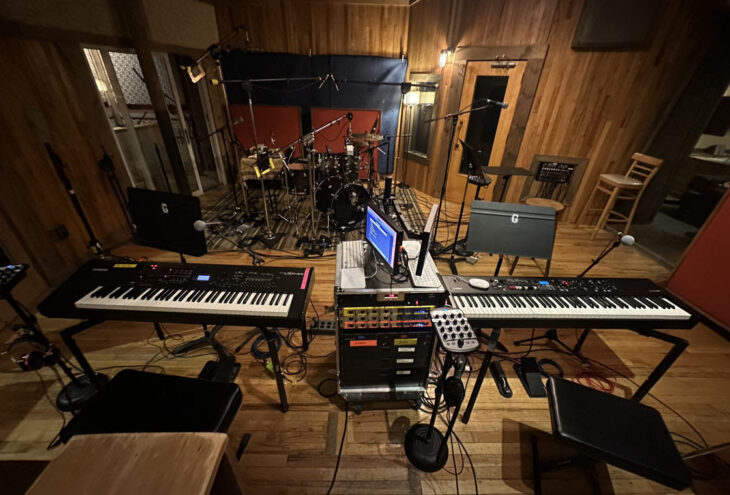
For more than 16 seasons, Emmy, GRAMMY, and Tony Award-winning composer and producer Bill Sherman has served as music director for Sesame Street, helping shape the musical identity of one of television's most recognizable institutions. At Studio G in Brooklyn, Sherman and his team record an eight-piece live band featuring rhythm section, horns and woodwinds, turning around a staggering amount of new material on a weekly basis.
“Very few shows, particularly kids' shows, have a guaranteed live band," says Bill Sherman, music director for Sesame Street. "We've had essentially the same band for 16 years, and that's become a big part of what makes the show what it is.”
That consistency isn't just a nice bit of behind-the-scenes trivia. It gives Sesame Street something increasingly unusual in television: a group of musicians who know each other's instincts, timing, and musical language inside and out. The result is a band that can move quickly without sacrificing the character and spontaneity of a live performance.
“We do anywhere from 30 to 40 cues of music every week,” Sherman explains in a statement. “It’s rhythm section in the morning, horns in the afternoon, and then we’re mixing and turning things around quickly.”
With that kind of production schedule, there's little room for guesswork in the studio. Sherman relies on a collection of AEA ribbon microphones, including the R44CX and R88, to capture everything from drums and upright bass to horns and the room itself.
“We use AEA mics on the drums and in the room all the time,” Sherman says. “That’s where they really shine for us. We also use them on horns, and they just sound fantastic.”
Engineer Tyler Hartman handles the recording side of the sessions, using the microphones as part of a broader approach designed to retain the weight and natural character of the musicians.
For upright bass, Hartman pairs an AEA R44CX with a condenser, allowing the ribbon to provide the instrument's body and low-end character while the condenser adds definition. On drums, another R44CX sits in front of the kit and is blended with the overheads to give the overall drum sound additional heft.
“When mixing drums, I start with the stereo overheads, then I push up the R44CX to add some heft to the drum sound,” Hartman explains. “The more I compress this mic, the more of the rear of the mic I can hear. It really adds a nice depth to the kit.”
The horn section gets its own ribbon-heavy treatment, with R44CX microphones capturing trumpet and trombone while an R88 stereo ribbon sits about eight feet back at head height. Rather than simply isolating each player, that room microphone helps preserve the sense that these musicians are actually playing together.
“The R44CX is just bright enough that I don't need to add any top end during the mix, and the R88 really helps to homogenize the horn sound,” Hartman says.
For Sherman, the value of familiar equipment ultimately comes down to one thing: not having to think about it.
“When you get to a certain point, you go with what you know sounds good,” Sherman says. “If I start worrying about whether something is going to work, it takes away from the creative process. With these mics, we know what we're going to get.”
That confidence is especially useful when you're producing 30 to 40 pieces of music every week. The microphones need to be predictable, but the music itself doesn't. Between songs for Elmo, Cookie Monster, Big Bird, and the rest of the Sesame Street universe, Sherman and the band have to continually find new ways to make lessons, stories and characters musical.
The fact that much of that work is still being performed by the same core group of musicians makes the show's sound feel less like an assembly line and more like a band with a very unusual weekly residency.
After 16 years, that's a pretty impressive gig—and one that happens to come with a lot more ribbon microphones than you might expect. It's a particularly good reminder that beneath the colorful characters and educational lyrics is a genuinely accomplished group of musicians.
For more information on the microphones used in the sessions, visit AEA Ribbon Mics.