
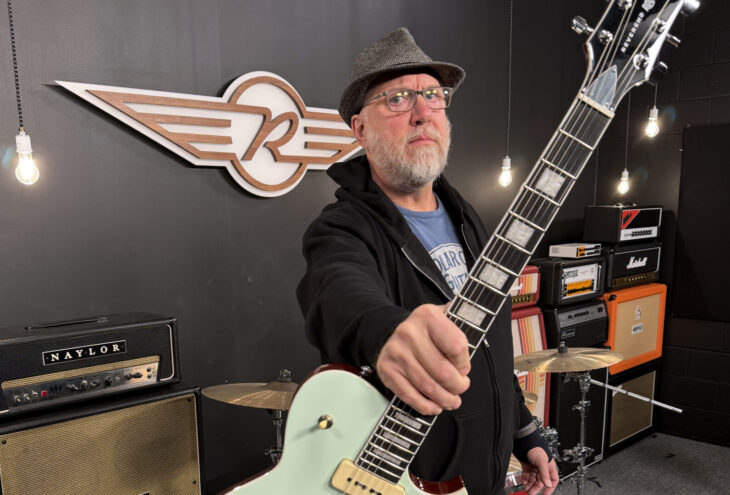
Built right, guitars are like extensions of a musician’s soul. The performer and instrument become one, both working in synchronicity to express an artistic vision. Few understand this better than Joe Naylor. His fiercely independent company, Reverend Guitars, remains humble, yet its origins are even humbler. A graduate of the Roberto-Venn School of Luthiery, he built his first guitars inside a garage behind a bicycle shop in East Detroit. He also fixed amps in those days, but it was his eye-catching, retro axe designs that began stirring notice.
One early endorser was Ken Haas. “His product was unlike anything I’d played to that point,” praises the former punk rocker. He was such a fan that he started hanging out with the rising craftsman. One day in the summer of ‘99, Naylor asked whether Haas would come with him to NAMM. “I didn’t even know what that was,” Haas confesses regarding the annual trade association for merchants of all things music. But he said yes. Being there was like being struck by lightning; Haas suddenly realized he’d been pursuing the wrong career. This was where he wanted to be.
As chance would have it, Haas struck up a conversation with Will Ray of The Hellecasters. His enthusiasm for Reverends resulted in selling multiple guitars to Ray. Impressed, Naylor began taking Haas with him to events to assist with moving product. Wife Penny came along too, so she could help in an unofficial capacity.
Naylor eventually hired Haas as sales director. By 2009, Reverend Guitars had grown to the point that the founder was spending all his time in the office dealing with the minutiae of running a startup, which made him increasingly unhappy. Haas saw an opportunity. He offered to buy the company from Naylor and immediately hire him back. That way, the designer could focus fulltime on what he does best—making guitars (and basses, too). Haas became Reverend’s CEO and Penny the COO.
As design director, Naylor continues to create elegant instruments that blend a throwback aesthetic with forward-thinking ingenuity. A number of factors set Reverend guitars apart. One is the Bass Contour Control knob featured on every instrument. Twisting it alters the tone with extra precision. Another differentiator is that, while most guitars today are constructed with maple, spruce, alder, rosewood, or mahogany, Reverend Guitars uses korina, a West African hardwood. “It’s lightweight, but also resonant with a strong midrange,” explains Haas. “It’s a very renewable resource that, because of its association with 1950s guitars, a lot of manufacturers demand a premium for.”
Reverend guitars have wormed their way into the hearts of many, from legacy musicians such as Fleetwood Mac’s Rick Vito and Ron Asheton of The Stooges to greener players like Frank Blation of indie trio Leisure Hour. “Reverend seems to be hitting something with Gen Z at the moment,” attests Haas. “You can’t buy that. We’re lucky to have cultivated this younger crowd.” Other notable aficionados include Living Colour’s Vernon Reid, The Cure’s Reeves Gabrels, and Robin Finck of Nine Inch Nails. Arguably most famous is Billy Corgan, front man for The Smashing Pumpkins.
Reverend partners with many of their most recognizable customers to craft signature instruments. On some occasions, Reverend simply accommodates a few simple requests and then makes the exact same item available to the public. Other times, musicians have extensive conversations with Naylor to determine what they want. “Billy [Corgan] used a lot of references to other guitar players and things he liked about their tones,” recalls Haas. “[Joe Naylor] was able to listen to Billy describe this midrange presence he was looking for and design a set of pickups that worked.” The signature models are identical to the ones the artists themselves play. Nothing gets downgraded for the sake of saving a buck. The fact that anyone can pick up the same instrument as one made for a major star at a reasonable price reflects Reverend’s DIY history and punk rock attitude.
Haas recommends the Charger 290 or the Charger H90 for novices, suggesting someone starting out might not want to mess around with a floating tremolo. “But maybe they do,” he counters, rethinking his position. “I did, when I was beginning.”
Coming soon is a model built in conjunction with Machine Gun Kelly’s touring guitarist, Justin Lyons. “He has a really cool idea for a guitar, so we’re putting that together,” says the CEO. Recent changes include adding the names of their guitars onto headstocks, as well as taking a cue from the car industry and offering a rainbow’s worth of shiny colors. Anyone desiring a Reverend guitar should consult the dealer list on their website or be prepared to buy online.
Despite thriving, Reverend Guitars remains relatively unknown. Haas points out how frustrating it can be when someone at an expo has no idea who they are. “And then the other part of me is—kickass! We’re nowhere near the saturation point. If people are asking that question, that means we still have work to do, and we’re making a difference.”
Visit reverendguitars.com