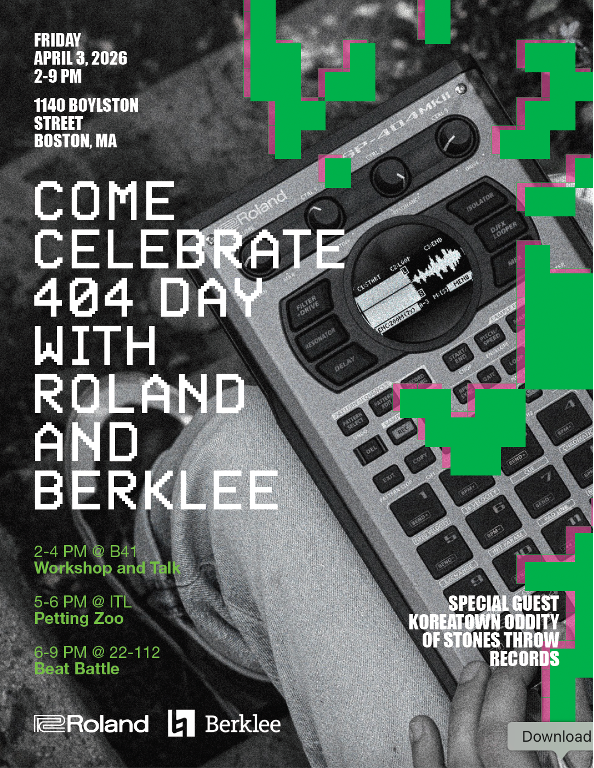
On April 3, 2026, Roland Corporation and Berklee College of Music joined forces for a 404 Day activation. Centered around the cult-favorite SP-404 sampler, the collaboration puts hardware-based beat production front and center—right where many argue it belongs.
At the core of the partnership is Berklee’s SP-404 Lab, a course that quietly launched in spring 2025 and quickly turned into one of the school’s most in-demand electives. The appeal isn’t hard to understand. In an era dominated by DAWs and plugins, the tactile immediacy of hardware offers something different—something arguably closer to the roots of beat culture.
As Roland’s Director of Education Jared Selter put it, “The SP-404 is an instrument of music production; it contains sampling, beat making, and remixing, but it's playable like a guitar or piano.” That framing—treating a sampler as a true instrument rather than just a tool—seems to be resonating with students in a big way.
The 404 Day event itself brings that philosophy to life. Workshops, artist talks, and a student beat battle transform Berklee’s campus into a hub where underground production techniques meet institutional rigor. Headlining the day is Koreatown Oddity, whose sample-heavy, deeply personal style embodies the creative freedom the SP-404 has long represented.
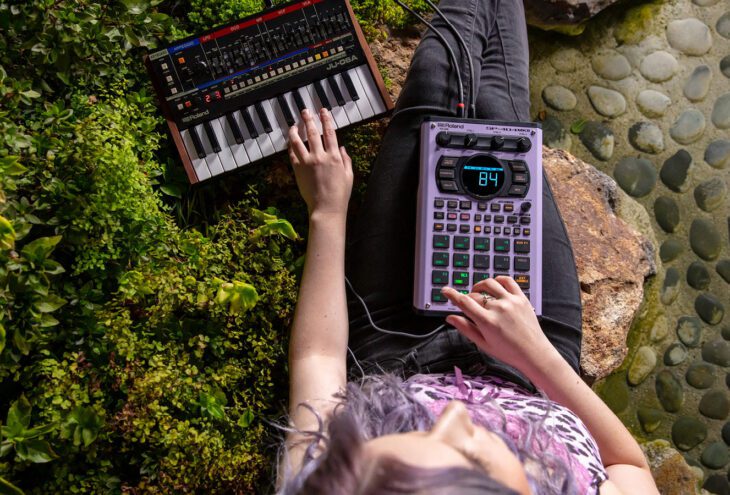
For Koreatown Oddity, the appeal of the device is refreshingly practical. “What I love about the 404 is the convenience it gives me in being creative,” he said. “Its portability frees me up to continue or start ideas wherever I go… I can go to one of my favorite gardens and work on music outside under some trees in the sun.”
That immediacy extends to the workflow itself. “Once I record any sample into a pad, it saves immediately to the 404… I can just get straight to work,” he added—an ethos that likely explains why the device continues to thrive in both underground circles and now, increasingly, academic ones.
Educators at Berklee see this shift as long overdue. Michele Darling noted that the institution is actively “embracing the electronic musician, the DJ, and the producer,” carving out meaningful space for them within a traditionally performance-focused environment. Meanwhile, instructor David Bellow (who performs as Lightfoot) highlighted how the machine unlocks new dimensions of creativity in students, describing it as both “specific and adaptable” in how it meets individual workflows.
Roland, for its part, isn’t treating this as a one-off activation. The company’s broader educational push reflects a belief that innovation doesn’t just happen in R&D labs—it happens in classrooms, studios, and scenes where culture is actively being shaped. That philosophy is echoed in a second statement from Selter: “I’m excited and encouraged to see that students and educators have a passion for hands-on learning and performance on modern instruments like the SP-404MKII. It speaks to Berklee’s foresight in its understanding of student needs, and to Roland’s ability to hold a conversation with music culture through its products and their development. The great results of this partnership come from its organic origins. Both sides are driven by creatives who see a bright new future for young musicians who want to get their hands dirty on some amazing machines.”
If there’s a bigger takeaway from 404 Day, it’s this: beat culture is no longer operating on the fringes of music education. It’s becoming foundational. And as institutions like Berklee continue to formalize what underground producers have known for decades, the line between classroom and culture is getting thinner—in the best possible way.
For more information on 404 Day celebrations globally, visit roland.com/us/promos/roland_sp-404.