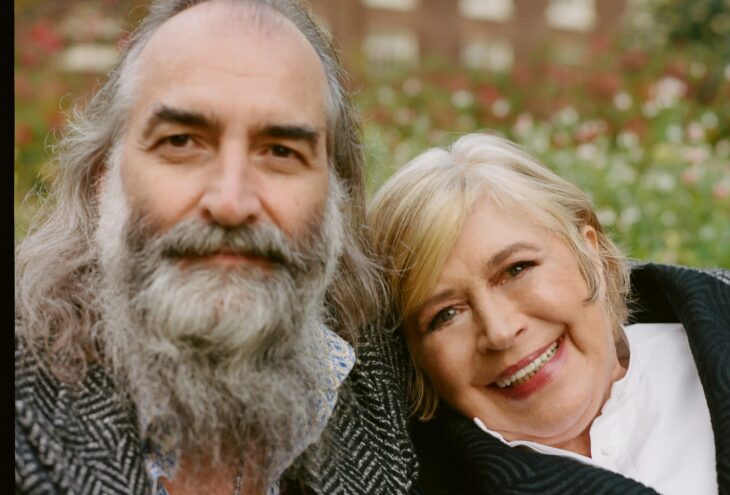
Broken English is a 2025 British hybrid documentary film that explores the life and career of singer/songwriter/author/performer Marianne Faithfull that features Tilda Swinton and George MacKay as fictional characters.
Interview subjects include Edith Bowman, John Dunbar, Sophie Fiennes and Barry Reynolds. The film incorporates Faithfull's last ever singing performance with Nick Cave and Warren Ellis. Marianne’s six-decade journey through her music, fame, disruption, narcotics and reinvention unfolds in this revealing documentary, blending reality and imagination as she makes her final artistic statement.
It’s written and directed by Iain Forsyth and Jane Pollard. The film premiered at the 82nd Venice International Film Festival, the BFI London Film Festival and Sundance in North America.
On March 20th 2026 the Broken English documentary will be released in Ireland and in the United Kingdom by Vue Lumiere, the film distribution division of Vue, Europe’s leading cinema operator.
In the March 2nd Telegraph newspaper, Mick Brown headlined his review of Broken English with “The unrepentantly wild and passionate life of Marianne Faithfull.” He also wrote, “Forever trying to defy perceptions, the late star was more complex than realized, as an inventive new documentary about her proves.”
During 2008, a decade and a half after Little, Brown and Company’s publication of 1994’s Faithfull: An Autobiography with author and collaborator David Dalton, one of the most acclaimed rock autobiographies of all time, Marianne in a second volume via Harper Perennial published Memories, Dreams and Reflections.
She muses nostalgically about her parents Eva and Glynn, languishing with Mick Jagger on Moroccan cushions at the George and Pattie Harrison pad while smoking fat joints listening to the Beatles’ Revolver, the outlandish antics of her Beat friends Allen Ginsberg and William Burroughs; Bob Dylan, Juliette Greco, concerns about her image in the press, chaos in Singapore while looking for an opium den, and collaborating with the likes of Blur and Jarvis Cocker.
This is a revealing and self-penned portrait of Marianne done with David Dalton. We witness her meditation on sex and drugs, sobriety, survival, and her own mortality in her battle with Covid and breast cancer.
Before her passing on January 30 2025, Marianne completed work on two projects that were to commemorate her 60th anniversary in music; the first was her final EP Burning Moonlight, a collection of four songs inspired by her Decca recordings, the second was her contribution to this series of reissues where she talked in-depth about her Decca recording career for the first time.
All four of Marianne’s original Decca albums Marianne Faithfull, Come My Way, North Country Maid and Loveinamist have been reissued on vinyl alongside Cast Your Fate To The Wind: a new double LP of the collected singles, B-sides and rarities. Simultaneously a 6 CD boxset will be released called Cast Your Fate To The Wind: The Complete UK Decca Recordings,which features all the albums reproduced on miniature facsimile LPs, a new double album of the singles, B-sides and rarities, five art cards and a 76-page book featuring many rare and unpublished photographs.
“As Tears Go By” is a song penned by Mick Jagger, Keith Richards and Andrew Loog Oldham. It reached top ten position in the UK singles chart. The Stones then recorded their own version, included on the American pressing of December’s Children (And Everybody’s) in 1965. Their American record label London issued “As Tears Go By” as a single that landed in the number six spot on the Billboard Hot 100 singles chart. The band subsequently performed the tune on an episode of The Ed Sullivan Show.
In 2000 I discussed Faithfull with her first producer Andrew Loog Oldham, the 1963-1967 record producer and manager of the Rolling Stones, for Discoveries magazine. I touted several of her discs and Andrew politely reminded me there might be a big division between her original fans and record buying public and current century consumers interested in her retail products and well-documented mythology.
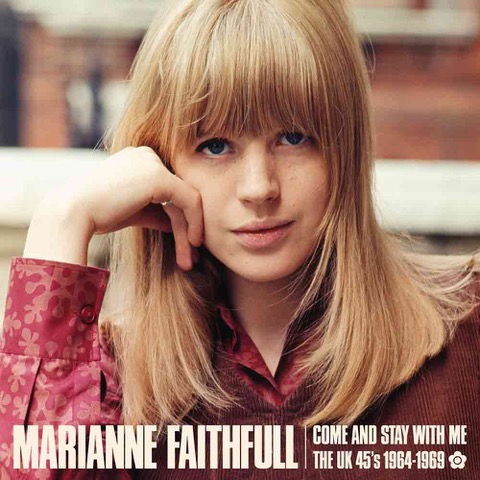
“It's the same with Marianne Faithfull if you are the left side of fifty. Her life gets concertinaed into heroin overdoses in a poor choice of location; an affinity for Mars bars and throw rugs as opposed to Sunday tea, and a dramatic relationship as cultural au pair to the young man Joan Rivers so aptly described as ‘child bearing lips.’ The fact is forgotten that Marianne had, between August of ‘64 and the summer of ‘65 four Top Ten hits in the U.K. ‘As Tears Go By’ and ‘Come and Stay with Me’ held up.”
Andrew also provided the backdrop of 1963-1964 music, radio and television gatekeepers.
“For one it was obvious that ‘this thing of ours’ was not going to disappear. We had come in following the Twist, Davy Crockett, Skiffle, and Trad Jazz. Skiffle and Trad Jazz had been very important; they had been the BBC and the Establishments last chance to control the key to what music we got to hear.
“There were villains, there was mayhem, action and if we had not had Pirate radio, I might not have had a hit with Marianne Faithfull's ‘As Tears Go By.’ The BBC would not touch it, they said Marianne could not sing. Mind you, that's what they'd said about Mick Jagger a year earlier when the Rolling Stones failed their BBC live audition. They said ‘The singer cannot sing.’ The BBC was the enemy, a limp wristed arm of the government trying to keep kids on a rationed musical diet of trad jazz and skiffle.”
On the day Marianne Evelyn Gabriel Faithfull left the physical world on January 30, 2025, novelist and writer Daniel Weizmann sent me a Facebook post from music journalist Bill Holdship, that best captures my special friendship with Marianne.
“The first week of March 2005, in the lobby of Hollywood's Pantages Theater, immediately following a great Bob Dylan show with the equally-great-that-night Merle Haggard opening, I was with my friend Harvey Kubernik, who has known her and Andrew Loog Oldham a long time. Harvey suddenly stopped in his tracks and exclaimed: ‘Marianne!’ She was purchasing a Bob Dylan poster at the time, which was kind of endearing in and of itself.
Hello, Harvey!’ she warmly said. She recognized him immediately, giving him a hug and a kiss. ‘Wasn't that just a fantastic show?’ Harvey introduced me to her as ‘my friend Bill.’ She was incredibly nice. And absolutely lovely and charming. When we were leaving following a brief conversation during which she told us what she'd been up to recently, she made a point of making eye contact with me, smiling, and saying: ‘Very nice to meet you, Bill!’
“It was short but so sweet and enjoyable and unexpected that it has stuck with me as a cherished memory all these years. I was rarely starstruck after all those years in Los Angeles and what I did for a living. But I'm grateful that my memory of Marianne Faithfull will always be a good and pleasant one.”
In my encounters with Marianne over the decades, walking on Hollywood Blvd. and interviewing her at the Chateau Marmont on Sunset Blvd., her confidence and self-determination were always evident along with school-girl charm.
In 1995 I knocked on the door to Marianne’s hotel room at the Chateau Marmont, ironically, right next to the suite where I once interviewed and had lunch with Leonard Cohen.
Marianne answered my knuckles, “Welcome to the poet’s corner,” she beamed.
I looked at her for about 30 seconds. She has big green eyes. The still alluring Marianne Faithfull turned out to be a fascinating interview subject. A real yenta, very funny, never avoiding a question during our time together.
Marianne has a dancer’s body. In fact, twice during the two-hour chat, she leaped off the couch onto the rug and sort of did a move, an interpretation of “the sideways pony” dance that Tina Turner once taught her paramour Mick Jagger in the hall way in front of her in 1965 at Colston Hall in Bristol, England. She explained that her mother Eva taught her to dance as a child.
I then mentioned that I briefly danced on American Bandstand as a teenager. She was rather impressed.
“Whew…Remind me to give you a kiss and a hug when you leave today and don’t worry if my boobs get in the way,” she warned. “No problem,” I assured her.
Room service delivered Marlboro Lights. Marianne also ordered a vodka martini for our smoky conversation. I had a mineral water. The record label paid.
Q: Can we talk about your mother, Eva?
A: She was the great love of my life.
Q: Eva seemed like a very generous woman. She saw it all.
A: She certainly did. I adored her. My mother died as I was performing Kurt Weill and Bertholt Brecht. I was performing The Seven Deadly Sins. And during the performance she died in England. I was in Australia. On the flight back from Brisbane, Australia, I had a copy of The White Goddess. John Dunbar had called me when I got back from my concert in Australia. Of course it was John, there’s no one else who could call me to tell me Eva was dead. I was at my hotel, sitting about, having a cup of tea and John called and said, ‘Your mother died.’ And so, I got on the plane to go back to England for the funeral and started to read The White Goddess. It’s a 24 hour trip. There were two people who understood immediately what ‘Broken English’ was and one was Chris Blackwell and the other was Eva. Immediately. And lots of people did not understand. I would play ‘Broken English’ for people. My mother got it and Blackwell got it. The movies she would see with her father were Tom Mix movies. She was born in 1911.
Q. Who is 93year old Glynn Faithfull?
A. My dad. He’s also a Pisces. My father is a scholar of Dante. My father has always known I would do it. And my mother, too. I grew up with total confidence from both of them. They’ve never wavered. My father not for a second. He’s had complete faith in me all of my life.
Q: The music of the Motown and Stax record labels really knocked you out in the mid-sixties.
A: I can tell you that while Andrew Loog Oldham turned me on to Phil Spector and Jack Nitzsche, Bob Crewe and the Four Seasons, the Mamas and the Papas, and a lot of things, the person who really educated me on the Motown level was Mick. I would have never gone that deeply into Motown without Mick. We just played the songs at home constantly. It must have been great fun for him...
“There I am at age nineteen and I've never listened to the Miracles before. 'The Tracks of My Tears...' Mick would run down the bass lines, song constructions on the label, and actually act out the songs in front of me! [Chuckles]. It was really an amazing education. And, of course, when I wanted another type of thing, I'd go and see Keith and then it was all blues. It all kind of fitted in somehow," she marveled.
“Mick and I wore out the grooves on the records so much we'd have to buy them again. For a long time, it was Vivaldi and Marvin Gaye in the morning. That's how we lived. Which is so wonderful. And I had Mick telling me everything. He knew everything. He knew the names of the session musicians at a snap. So did Jack Nitzsche. Brilliant man. We never could quite get it together to do an album, but at least we have “Sister Morphine.”
Q: I recently conducted a series of interviews with the Funk Brothers, the surviving Motown session men who are spotlighted in the documentary film, Standing in the Shadows of Motown.
A:Oh God...I'm dying to see that movie. Oh man...Oh man… Nice to see the players get some attention. I like the idea that Berry Gordy still cares that much. He cares about the Motown legacy and we're not just talking about money. There's something he did there that he cares very much about. It's incredible. Obviously, he knows what he did, but for me, it changed my life. I found the Stax records myself. I was lucky.
“Mick knew the Motown records already, but they knocked me for a six. That's why I know about the Four Tops doing 'Walk Away Renee.' I spent years listening to Motown. Smokey Robinson...His voice. ‘The Love I Saw in You Was Just a Mirage.' [Sings the first two lines]. The most beautiful stuff I've ever heard...And to this day I'm sure Motown and Stax songs are in the Stones' live repertoire.
Q: How did Faithfull: An Autobiography come together? I know you’ve been approached over the years and obviously film adaptations are being offered on this book and your life.
A: It took a long time. I have great recall.
Q: Why did you do the book?
A: I did it for you. (laughs). My dear little Piscean. I felt there was something in the story that was very common to everybody. I do believe that the details and the individuals are different, but the emotions and the sort of core thing is very, very connected to all human experience. Therefore, I felt it was a valid story to tell. And then again, I felt I was very close to some of the greatest people of my time. And I had a lot of help.
“David Dalton came to Ireland for two weeks. He’s a very shy person. He selected me. Such a strange story. Tony Secunda, who recently died, I dedicated my paperback English edition to him, he had become a literary agent, and he was working with Dalton and he came to Ireland. I didn’t want to do this book, really. Much as I care for humanity…Tony suggested David, who I’ve ended up very close friends with.
Q: He picked David Dalton who was a Rolling Stones fan.
A: That was peculiar for me. And my great tease. I would tell David at first, that what I saw in him as a writer was that he was basically a necrophiliac. ‘You have only written books about dead people. (James Dean, Janis Joplin, Jim Morrison). How are you going to cope with someone who is not dead and not likely to be dead?’
Q: But I’m sure you also gave a view and observations of your life and art process that were different than the myth and history events captured so far in printed and celluloid documentation of the Rolling Stones.
A: It took him a long time to believe me. I have to stand up for David because it wasn’t as simple as that. Yes, he was a Rolling Stones fan, but that in itself shouldn’t be a problem. The interviews went on for hours. It was so dreadful. Those first two weeks we would start in the morning. David would sit there and ask me. He’s kind of conservative but a loon. He didn’t know me at all. He came up with all the preconceptions that everybody else does. It was Ellen Smith, my press agent, who said to me, ‘Think of him as everyman. He’s just coming to you with everybody’s pre-conceptions. Think of him as everyman.’
Q: Was it hard during the interviews with David Dalton to tell your point of view? I would imagine you had to at times be combative.
A: Yes. I thought it was really good for me and about fuckin’ time I learned to do that. I didn’t want to. I resisted it but I had to. I had to. David is married to a very intelligent woman Coco and she really worked very closely with him and I think it had some impact. It was much harder work than David had ever done before. A living person.
Q: And for once, you had narrative opportunity and forum to tell your side of the story. The truth you saw and experienced. You were in control.
A: Well, I didn’t realize that, ya know. That’s what made it so hard for Dalton. He kept saying to me, ‘This is your book! This is your thing! I will only do what you want.’ But I didn’t believe him. What he did suggest…The first two weeks were a nightmare. He would sit there and say ‘Marianne, what exactly happened and what were you doing on March 10, 1965?’ Didn’t work at all. Then he got into despair. After two weeks I remember the taxi came to take him away and I said goodbye to him and it was so typical of the way I am, and Allen (Ginsberg) knows this backwards, as Dalton was leaving my house, after we toured the castles of Ireland and he met my friends, his mind had been completely blown.
“I had been very funny and told lots of stories. But at the very end, just sorta in my way, ‘Well David, you do know these are just my ‘party pieces.’ And on that, poor bastard, he went back to the states. So, he was in despair. So, his next thing was that I would take ‘truth serum.’ Sodium Pentothal. (laughs). He had some serious preconceptions. And he thought I was lying. (laughs). So, for three years, two years in, suddenly it all fell into place.
“Like I would tell him a story like ‘Dylan Redux,’ and he did not believe it. And then Demelza came up from Cornwald, I hadn’t seen her in 15 years. She walked in to my brother’s house. She sat down and told him without even consulting me exactly the same story. So, then Dalton began to realize I was telling the truth.
Q: The Dylan chapter is so detail oriented about environment. Obviously, you were doing a memoir. I noticed you were in one of the hotel room scenes in the D.A. Pennebaker-directed Dont Look Back Bob Dylan documentary chronicling his 1965 British tour. In your book you provide a glimpse of Dylan in action in the mid-sixties and then years later. I thought it was one of the vivid sections where you and David Dalton worked really hard in bringing the moment to the reader.
A: I think that was the bit that David did best. I didn’t work the hardest on that, David did. But it was wonderful. I wish he’d written the whole book like that. And all the Bobby Newirth stuff was so beautiful.
Q: Had you never seen a person like Bob Dylan or an American like him in 1965?
A: Never. Never seen. Never in my wildest dreams could have imagined anyone like Bob in 1965. His brain, but I was frightened. I didn’t know they were probably more scared of me. I don’t know. They were all on methedrine. He played me the album Bringing It All Back Home himself on his own. It was just amazing. And I worshipped him anyway. That was where I got very close to Allen (Ginsberg) ‘cause Allen was the only sort of person I could recognize as being somewhat like me.
Q: I really enjoyed the passage in your book when Allen came to London with the Italian poet Giuseppe Ungaretti. They read at Queen Elizabeth Hall. You had spent some time with Ginsberg during Dylan’s ‘Dont Look Back’ tour and I laughed out loud as you described inviting Allen to the house you shared with Mick Jagger. Great image, and a very fortunate position for you as Ginsberg sat on your bed with you and Mick naked under a fur cover. As you put it, “Allen, as usual, was on a mission. Allen was trying to get Mick to put William Blake’s The Grey Monk to music.” Again, until this book, I never knew you had such a beat generation poetry jones.
A: (Smiles). I find them very sexy all those guys. Wonderful. I teased Allen in my book. I adore him. The first time I went to Naropa, Allen was literally by my side like he is. There was a lot of criticism and ‘Who is the woman?’ ‘Why do you (Allen) think she can do this?’ And he didn’t say anything. ‘I just do.’ And then I came back again. We are very good friends. He also represents a lot of things for me that aren’t part of our friendship or our relationship. He is the greatest living American poet. I hooked Allen up with Hal Willner.
Q: So, Professor Faithfull. Tell me about your work and teaching functions at The Naropa Institute?
A: I was teaching lyric writing and Allen Ginsberg eventually showed me a book of one of his great treasures of Japanese haiku. He explained all that to me and said ‘Don’t you understand this is the same thing.’ I was a teacher dealing with process and content. And my other thing, was that I took to meditation like a duck to water that I was always somebody so when students said, ‘We find meditation very boring and very hard,’ Allen could depend on me to say, ‘Well, you’re all wrong.’ ‘Meditation is a very good thing and if you really want to write something interesting, I suggest you go off and meditate.’ So that’s another thing. Allen knew that base was covered. Not that I’m a Buddhist exactly, and I’m not joining. I’m part of Naropa but not as close as Allen is. I don’t have a guru. Allen is my guru. (grins).
Q: How has meditation impacted your life and work?
A: Philip Whalen taught me to meditate. That was a great help. It cleans. It is sort of brain washing I suppose. (laughs). Not a real brain washing. When I’m home, I meditate twice a day. Shell Cottage is…The whole point of it is one great long meditation and the long walks. On my third trip to Naropa, I also learned how to do a walking meditation.
Q: Did photos trigger recall of events?
A: No. I’ve been carrying this around for a long time. And I had remembered the things that were important to me which were always the same. It was always very, very clear that what I was really interested in and always had been interested in was motive and psychic position. And why. There were a million things I could not remember, which are not interesting to me.
“Like most of the time I don’t remember what people were wearing. I remember what Allen was wearing, because often, Allen would take his clothes off. So, I would know that and understand that. I would see Allen clothed and unclothed. And that’s a very simple situation. And I remember one thing, I think is the White Ball and the black dress. So, it’s only on very clear demarcations like clothed, unclothed, black, white that I really know exactly.
“Now Anita (Pallenberg) actually remembers things only through what we were wearing. ‘Cause that’s what she’s interested in. I don’t mean that as a put down. But that’s how she remembers things. When I say, “Do you remember such and such a day…” The way back for Anita is ‘Oh yeah... You were wearing a red velvet …and I was wearing…” You’d dig her, man.
Q: The Stones’ recording of “Sympathy for the Devil” happened because you gave Mick Jagger the novel The Master and Margarita. In Faithfull: An Autobiography, you wrote that some of the Rolling Stones characters in their songs came to audio life partially owing to acid.
A: Of course they did. I don’t think acid is relative or relevant anymore. I wouldn’t do it again. But I think that it was important then, and I think it taught us a lot.
“They were all very much in love with me at that time. Not only me, but I was one of the many women they were in love with. Keith and I are still very close. I’m under his wing and I know I will always be under his wing.
“Well Brian [Jones] was a genius but he was a very irritating person. Brian wasn’t as bad as everybody thinks. Keith really loved Brian. I use Brian. I have a whole lot of friends on the other side that I call up when I need them. I use Brian, Janis and now I’ve got Tony Secunda and Denny Cordell.
“I mean, I pushed them away so much. It’s my fault. The door is open completely. I had to push them away I suppose to find my own spot. Much too much. Mick, too. ‘Cause I couldn’t stay in that position.
Q: I still dig the band, and always go to see them play, but…
A: Don’t be too harsh on Mick. (Smiles). You’d really like him and he’d support you. He’s a good guy.
Q: What was it like seeing the galleys? The first typeset edition?
A: That was heavy. (sighs). That was when I also saw the pictures. My editor came over with the pictures. That was one of the harder bits.
Q: Did you take things out then?
A: Yes. It wasn’t legalities. There were some mistakes and I could not have them. I cut out some things about Brian Jones. He went on and on and made him much more of a worse person than he was. He could only do that really because he was dead. He couldn’t go on and on about Keith [Richards] and Anita or even me because I did the classic Buddhist thing: I just did a drive all blames into one. I made that decision. That is something I learned from Allen. I’ve had good Naropa training. The galleys were hard to read.
Q: What is it like now reading the book?
A: I’ve read it and re-read it and it’s still hard…It’s hard to believe I’ve done it and that it’s really me and a part of me now. David did a good job, man. I have to say this.
Q: Your book is a reality.
A: I’m terribly pleased with it and proud of it. It’s like a child of mine that has gone out and done well. It’s a good read.
(Harvey Kubernik is the author of 20 books, including 2009’s Canyon Of Dreams: The Magic And The Music Of Laurel Canyon, 2014’s Turn Up The Radio! Rock, Pop and Roll In Los Angeles 1956-1972, 2015's Every Body Knows: Leonard Cohen, 2016's Heart of Gold Neil Young and 2017's 1967: A Complete Rock Music History of the Summer of Love.
Sterling/Barnes and Noble in 2018 published Harvey and Kenneth Kubernik’s The Story Of The Band: From Big Pink To The Last Waltz. In 2021 they wrote Jimi Hendrix: Voodoo Child for Sterling/Barnes and Noble.
Otherworld Cottage Industries in 2020 published Harvey’s Docs That Rock, Music That Matters. His Screen Gems: (Pop Music Documentaries and Rock ‘n’ Roll TV Scenes) was published on February 6, 2026 by BearManor Media.
Harvey spoke at the special hearings in 2006 initiated by the Library of Congress held in Hollywood, California, discussing archiving practices and audiotape preservation.
In 2017, he appeared at the Rock & Roll Hall of Fame in Cleveland, Ohio, in its Distinguished Speakers Series and as a panelist discussing the forty-fifth anniversary of The Last Waltz at the Grammy Museum in Los Angeles in 2023.
During 2025, Kubernik was interviewed in the Siobhan Logue-written and -directed documentary The Sound of Protest,airing on the Apple TVOD TV broadcasting service. The film also features Smokey Robinson, Hozier, Skin (Skunk Anansie), Two-Tone's Jerry Dammers, Angélique Kidjo, Holly Johnson, David McAlmont, Rhiannon Giddens, and more. Harvey was an interview subject along with Iggy Pop, the Beach Boys’ Bruce Johnston, Love’s Johnny Echols, the Bangles' Susanna Hoffs, Victoria and Debbi Peterson, and the founding members of the Seeds for director/producer Neil Norman’s documentary The Seeds: Pushin' Too Hard. In summer 2026, GNP Crescendo will release the film on DVD/Blu-ray). Author Miss Pamela Des Barres narrates).
Top photo of Marianne Faithfull and Warren Ellis by Rosie Matheson