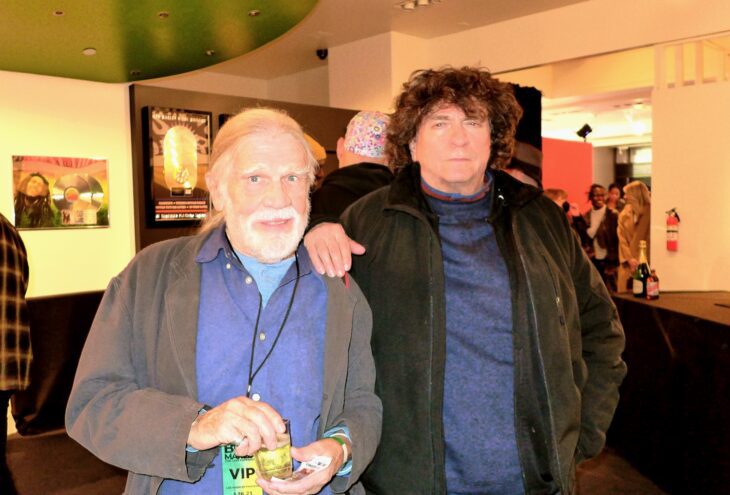
Pictured above: Henry Diltz, left, with Harvey Kubernik. Photo by Heather Harris.
Henry Diltz, the legendary photographer who has shot over 250 album covers and was the official photographer at the 1969 Woodstock festival, has announced a 2026 edition of his Behind the Lens tour.
He’ll present his slide show and storytelling experience “of the photographs that made music history” for a series of dates along the U.S. east coast in March. Tickets available at his website
Henry Diltz Behind the Lens 2026 Tour
Mar 04 – Portsmouth, NH – Jimmy’s Jazz Club
Mar 05 – Fall River, MA – Narrows Center for the Arts
Mar 06 – Fairfield, CT – Sacred Heart University
Mar 07 – Old Saybrook, CT – The Kate
Mar 08 – New York, NY – The Roxy Theatre
Mar 11 – Washington, DC – Miracle Theater
Mar 13-20 – Cayamo Cruise
Mar 21 – Stuart, FL – The Lyric
Mar 24 – Clearwater, FL – The Murray Theatre
Whether working in conventional film or digital images, photographer/musician Henry Diltz finds the perfect balance of illumination, color and reportage. Henry and his images are embedded fixtures in rock culture.
Henry Stanford Diltz, born September 6, 1938 in Kansas City, Missouri, has taken photos gracing 300 album covers. Henry’s work secured him cover shots in Rolling Stone, LIFE, Cash Box, MOJO, UNCUT, Guitar World and Acoustic Rock magazines. His photographic endeavors have been published in The Guardian, SPIN, High Times, The New York Times, The Los Angeles Times, Newsweek, People, Billboard, Ugly Things, Record Collector News magazine, Shindig! and on the websites www.bestclassicbands.com and www.rocksbackpages.com.
Diltz is very active touring globally and on US college campuses, presenting slide shows of his catalog, touting books and limited edition signed prints. He’s always armed with his faithful Nikon camera. “Usually two Nikons, one for color and one for black and white,” he volunteers.
During 2007, Genesis Publications published a signed limited edition and prized collection of Diltz’s photography, California Dreaming.” (Memories & Visions of LA: 1966-75). The volume incorporates 500 photographs and a 96,000-word text. Contributors include Graham Nash, John Sebastian, Ray Manzarek, Micky Dolenz, Gerry Beckley, Robby Krieger, David Crosby, Stephen Stills, Joni Mitchell and the Kingston Trio.
In 2009, the book Who Shot Rock & Roll, edited by Gail Buckland, and published by Alfred A. Knopf features a Diltz cover shot of Tina Turner.
Taking Aim, by Graham Nash and Jasen Emmons was published in 2010 by Chronicle Books, implementing a plethora of Diltz’s images on the pages.
In 2026 numerous photos from his library grace the cover and displayed in my just published book Screen Gems: Pop Music Documentaries & Rock and Roll TV Scenes published by BearManor Media.
Henry was the official photographer for the landmark Monterey International Pop Festival, and the official photographer of the Miami Pop and all three Woodstock Music Festivals.
In February 2023, Henry was honored with a Recording Academy Trustees Award as part of the Academy’s annual Grammy Week festivities. The National Academy of Recording Arts & Sciences (NARAS) presents this Special Merit Award to people who have made significant contributions to the music industry during their careers. Previous honorees include the Beatles, Dick Clark, Walt Disney, and Duke Ellington.
I first met Henry Diltz in 1967 on the set of The Monkees television series. Henry, along with his trusted archivist/librarian Gary Strobl, have been very generous providing photos to books and published articles I’ve written this century.
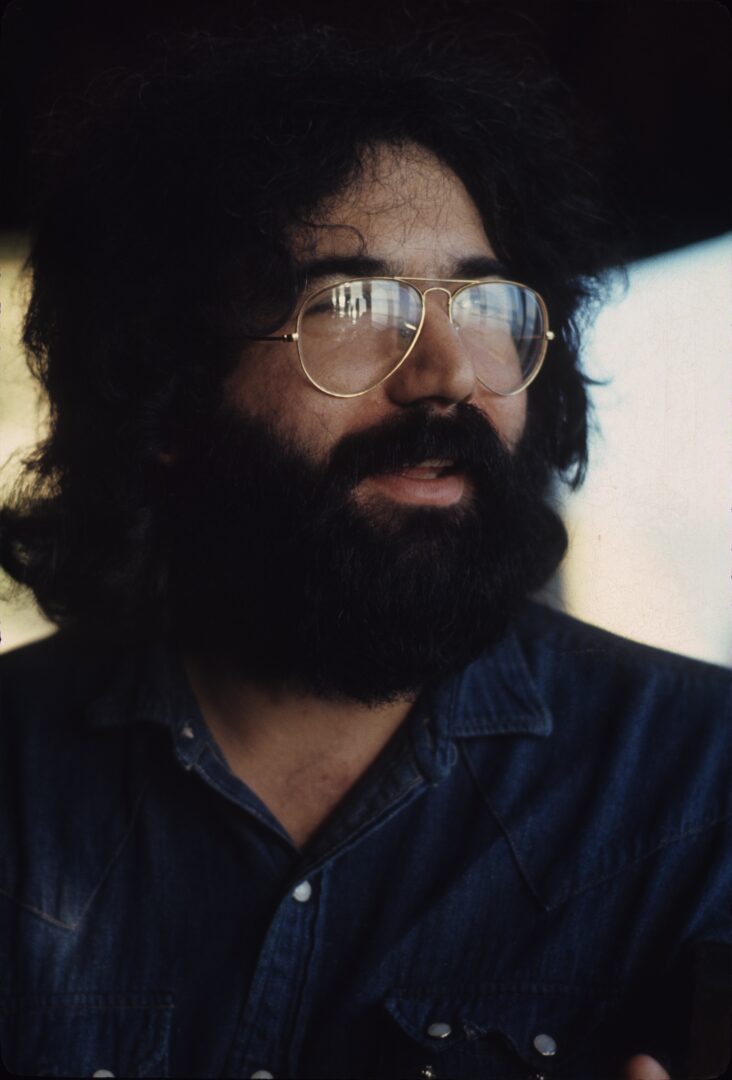
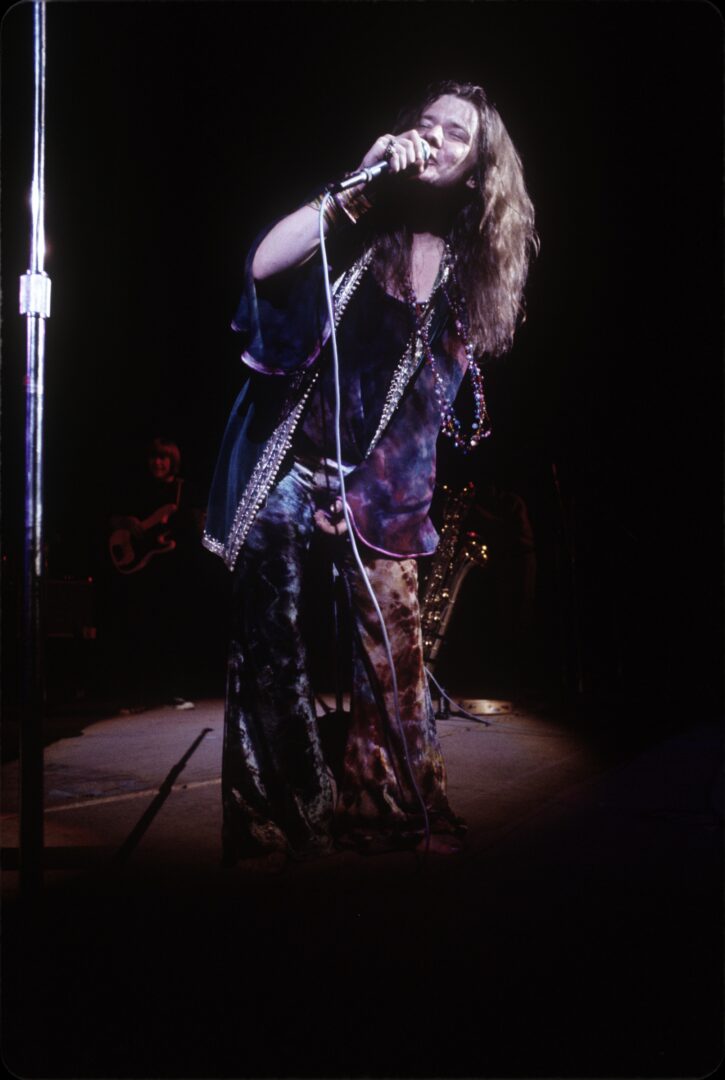
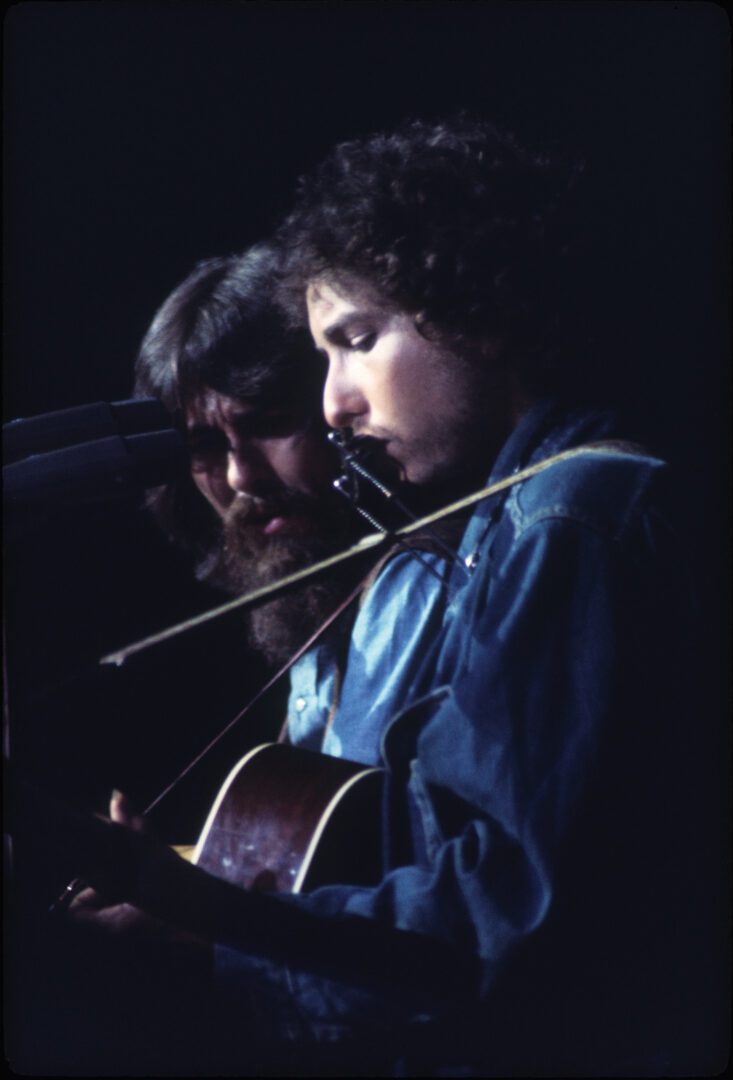
I interviewed Henry during 2008, 2010 and 2024 at his photography studio office in Studio City, California.
Q: In the mid-sixties you were the MFQ. [Modern Folk Quintet] who cut “This Could Be The Night,” a Jack Nitzsche-arranged/Phil Spector production. You also played banjo on Spector- produced recording sessions at Gold Star studios in Hollywood: “Paradise” by the Ronettes, and the Righteous Brothers’ “Ebb Tide.”
A: The MFQ was involved with Phil Spector and his Big T.N.T. Show in 1965 in Hollywood, filmed at the Moulin Rouge, which became The Hullabaloo Club and the Kaleidoscope. We played music between the acts booked and recorded the theme song. In 1966 I remember Phil jamming with us at The Trip nightclub.
Q: In 1965 you purchased a camera. Initially, you just took photos of friends, and then showed slides of pictures on a wall at parties.
A: After the first slide show I said to myself, ‘I have got to take more pictures this week.’ So next weekend we can have another slide show.’ And that was the only goal I had in mind. Try to make them interesting with nice colors and angles. Get some moments. Take pictures of my friends. So that when we get together for the slide show, ‘Oh wow! That’s me. I didn’t even know you took that picture.’
After a short period of taking slides of my friends they began to be used. A Buffalo Springfield shot that I took just for myself got used in a magazine by accident. And they paid me 100 bucks. Wow! That was an epiphany right there. First was seeing the slide on the wall and then getting 100 bucks from someone. I was just photographing my friends and they got used. At some point, some people asked for a black and white head shot. OK. Around 1966 my old friend, Erik Jacobsen, a fellow folk musician, we were on the road together and he became a producer.
We actually shared an apartment in New York City and he worked with The Lovin’ Spoonful. He got them together and called me in California and said, ‘Henry, I know you are trying to become a photographer and the guys need a lot of photos. Spend the summer and go on tour with them. And we need photos for everything.’ So, it was like an apprentice thing and they paid for film and processing and if we use it, we’ll pay you for it.’ It was great. I loved their music. Magic in the blend.
Cass Elliot introduced me to Graham Nash of the Hollies in 1966 in New York and I did some photos and one ended up as a cover of an LP. That lead to the album cover of the first Crosby, Stills and Nash album.
Q: Do you have any philosophy or methods in taking photos?
A: I think the technical part is simple. The rest of it is framing. And you want to frame it exactly to the way you want to see it. For me, initially, it was slides, transparencies that I would project on the wall. I could not believe I could re-live these great moments that we had huge on the wall for all our friends to see. Lights shining through the plastic on the wall and its glowing.
As far as shooting musicians live, I prefer being to one side of the stage so the microphone is not in front of the person on stage. And you pick one side or another depending on which way the guitar looks the best. And you sort of get a side front ¾ view from either way. I like to have a nice telephoto lens so I can get them waist up. Guitar up. And that fills the frame generally in a vertical way.
Q: You were at the June 1967 Monterey International Pop Festival.
A: Jefferson Airplane was great. Psychedelic folk music. Grace Slick was beautiful. Most all of these groups we had heard on the radio, but to see them actually playing music, that was more than familiar, you could hum along, all that stuff. The thrill was ‘They they actually are.’ The actual sound that we all know so well. That was very pleasing to see that, one song after another.
Being a rock photographer, you get the best seat because you are in front of the front row. I remember nothing was between me and Otis. The warmest most wonderful music and so different than the rest. A different flavour of music. It came from a whole other place, not these things, bands who emerged out of folk music. I just basked in this amazing sound. Warm and tender delicious tension. The feel of his voice. The edge of it.
Q: You told me you loved Simon & Garfunkel’s appearance.
A: We knew every note of every song. To see their two heads, right next to each other in the middle, at the microphone, right after seeing groups and bands. Just the two of them. A hush fell over the whole crowd. Paul Simon orchestrated the songs. So simple but so full. And so perfect, with the blending of the voices. Garfunkel’s voice. It was the interplay of the harmonies that made it so beautiful. Garfunkel was more the voice, and Simon would do the harmony part below it in some cases. I always think of him as kinda putting the cement in there, but Garfunkel was really the voice.
Ravi Shankar was our hero. All you ever heard in Laurel Canyon before the festival in the afternoon was his music and incense burning. It was just the soundtrack to our lives. To really see him was great. that was very special. At Monterey everyone was in a trance. Not just the audience, but the others artists, in the crowd, like Michael Bloomfield and Hendrix, were really getting into it, too.
At Monterey, people were smoking pot there. During January of 1967 in San Francisco, they had the Be-In. And, this was the era of peace and love. I just remember being in warm crowds of fellow musicians, not a lot of record company people or promo men, I think they were all huddled together themselves over on the side somewhere. At Monterey some of the big boys introduced cocaine, and that was too bad. Because that was part of the downfall of that whole wonderful scene.
The dressing rooms were underneath the stage on dirt floors. Like a basement. The Mamas & Papas were backstage grabbing their tongues and doing various vocal exercises like holding the tip of your tongue with your two fingers and sort of chanting sounds and making all these scales. OOO-AAAH. So, the group is backstage, all holding their tongues, preparing to perform, and Jimi Hendrix, who had just finished playing was on the other side of the room, sitting in a chair, eating a piece of friend chicken, people all around him, and checking out these ‘other’ hippies, the Mamas & Papas doing their ‘unique’ chant harmony, and Jimi was chewing on this chicken breast.
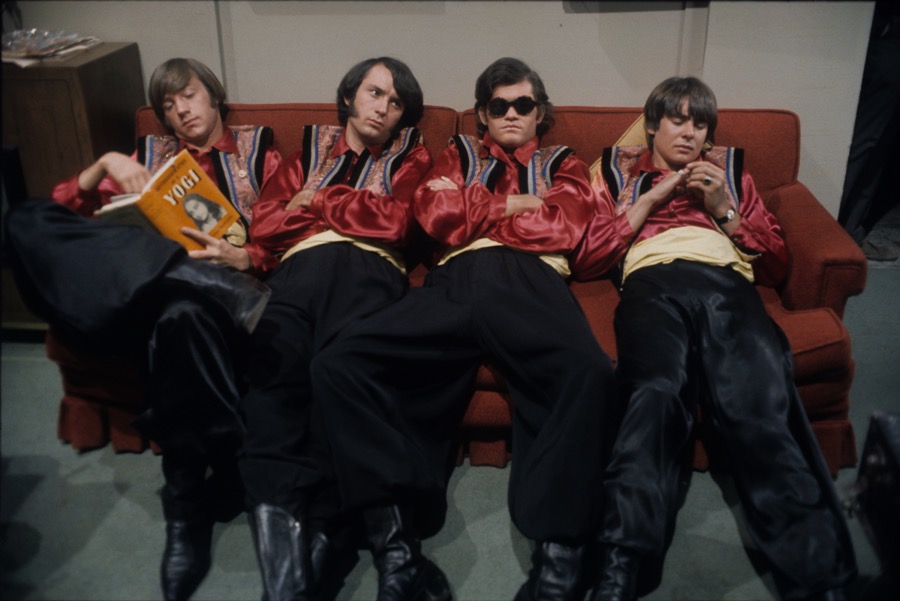
Q: I first saw you in 1967 in Hollywood at Columbia Studios inside Gower Gulch when you were the second season set photographer on The Monkees television series. My mother Hilda worked for Raybert Productions in Gower Gulch who produced the TV show.
A: I worked on The Monkees’ television series and did a lot of work for Tiger Beat. They were great visual subjects. I would sit there with a telephoto lens and focus on one of those Monkees until he turned around, smiled, winked or made some kind of a joke. Then I would click and grab it. So, you would get those great looking headshots they would use. I got a day rate of $300.00. My job was to hang out with these guys who were very good friends of mine. They were totally comfortable around me.
Q: Who have been some of the most telegenic people you have caught on film?
A: Donny Osmond and David Cassidy. They lent themselves to good portraits. There was a huge need for many pictures of them, not only for magazine covers but full page inside color spreads and posters. Stuff like that when I worked for teenybopper magazines. They wanted tons of headshots.
I was the first guy who was a musician in the Modern Folk Quintet, and photographer. So, when I got there, I was a kindred spirit. I had long hair and smoked grass. Eventually I had love beads.
The producers made a “smoking facility” called Frodo’s Room. Micky named it Frodo’s. No one knew what it meant. It was from Tolkien. So, the big room had carpets and cushions, and a red light would go on when they wanted them on the set. ‘The young thespians are wanted on the set!’ And I would go directly to the set and there was a lot of wild energy. It was zany. Friends of mine were on a fantastic TV show, and the music they made was terrific.
The songwriting team of Tommy Boyce and Bobby Hart lived in Laurel Canyon who wrote a lot of songs for the Monkees, as did Gerry Goffin and Carole King, and John Stewart. The Monkees exposed a lot of people to cool songwriters. And you would hear all these great songs on the radio. It was a nice turn-on.
I was closest to Micky. He’s a very centered person. Not a guy where it went to his head and changed him into something else. Micky is a true artist. He put his attention into things. People thought the Monkees weren’t a real band, but they proved them wrong. In 1967 I went on a summer tour with the Monkees. Micky was my neighbor in Laurel Canyon and always championed Ravi Shankar.
And then we were reading Autobiography of a Yogi. And, so we were all things, India. A place that was looming, a very deep and interesting and informative world. In there he talked about what was really going on in life. Life is a pea soup of swirling electrons is what his guru told him. That’s what everything is at different speeds, you know. When you break it down. The mind is a sending and receiving set. You can actually send a thought to somebody. Those kinds of things. And when you sort of clear your mind of all the daily bull shit that is going on, and you get to some of those deeper feelings, when I would smoke a little marijuana, and read that book. ‘I see this. I know this.’
In 1967 I was invited to attend the Ravi Shankar press conference at the Kinnara School of Music in L.A. George [Harrison]was there. I took photos. Ravi at the time was the soundtrack of Laurel Canyon. There is a relationship between the banjo and the sitar. They have drone strings. Like a bagpipe. There is one note that plays over and over again which is banjo. It’s the fifth string. It was in mountain modal music. And it was kind of head trippy, you know.
Q: In the summer of 1969, you got a phone call from the promoter Michael Lang, offering $500 bucks and jumped on an airplane, and went to the Woodstock Arts & Music Festival.
A: I got there two weeks before the festival. When I got there, they were just starting to put the lumber on the stage. It was like being in an idyllic summer camp in upstate New York. Blues skies, green trees and meadows. And, in the middle of this huge alfalfa field and green grass was this huge wooden aircraft carrier. A flat deck, and there are all these hippie guys with their shirts off with hammers and saws.
I know the producers of Woodstock had seen the Monterey Pop movie. Maybe I’m a creature of the moment but I got very hung up in the beauty of just being out in the sunshine in these green areas with these rolling hills around, and then the Hog Farm arrived, and they would get in the bus and drive down to this nearby lake, all take their clothes off and go swimming in the lake. And, I did two, and I had my super 8 movie camera, and I filmed a bit of that. So, you’d walk into a lovely forest, and there was the Hog Farm with their teepees and tents, and all these great people of the earth. Hippies on acid, smoking pot, and they built a geodesic dome out of clear plastic and wood, and the girls would be making salads to feed the workers.
Before the Woodstock festival started. My time was divided between photographing carpenters and then the hippie girls would come in the afternoon with sandwiches and drinks for all the guys. There was one trailer, a desk, and couple of chairs, with the blueprints laid out. I did see the impact of Monterey. But at Monterey there was a lot of hanging out and people and the artists being together.
At Woodstock the groups flew in on helicopters, and didn’t stay and hangout. An L.A. group Sweetwater did the sound check for Woodstock. And, the groups like Canned Heart, Jefferson Airplane, Janis Joplin, Jimi Hendrix were younger and kinda fresher at Monterey. There was a lot of love at Monterey, and people performing for their peers. Some of the vibe of the Renaissance Fair of the San Fernando Valley and Agora area, carried into Monterey. The Renaissance Fair was Shakespeare mixed with the L.A. hippie scene. All these booths and lots of foods to eat and wares to buy. They had that at Monterey as well. At Monterey it was a closed venue, a contained little group in an outdoor festival, with bleachers on the side. At Woodstock the massive sea of faces went on forever. It was a huge hoard of people for all the eye to see.
Janis Joplin… I knew about her but had never seen her. Another force of nature in the middle of the stage. The incredible energy and outpouring of emotion into the microphone, I mean, this crying, shouting, screaming and singing, you know. So much force and feeling behind it.
Q: You took the album cover of the Doors’ Morrison Hotel in downtown Los Angeles at The Morrison Hotel located on 1246 South Hope Street and back picture at 300 E. Fifth Street in the area.
A: The Doors were interesting and weren’t a guitar band.
They came from a different place. It was that keyboard thing. They didn’t have a bass. Ray Manzarek played bass on a keyboard with his left hand. It was a little more classical and jazz-oriented. And then you had Jim Morrison singing those words with that baritone voice. It was poetic and more like a beatnik thing. It was different. And Jim wrote all those deep lyrics. I took concert photos of them at the Hollywood Bowl in 1968.
Jim had lived in Laurel Canyon. So did Robby Krieger and John Densmore. We were all friends in the area. I knew him as a musician just as I was first really taking photos.
I was with the Doors in downtown L.A. for Morrison Hotel and got that cover LP picture. Then two days later they needed some black and white publicity pictures and we walked around the beach in Venice.
Before I shot the cover of Morrison Hotel, we had a meeting at the Doors’ office on Santa Monica Blvd and La Cienega.
They had an office in a little funky building and various ideas were discussed and no one really had any. And then Ray Manzarek just said, ‘My wife Dorothy and I were driving through downtown L.A. the other day as we do and we saw this funky hotel.’
And my partner Gary Burden, he was a graphics artist, and I thought, ‘Fuck! Morrison Hotel. That’s great. Let’s go down and look at it.’ We all piled into a Volkswagen van and drove down that afternoon and saw it in all its glory. That front window! And we took some shots. And a week later we came back with the band. The Doors were always very cooperative photo subjects.
I used a Nikon camera and a 35 or 85 lens. Gary Burdon usually said ‘Back up.’ In this case he instructed, ‘Get the whole window.’ I went across the street and even shot with a mild telephoto. And, it was slide film. [Kodak Ecktachrome ASA]. We got back the transparencies back from the lab.
Gary then looked at them first, lays it out on a slide board at night, reviews them and makes choices. And then he picks the one. He had unerring taste for picking ‘the one’ that really said it. And I totally trusted him to do it. He was very good.
He always had exquisite taste. Gary would set up kind of a situation for me to photograph the whole thing, ‘film is the cheapest part,’ he would always say. He would review them all and tell the record company after we’d show the group first. ‘Yea! Fantastic man. ‘Here’s the cover.’
Q: Tell me about the Concert for Bangladesh that George Harrison and Ravi Shankar initiated. You were at the two August 1971 charity shows held at Madison Square Garden in New York and around pre-production.
A: I was there and at the soundcheck, I did not leave the perch but walked around with a crew pass so I was golden. I could not have a camera in my hand. I noticed Allen Klein sitting in the audience just up the side in the bleachers with couple of chauffer goon type guys. He had a cane and I saw him point his cane to someone on the floor. ‘Who is that guy? Get him out!’ And these goons went down and escorted whoever that was out. Someone with a camera. Very tight security. I could not get kicked out. I watched the rehearsal. Phil Spector was around and at the soundboard producing live sound and working closely with George.
I already had been at Woodstock, let alone Monterey, I got the sense something monumental was bring brewed up by important people in the music industry. Not the people I was hanging out with. I was there and watching. Sound check was kind of boring.
The show was amazing. Not lost with me was George Harrison introducing Ravi Shankar. I saw Ravi at Monterey, and he later played Woodstock. I was very familiar with him and his music and loved it. Ben Shapiro was the MFQ’s agent and was Ravi’s agent. I was tremendously moved by his mood. This was an inside facility and I had always seen him outside in venues. I loved the sound of the sitar and the hypnotic rhythm of it. There was the wonderful sound we all loved. I’m a banjo player and there was a relationship to the sarod.
Q: You never planned for picture sales or a photography career.
A: I never thought one day I’ll have an archive of history. I think it’s great people can see and purchase and own signed limited editions of musicians. Portrait and concert shots. Wonderful days of peace, love and brotherhood. I’m glad I have this body of work that reflects those things. The fun of framing something up and pushing the button and capturing things that were lovely moments to me.
Initially it was a fun hobby that made me appreciate the moment. I knew the music of Jimi Hendrix, the Rolling Stones, the Monkees, the Beatles, Neil Young, Joni Mitchell, and the Doors would last. I was a huge fan and musician. I never thought taking a photo in 1967 of the Whisky A Go Go marquee with Love and Mongo Santamaria on it would be published. Or shooting Donovan, the Mamas and Papas and Sonny & Cher at a Hollywood Bowl soundcheck for radio station KHJ 1966 charity concert would subsequently be in books and exhibits.
The 12-inch album cover was a real form. It was the perfect size to hold in your hand while you heard the record and stared at it, read the back and look at the pictures. Now, it’s really too small to do that. So, nobody sits there and stares at the CD cover.
(Harvey Kubernik is the author of 20 books, including 2009’s Canyon Of Dreams: The Magic And The Music Of Laurel Canyon, 2014’s Turn Up The Radio! Rock, Pop and Roll In Los Angeles 1956-1972, 2015's Every Body Knows: Leonard Cohen, 2016's Heart of Gold Neil Young and 2017's 1967: A Complete Rock Music History of the Summer of Love.
Sterling/Barnes and Noble in 2018 published Harvey and Kenneth Kubernik’s The Story Of The Band: From Big Pink To The Last Waltz. In 2021 they wrote Jimi Hendrix: Voodoo Child for Sterling/Barnes and Noble.
Otherworld Cottage Industries in 2020 published Harvey’s Docs That Rock, Music That Matters. His Screen Gems: (Pop Music Documentaries and Rock ‘n’ Roll TV Scenes) was published in February 2026 by BearManor Media.
Harvey spoke at the special hearings in 2006 initiated by the Library of Congress held in Hollywood, California, discussing archiving practices and audiotape preservation.
In 2017, he appeared at the Rock & Roll Hall of Fame in Cleveland, Ohio, in its Distinguished Speakers Series, and as a panelist where he discussed the forty-fifth anniversary of The Last Waltz at the Grammy Museum in Los Angeles in 2023.
During 2025, Kubernik was interviewed in the Siobhan Logue-written and -directed documentary The Sound of Protest,airing on the Apple TVOD TV broadcasting service. The film also features Smokey Robinson, Hozier, Skin (Skunk Anansie), Two-Tone's Jerry Dammers, Angélique Kidjo, Holly Johnson, David McAlmont, Rhiannon Giddens, and more.
Harvey was an interview subject along with Iggy Pop, the Beach Boys’ Bruce Johnston, Love’s Johnny Echols, the Bangles' Susanna Hoffs, Victoria and Debbi Peterson, and the founding members of the Seeds for director/producer Neil Norman’s documentary The Seeds: Pushin' Too Hard. In summer 2026, GNP Crescendo will release the film on DVD/Blu-ray). Author Miss Pamela Des Barres narrates.
Kubernik is a featured interview in the Alex Rotaru directed documentary Elvis, Rocky and Me: The Carol Connors Story that premiered in January 2026 at the 37th Palm Springs International Film Festival. She was Elvis Presley’s lover, and Rocky Balboa’s lyricist. The twice Academy Award nominated songwriter’s career is captured in interviews with her friends Dionne Warwick, Dianne Warren, Bill Conti, Talia Shire, David Shire, Barbi Benton, Mike Tyson and Irwin Winkler. Her numerous songwriting credits include the Rip Chords 1964 hit “Hey Little Cobra,” and 1980’s Billy Preston & Syreeta Wright duet “With You I’m Born Again.” During 1977, Carol Connors co-wrote the anthemic “Gonna Fly Now (Theme from Rocky).”