
Let’s be frank here—just about everyone is terrified of A.I. Within the arts, be it music, writing, filmmaking, or anything else, a lot of that fear stems from two things: being replaced, and having your work stolen and incorporated into the A.I. “hive” of data. And to be fair, much of that fear is valid. There are bad people out there, soulless creatures who put the bottom line over artistic endeavor. Tamber isn’t that.
In May, Tamber launched its “sonic intelligence-powered creative suite, introducing a new category of music technology designed to work alongside artists as they create,” according to a company statement. “Built to bridge the gap between instinct and execution, Tamber helps musicians translate abstract ideas—from language, emotion, color, texture, taste, gesture, and place—into sound in real time.”
For the non-techy folks out there, what does this mean? Tamber doesn’t do anything generative, which is key. It doesn’t “generate” the music for you at all, using other people’s work without their knowledge or consent. Rather, the tool is purely assistive.
“I think the term ‘artificial intelligence’ has become incredibly synonymous with something that it not necessarily is, because of the Suno’s and the Udio’s of the world,” says founder and creator Zoe Wrenn. “I think a lot of people have assumed A.I. is consistently generative A.I., which is just not the case. So, we don’t really like to be associated with that kind of terminology.”
Rather, Wrenn refers to Tamber as “Sonic Intelligence.”
“Tamber has been created to be like the Adobe Creative Suite of music creation and discovery tools,” she says. “The whole goal is to create a suite of tools that basically function like a bionic arm for musicians to move faster, expand their capabilities, etc. And I’ve created it with a lot of different musicians. All of our back end, our models, have been trained on the back end with artists that have synesthesia [defined on Wiki as a ‘perceptual phenomenon where the stimulation of one sensory or cognitive pathway automatically and involuntarily triggers experiences in another’]. So, it understands what a note sounds like, but what does it taste like? What color is it? It learns to be a pretty flexible, fluid system.”
Wrenn was perfectly placed to create a tool like Tamber. A musician in her own right, Wrenn has also been coding since she was 13. Tamber combines her two loves. The fact that Wrenn has the heart of a musician means that, rest assured her intentions are good. Nobody is getting burned.
“For college, she attended the Clive Davis Institute of Recorded Music at NYC Tisch, leaving after a year to tour behind her own music,” reads Wrenn’s bio. “She used a beta version of Tamber to create her 2020 breakout single ‘Hailey,’ which reached No. 2 on the Billboard Digital Song Sales chart, generated more than 350 million TikTok impressions, and surpassed 30 million streams.”
MC showed up at Tamber HQ for a presentation of just what the tool is capable of. It quickly became apparent that Tamber is a tool that will aid musicians, not replace them.
“Tamber points toward a future where technology amplifies creative instinct rather than replacing it,” reads a statement. “By pairing advanced sonic intelligence with human-centered design, the platform opens new pathways for expression—empowering artists to create in ways that are more intuitive, immersive, and distinctly their own.”
We watched as Wrenn asked Tamber to elongate guitar parts and then used her hands, in thin air, to manipulate the sounds. It was incredibly impressive, and absolutely intuitive. One must wonder how the sound library was gathered though.
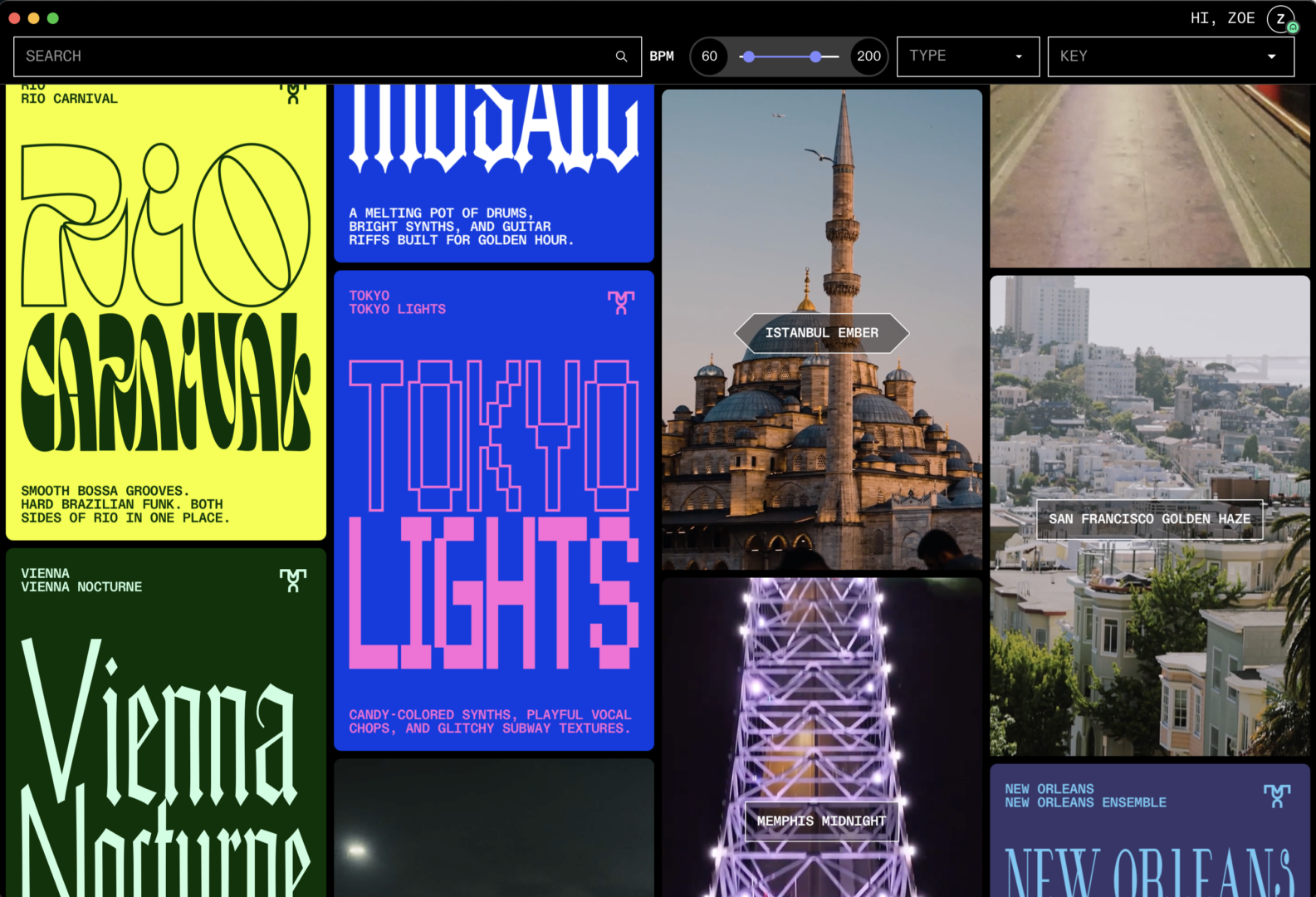
“We hired a whole bunch of musicians and filmmakers from all over the world and had them go out with handheld microphones and capture the ambient sounds of the streets, and then we remixed them into usable samples,” Wrenn says. “So, there’s a lot of really interesting stuff from singing in Istanbul to toys in the alleyway. We hired musicians, like actually on the streets, to play things that turn into a lot of these song starters. It’s really cool.”
That’s important. The musicians in the library were hired, while ambient sounds were remixed. The sound library was ethically curated. And the proof is in the pudding. As previously mentioned, Wrenn used an early version of Tamber to create her own song “Hailey.”
“I like to say it’s something that helps you cut through the noise,” she says. “I think right now we’ve got very much a tragedy of choice. There’s just a lot of things all the time, and I think that can become very difficult for a user to create something that’s very pointed. I do archery as well, and so I like to say, you can shoot and fire things, but if you have a bullseye, you’re much more likely to hit an actual target, like hit a bullseye. So, I think this just like it cuts out the noise. You’re able to focus a lot more.”
All of that said, anything A.I. is still going to raise eyebrows in certain corners of the music industry. That might not ever change. But Wrenn is doing all she can to involve everyone.
“There’s a feature I’m working on currently where you can plug in any piece of analog gear and speak to it,” she says. “You can change your parameters in real time. Do I ever know this will be part of this? I don’t know. I’ve gone into quite a few big analog studios, and they’ve been very interested in what this can do. Tamby (Tamber’s “in-session co-producer, allowing users to control Ableton Live using spoken or written language”) has been an exciting one because she is very adaptable to people’s workflows. My father is a very intense analog musician and tells me what he likes and what he doesn’t like, and I think Tamby’s been an interesting thing even to him.”
Find out more at tamber.music