Web: sixftblonde.com
Contact: mfisher@vectormgmt.com
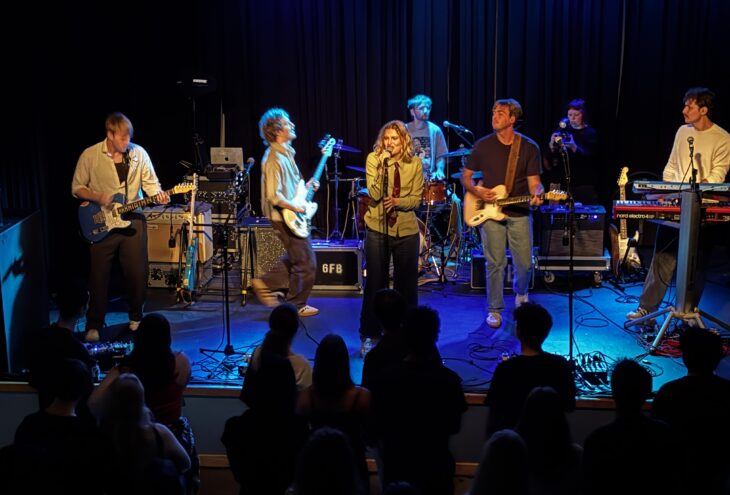
Players: Julia Rusyniak, vocals; John Alex Rusyniak, keyboards, synthesizers, saxophone; Zach Patrick, guitar, backing vocals; Elliott Obermaier, guitar; Dom Heyob, bass guitar, backing vocals; Brian Healey, drums
When six musicians walk onstage and unleash a guitar lick blistering enough to peel the paint off a few Chevy Impalas in the parking lot, it’s a sign to strap in and hold on.
That was how Six Foot Blonde opened its set at the Cat’s Cradle Back Room. The appropriately-titled “Drinkers” led into “Land Girl” and “Carmilla,” a trio of Phil Spector–inspired walls of sound and splashy grooves. The band looked fresh from its last semester at IU, as though the musicians had rolled east from Bloomington, Indiana, and landed onstage ready to let loose.
The sound suggested early Chicago crossed with Tower of Power: lush arrangements with guitars and keyboards supplying the punch usually assigned to horns. Add the Dave Clark Five’s exuberance and a dash of Byrds-ian jingle-jangle, and you had a potent retro rocket with hooks to spare.
As “Perch,” “Notch,” and “Nora” followed, frontwoman Julia Rusyniak sang with purpose, sending sparks around the room like a rock welder. The stage stayed in motion around her. Guitars swung, the bass darted through the arrangements, and the keyboard player channeled Rick Wakeman without the cape, directing traffic from behind a double rack.
Nearly everyone seemed to sing, and the stacked harmonies gave the ensemble passages muscle and lift. When those voices locked together, they filled every corner of the room.
That abundance also exposed the set’s chief limitation: there wasn’t always enough room for dynamics. A wall of sound makes a thrilling entrance, but sustaining that excitement requires knowing when to pull back. A quieter phrase or a sudden shift in intensity could have turned the room on a dime. Rusyniak had those openings, and a few slipped past.
Still, she steered these Hoosiers confidently through the set, pulling the pieces together whenever the music threatened to head off the rails. “Hybrid” and “Karma” kept the momentum rolling, with guitars, bass, and keys racing down the electron highway and giving the percussion plenty to chase.
Then came the exquisite “Honey” and a stellar “Crazy Eyes,” bringing Rusyniak’s vocal range into sharp focus. At full throttle, she recalled Shania Twain’s big pipes; in smokier passages, Etta James came through. Elsewhere, she landed between Reba McEntire and Bonnie Raitt, moving easily among country, blues, and soul. Hints of Stevie Wonder surfaced in a few choruses, and even Mott the Hoople raised its head, nodding as it shook off the dust.
Those echoes gave the music familiar footholds without overwhelming the band’s personality. With only 12 notes to work with and more music arriving daily, finding a distinctive groove takes imagination—and the discipline to let a good idea breathe. At their best, Six Foot Blonde had both.