
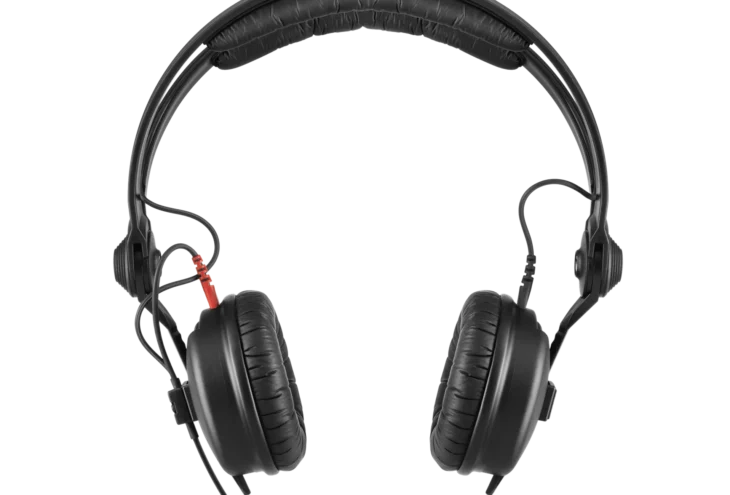
Sennheiser has been making high quality headphones since 1968. Originally designed in 1988 for film and TV broadcast, ENG (electronic news gathering), and live sound monitoring, the Sennheiser HD 25 Headphones became a tried-and-true industry standard for club DJ’s in the 1990’s. Still a favorite in the DJ scene, the HD 25 have a variety of unique features that make them great for many applications.
The HD 25 feature extremely durable construction, low weight, the ability to wear one ear off (a staple feature for DJ’s), and extremely high acoustic isolation from external sounds. The HD 25 also have a sonic curve that is particularly advantageous for DJ work. The HD 25 has what is called a “smile” curve frequency response, with accentuated bottom and highs, and an non-accentuated midrange. DJs have found the subdued midrange to be non-fatiguing for long nights at the club, while the accentuated high frequencies are helpful for cueing tracks in a noisy environment. The accentuated bass helps to provide a pumped up feeling that coincides with the big bass often found in clubs.
The HD 25 are engineered to produce immense volume without distorting, even on low powered amps and mixers, and are rated to a level of 120 dB SPL. THD, total harmonic distortion, is rated at < 0.3% @ 1 kHz. The HD 25 require very little power to drive efficiently, meaning they can get incredibly loud even when plugged into basic controllers or high-output club mixers.
Ear cups are Supra-aural, which means that the headphone ear cushions rest directly on top of the outer ear rather than surrounding it. They are commonly referred to as on-ear headphones. They are much smaller, highly portable, and rely on the physical clamping force of the headband to compress the ear and block out sound. Most studio headphones are circumaural (over-ear), where the pads are larger and feature a cavity that completely encloses the entire ear.
While not musical in nature, it’s worth mentioning the historic uses of the HD 25. The HD 25’s are very popular for broadcast & live TV, with camera operators, sports commentators, and sound engineers on set because of their high noise isolation and rugged build. For field recording and journalistic reporting, they are favored by reporters and audio recordists needing a lightweight, reliable way to monitor clean audio in loud or outdoor environments. For commercial aviation, the HD 25 were historically used in specialized environments including the Concorde due to their tight fit and ambient noise attenuation. And for audio testing & general monitoring, the HD 25 are often used by technicians testing audio gear.
While most of the headphones that we cover in MC are recommendedfor all studio functions, the HD 25 are not ideal for critical studio mixing & mastering. Sound engineers generally advise against using them for final mixdowns because their frequency response is not flat and features a punchy U-shaped signature with a low-end bass boost and a high-frequency peak, which can translate unevenly across other speakers.
Unlike studio headphones which are engineered for a flat, uncolored, and completely accurate sound, DJ headphones feature a highly specialized sonic profile. The HD 25 are a time-tested favorite in the field used by DJ’s and clubs, with other industrial uses that attest to their durability and functionality. $149.95