Freddie Mercury and Harvey Kubernik 1975 Interview
Over half a century after it set them on the path to superstardom, Queen’s regal second album, Queen II, has been remixed, remastered and expanded for a lavish new box set.
Arguably the heaviest Queen album, Queen II was originally released in 1974 and widely heralded as their first true masterpiece. With Brian May and Roger Taylor as executive producers, the album has been stunningly mixed by the team of Justin Shirley-Smith, Joshua J Macrae and Kris Fredriksson.
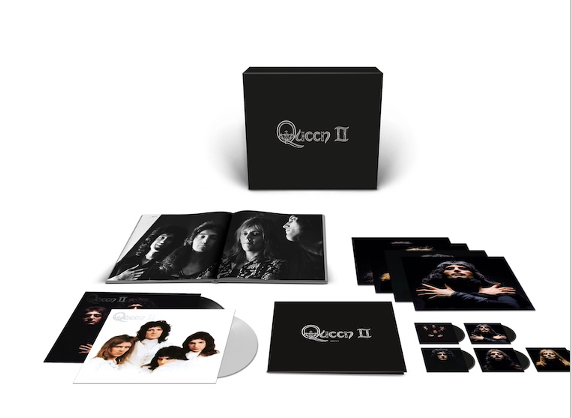
The 5CD+2LP Queen II Collector’s Edition box set features the 2026 mix of the album, plus intimate fly-on-the-wall audio of Queen in the recording studio, previously unheard outtakes and demos, live tracks and radio sessions.
It’s also released as 2xCD Deluxe Edition, Vinyl LP, Vinyl Picture Disc LP, 1xCD and cassette formats, all featuring a brand new 2026 mix.
The Queen II Collector’s Edition box set also comes with a 112-page book featuring previously unseen photographs, handwritten lyrics, diary entries, and special memorabilia, as well as memories of writing and recording the album from the band members.
A press release on the official Queen website details this 2026 reissue.
“My God, we were such impatient boys” – Freddie Mercury
"Queen II was a vital step in the long journey to the explosion of marvellousness we eventually became” – Roger Taylor
“We had the desire to create something extraordinary. And we did.” – Brian May
“Queen II was the single biggest leap we ever made,” says Brian May. “That’s when we really started making music the way we wanted to, rather than the way we were being pushed into recording it.”
“With Queen II, I couldn’t believe how much work we put into it,” adds Roger Taylor. “I think we felt we were evolving our own sound. We were pioneering this sort of multitracking thing. It gave you a tremendous pallet, massive choral effects with just three of us singing.”
The task of remixing Queen II for this new edition was in the hands of the trusted team of Justin Shirley-Smith, Joshua J Macrae and Kris Fredriksson, who worked on the Queen I reissue as well as several other past releases from the band, with Brian May and Roger Taylor acting as executive producers.
“The idea was to reveal more of the clarity of the songs,” says Justin Shirley-Smith of their approach. “Rather than add anything, we wanted to reveal more of what was there and get that desired sound.”
“The lengths the band went to achieve what they achieved with the technology they had at the time was incredible,” says Joshua J Macrae. “Some of it is so ahead of its time. Working on this was like entering a room of fabulousness.”
Queen’s self-titled 1973 debut album had established the band as one of the boldest and most unique new voices in music. Even a troubled recording process, which resulted in a sound the band were unhappy with (subsequently rectified on the 2024 reissue), couldn’t mask the brilliance of the songs, nor the ambition of the band behind them.
For the follow-up, recorded once again at Soho’s Trident Studios with Queen I co-producer Roy Thomas Baker, Queen seized control of their own destiny. They were already incredibly well-drilled before they began, with “Father To Son” and “Ogre Battle” having featured in the live shows as far back as September 1973. The result was an album that didn’t so much tear up the blueprint as redraw it on a grand scale.
“I wanted to give it everything – to be self-indulgent,” said Freddie Mercury at the time. “But the whole band in particular, we don't go in for half-measures and I'm pretty hard with myself. There are no compromises.”
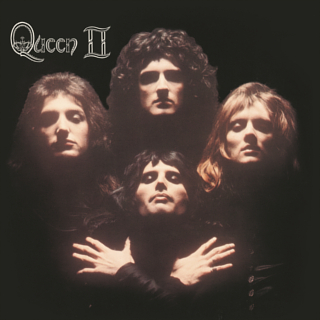
Originally released in the UK on March 8, 1974, Queen II still sounds extraordinary today. Bold, brave and madly ambitious, it’s the work of a band whose self-belief, vision and ability were unmatched. Its songs range from the intricate and complex to the raw and heavy, with vocals stacked to near-operatic levels and Brian May’s fabled ‘guitar orchestra’ giving the band a sound like no other.
Like the iconic Mick Rock photo that stares out from the cover – revisited by the band themselves nearly two years later in the groundbreaking promo video for Bohemian Rhapsody – Queen II is an album of shadow and light.
Rather than the traditional sides one and two, in characteristically flamboyant Queen fashion the album is divided into Side White and Side Black. The former is dominated by Brian May’s songs, including soaring rocker “Father To Son” and the ethereal, celestial “White Queen (As It Began)”, with Roger Taylor’s raucous but bittersweet “The Loser In The End” capping off the white side.
Side Black is given over to Mercury’s complex musical excursions, from the roaring “Ogre Battle” and the filigreed finery of “The Fairy Feller’s Masterstroke” (inspired by a 19th century painting by maverick artist Richard Dadd) to the quasi-mythical fanfare of “Seven Seas Of Rhye”, which gave the band their very first UK hit single. The centrepiece of Side Black was “The March Of The Black Queen”, a multi-part mini-epic that, like much of Queen II, pointed towards Queen’s glorious future.
“The March Of The Black Queen was definitely a forerunner of Bohemian Rhapsody,” says Brian May. “Freddie’s mind was just working on a different level, even at that point. Father To Son, The Fairy Feller’s Masterstroke – you can hear the seeds of what was to come in those songs.”
Even beyond the brand new 2026 mix, the Queen II Collector’s Edition reframes the album on a much bigger canvas.
CD2: Queen II – Sessions is a treasure trove for Queen fans, presenting a completely different and 100% previously unreleased version of every song from the album in the form of outtakes from the original Trident sessions, complete with false starts, guide vocals, the odd mistake, and some fabulous studio banter between the four band members.
Individually and taken together, the Sessions CD presents an alternative tracklisting that shows how this most grandiose of albums took shape. Some songs, such as Father To Son and Some Day One Day, feature guide vocals and musical sections that are subtly different to the finished tracks, while others, such as The Fairy Feller’s Master-Stroke and The March Of The Black Queen, find the foursome striving to perfect the music they‘d written.
“Those outtakes show how dedicated the band were, and how precise they were,” says Joshua J Macrae, who, together with Justin Shirley-Smith and Kris Fredriksson, sifted through dozens of hours of recordings to find the right takes to include.
Most intriguingly, the Sessions CD also includes early versions of two songs: a solo Brian May version of “As It Began”, aka “White Queen”, dating from 1969, plus two solo demo versions of Roger Taylor’s “Loser In The End” which show the song’s evolution towards its final incarnation.
“The demos really show you what Brian and Roger were doing with the songs before the rest of the band got involved with them,” says Justin Shirley-Smith. “It’s a really fascinating insight into their creative processes.”
Not only do these revelatory tracks lift the lid on the band’s creative process at the time, but the snippets of conversation and studio banter at the beginning and end of these tracks adds a fascinating new dimension not just to Queen II but to the band themselves. “This pop star lark is too much for me,” mock-sighs Freddie Mercury at one point. “I should go back to doing blue movies.” It shows the real-life personal and artistic friendships at the heart of this legendary band.
“The fans loved the banter and interaction on the Queen I reissue, and I’d say it’s probably even better here,” says Kris Fredriksson. “You get to hear how they relate to each other, and it’s really fascinating to hear.”
The Sessions CD also features the lilting, evocative “Not For Sale (Polar Bear)”, a song the band worked on during the Queen II sessions but never completed. “We knew that song was there, and that there were different takes, but they had never decided on a master backing track that they would have built on,” says Kris Fredriksson. “We have technology now that we didn’t have even a few years ago that meant we could get the best out of what they played and what Freddie sang.”
CD3: Queen II – Backing Tracks complements both the album itself and the Sessions CD by offering mixes of the songs from the album without lead vocals, highlight the stellar musical performances of the band members.
“Their performances are absolutely stunning,” says Justin Shirley-Smith. “It’s the sound of a band in total command of everything they’re doing.”
CD4: Queen II – At The BBC brings together tracks from three separate sessions the band did for BBC Radio 1 DJs and early Queen supporters John Peel and Bob Harris in late 1973 and early 1974.
Two tracks, future b-side “See What A Fool I’ve Been” and a tantalizing version of “Ogre Battle”, were recorded for Harris’ Sounds Of The Seventies programme and John Peel’s show respectively in September and December 1973, predating the release of Queen II by several months and showcasing the huge leap forward they’d made from their debut. Two more tracks, “Nevermore” and “White Queen (As It Began)”, were recorded for Harris in April 1974 and capture Queen in full flight for the BBC tapes.
The At The BBC CD is rounded out by the band’s set at the Golders Green Hippodrome on September 13, 1973, a full six months before Queen II was released. Once again, its eight tracks present a band who are ready on to seize the future.
The Collector’s Edition is completed by CD 5: Queen II Live, a showcase of the album’s songs from concerts at North London’s fabled Rainbow Theatre on March 31, 1974 and Hammersmith Odeon the following December. Highlights include a blistering “Father To Son”, the furiously fantastical “The Fairy Feller’s Master-Stroke“ and the epic yin-yang of “White Queen (As It Began)” and “The March Of The Black Queen”, which show off every facet of the band’s distinctive personality.
“Our whole set is frantic, we come on, let rip, move around a lot then we’re off, leaving the crowds stunned and wondering what hit them,” said Brian May in 1974.
The incredible story of Queen II is further fleshed out by the 112 page book which is included in the Collector’s Edition. Shining a new light on both the album and the band that made it, it includes a host of previously unseen photographs of the band, including outtakes from Mick Rock’s legendary photo session for the Queen II cover. Queen devotees will be amazed to see Freddie Mercury, Brian May and Roger Taylor’s handwritten lyrics and musical notation for the songs on the album, as well as journal entries, letters to friends and supporters and a trove of memorabilia, including images of vintage adverts and gig posters, turning the Queen II Collector’s Edition into a multi-dimensional experience.
Fifty-two years after it was originally released, Queen II remains the first great of many great pinnacles of the band’s career, sending out a message to the world: “This is who we are, and this is what we can do.”
“We were charging down the road of voices and orchestrating and all of that was a dream come true,” says Brian May. “It had been in our heads for so long, and finally we were able to make it happen."
“I don’t think the album sounds like anyone else,” says Roger Taylor. “We gained a mental identity, a group identity and we were just doing what we did.”
I saw Queen perform three times during the seventies and also interviewed Freddie Mercury twice- Once in Beverly Hills for the now defunct UK music periodical Melody Maker with journalist Justin Pierce at the Beverly Hilton Hotel, and later in summer of 1975 in his publicist’s office in the UK.
Freddie Mercury regally waltzed into the room, stuck out his hands, and greeted me and fellow journalist Justin Pierce with “Hello darlings. What do you think of my black finger nail polish?”
I quickly replied to him, “Freddie, I grew up in Hollywood. I know what kind of finger nail color and polish real Queens wear. So, while in L.A. why don’t you go over to Ball Beauty on Fairfax Ave? My cousin Shelia Kaye and Cher get their makeup supplies at that shop. It’s near Norty’s Music Center. Ask one of the girls in the office at your Elektra Records label on La Cienega Blvd. to drive you there.”
Mercury immediately poured a glass of champagne and requested “to please put the tape machine on.” Freddie was a yenta and thoroughly enjoyed trumpeting Queen and discussing the machinations of their mid-seventies career.
We must have spent the first 10 minutes just talking about Liza Minelli and Judy Garland.
I saw Judy sing in 1963 at her CBS-TV Judy Garland Show taping in Television City with my mother Hilda in a memorable duet with Barbra Streisand. In 1975 I sat next to Liza at a Rolling Stones’ 1975 Forum concert. Freddie had seen Minelli at the London Palladium in 1972.
Mercury was very impressed.
Freddie had an air of confidence and mega-stardom destiny about him. He had a keen sense of the pop music process and being a star on and off the stage.
It was mid-afternoon in Beverly Hills as Mercury peered over the swimming pool of the Hilton Hotel and reflected on Queen’s latest tour of the States.
“The tour has been going just great. The only drawback has been the problems with my voice, which I’ve been over-taxing. But since I’ve been taking care of it and resting more, it’s been fine. The problem is that when you do a tour, you try to schedule the concerts as close as possible.
“Therefore, it’s like a constant workout. However, at this moment it’s raring to go and at the conclusion of this tour, we’re going to take a rest in Hawaii, which we really deserve. From there it’ll be on to Japan and Australia.”
The success story of Queen is remarkable when one considers the time in which they’ve become one of the world’s most popular bands. In Japan, they were recently voted one of the top three bands in the world, and that’s without even doing one date in the Orient.
What does Freddie see as being the key to their phenomenal following? “I can’t pinpoint it, but there’s something about our music that’s different and unlike anybody else’s.
“I believe that’s our major strong point. But there’s other ingredients. Besides the fact that our timing has helped, there is the fact that we take risks. We’re not one of those groups that go through every stage, for we skipped a few hurdles and we’re willing to take the chances that brought us to our level of acceptance.
“This American tour is a perfect example. To undertake this kind of massive tour is not unheard of, but it is a risk. People were constantly telling us about the American economy and how the biggest groups are having trouble filling venues.
“And for us to come on as strong as we are, headlining after only half a previous tour, shows how confident we are, or what you can put across unless you were a headliner.
“And now we’ve proved we can do it. Here we are, the first time in L.A. and we’ve sold out two shows, and it’s simply an amazing feeling.”
That feeling is bound to be even greater on subsequent tours for Queen who are only now breaking into the American record charts with their single recording of “Killer Queen” from Sheer Heart Attack.
The gentleness and buoyancy of the tune is in marked contrast to the high level of energy that characterizes their first two albums.
It is only on the third album that the diversity really became apparent. However, Mercury really doesn’t look at it as a great change: “The thing I hate is trying to pinpoint everything for everybody.
“People always ask questions like, ‘Why did you write such and such a lyric and what does it mean? That’s now what it’s all about. The one thing the British press has been trying to do for years is to pinpoint and categorize. It really annoys us.
“We came out with ‘Keep Yourself Alive’ as a single, which is raunchy, and then we decided on ‘Killer Queen’ for a latter release. The first thing they do is go up to you and ask ‘What are you up to?’ This is our music and it’s up to the individual to interpret it. It’s not up to us to come out with a product and label it.
“It would be boring if everything was laid out and everybody knew what it was all about all the time. I like people to make up their interpretation.
“They also want to categorize stage image. I remember back in an interview where I said, ‘I play on the bi-sexual thing.’ Of course I play on it. It’s simply a matter of wherever my mood takes me. If people want to know and ask me if I’m gay, I tell them it’s up to themselves to find out. I’m just being my flamboyant self and having a good time,” he smiled.
Even though Mercury prefers not to try and analyze Queen’s music, he discussed their cumulative work in a logical manner: The first LP was very raw and full of freshness.
“It was simply a reflection of what we’d been doing for so long and we just wanted to get it out of our system. On the second album we found out that even though we had a formula we didn’t necessarily have to keep it.
“Therefore, we dabbled at other things. Sheer Heart Attack was something different again. We wanted to make it interesting for ourselves as well as the listener. Hopefully, we succeeded on both counts. When we’re on stage we try to do the same thing.
“We’re perfectionists. Although all of us write, it doesn’t necessarily mean that every song composed will appear on an album.
“Having all the members write adds to our versatility, and that’s another strong point. On the last album we wanted to create a certain feel, and did. However, there were so many ideas and things that we wanted to do and have yet to carry out.
“You simply can’t do everything on one album. Lots of groups eventually burn themselves out due to lack of new ideas. But at this point, there’s no way we’re going to burn out. In fact, presently we’re stronger than ever.
“We do rock ‘n’ roll, and our presentation is just a way of putting across the music. We view albums and concerts as two spheres of work. There’s a different level in the studio as compared to when you’re on stage. But when we’re before an audience, we let loose,” Freddie underscored.
Mercury was at the end of the US tour. It was interesting to know how he felt the English music market differs from the American.
“Even though singles may have been more important at one time in Britain, I feel that the stress on the singles and the albums is becoming pretty even. If you play too much on singles you can quite easily become a singles group.
“At that point it’s almost impossible to revert back to albums. I feel we’re in a fortunate position for we’ve only released four singles, including our new one. Therefore, we’ve achieved a balance. I think the same thing is true in America, though we’ve had to rely on response to our albums to carry us through. It wasn’t really till ‘Killer Queen’ that we received mass exposure on a commercial level.
“Back home, you have to be very careful of what you say or do because you’re in a position of immense responsibility. In fact, it can sometimes get ridiculous.
“We have this black-and-white theme that we carry out in England and it’s very strong. It has even got to the point where the audiences dress and look like me to a tee. They’re very faithful and it’s beautiful. On this tour, in Dallas, there was even a fan dressed with black makeup on one side of his face and white on the other, and it was marvelous.”
As for his own musical tastes Mercury says: “I listen to all kinds of music from Hendrix to Liza Minelli, all the way back to Mae West. I also enjoy Flo & Eddie when I hear them on the radio. They’re simply a riot. I also enjoy Joni Mitchell tremendously, and am constantly awed by her vocal phrasing as well as the amazing things she writes. She’s simply beautiful.”
Mercury, the former Farrokh Bulsara, as a student at Ealing art college, displayed a photograph of Jimi Hendrix on his bedroom mirror.
In 1970, when he was playing in a pre-Queen band called Smile with May and Taylor, on the evening Jimi died, the boys did a trio of Hendrix songs, “Voodoo Chile,” “Purple Haze” and “Foxy Lady.” Freddie and Brian told me they saw the Jimi Hendrix Experience a handful of times during 1967-1970 in the UK. May was at the January 29, 1967 Saville Theatre when Hendrix and Co. opened for the Who.
After Justin Pierce and I interviewed Mercury, I mentioned I was planning a summer 1975 trip to London. Freddie promptly suggested, “If you come to London do call my publicist Tony Brainsby. We must do this again!” And we did, but on my ’75 visit, Freddie was wearing green finger nail polish. It was delightful to talk about records and performers with him.
I was subsequently quoted describing Queen’s stage show on www.brianmay.com, “As American journalist Harvey Kubernik put it, ‘it wasn’t rock ‘n’ roll, it was Broadway.’”
As Freddie himself once said, “A concert is not a live rendition of our album. It’s a theatrical event.”
Queen’s 1976 stage repertoire included an encore of Cy Coleman and Dorothy Fields’ song “Big Spender” first done on stage by Shirley Maclaine in the Broadway musical Sweet Charity. Mercury had heard Shirley Bassey’s 1967 version of the tune on BBC Radio and by Liza Minnelli. “Big Spender” is on Queen Live at Wembley ’86.
In December 1978 I was invited to see a Queen concert in Southern California at The Forum in Inglewood. On their ’78 US trek, Queen on occasion included “Big Spender” in their repertoire. After the show there was a reception in Beverly Hills at a Chinese restaurant. Freddie walked across the room and greeted me.
Freddie Mercury’s fascination with Jimi Hendrix continued. There’s a 1989 Queen track. “The Miracle,” which is on the album of the same name, where lyricist Freddie sings “Jimi Hendrix to the Tower of Babel.”
During 2012 I was interviewed along with Queen guitarist Brian May and drummer Roger Taylor in their 2012 documentary Queen at 40 directed by Matt O’Casey for BBC Television. It was expanded and distributed as Queen: Days Of Our Lives The Definitive Documentary of the World’s Greatest Rock Band as a 2014 DVD and Blu-Ray via Eagle Vision.