
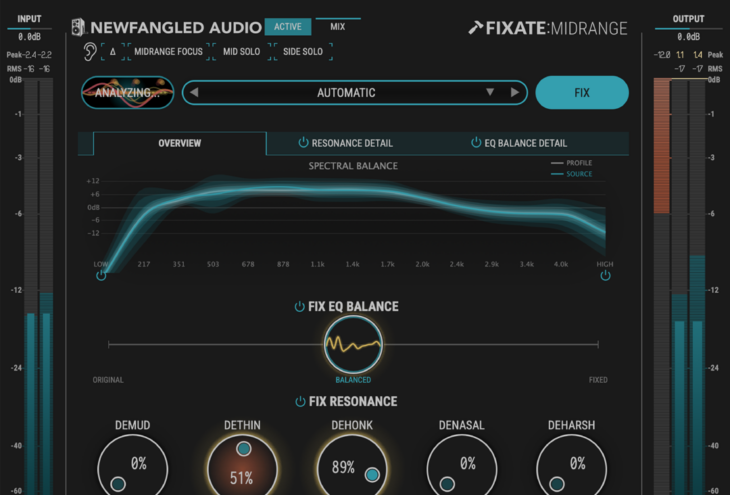
This week, Eventide Audio announced Fixate:Midrange (developed by Newfangled Audio), which they describe as "a new intelligent EQ plug-in designed to solve one of the most important challenges in mixing: perfecting the midrange. Built on a model of human hearing, Fixate:Midrange quickly identifies and corrects issues like mud, harshness, and imbalance, helping engineers and producers get to a polished, professional mix with minimal effort, available May 12, 2026 for $139 USD."
Music Connection has yet to examine the plugin at the time of writing, but they seem excited about it.
"Nailing the midrange is the key to a great mix, and I've always found it challenging," said Dan Gillespie (Owner of Newfangled Audio). "I wanted to build a tool that made perfect midrange easier for those who struggle and faster for those who've already mastered it."
"The midrange is such an important part of making music sound good, it was great to work with some brilliant ears to build a product tailored to solving those problems,” Gillespie told MC.
A company statement reads, "Melody, harmony, texture, and ambience all compete for space in the midrange. Fixate:Midrange brings order to that complexity. With a simple Analyze and Fix workflow, the plug-in listens to incoming audio, detects problem areas, and applies dynamic, signal-dependent processing only when needed. The result is a more balanced mix that keeps its original character intact."
"At the core of Fixate:Midrange are six dedicated processors targeting the most common problem areas: Mud, Thinness, Honk, Nasalness, Harshness, and Spectral Imbalance. Each operates automatically, responding in real time to the material. For users who prefer a hands-on approach, visual hints highlight exactly where issues occur across the interface, making it easy to fine-tune by ear."
"Fixate:Midrange is powered by critical-band analysis, a method based on how the human ear groups frequencies. By evaluating energy across these bands, the plug-in detects resonances and imbalances that traditional analyzers often miss, leading to more natural, musical results."
For more info, visit here.