
It’s early in Franklin, TN, Dave Mustaine’s adopted hometown. Sunlight floods the relatively spare room where the Megadeth frontman sits in a high-tech swivel chair. Behind him is his GRAMMY Award for Best Metal Performance, which he won in 2017 for “Dystopia”—his only win so far out of 13 nominations. Next to it is his Silver Clio Award, which he collected in 2016 for “The Megadeth VR Experience,” a virtual reality campaign tied to the Dystopia album. Also on the sideboard are a flowering orchid and various houseplants that bring an organic touch to the space.
“We lived here several times when we made records because it’s more cost-effective than commuting back and forth from California,” he says of Tennessee. “We found really nice people. We found a beautiful house. Traffic goes about 40, almost always wide open. I get to drive the 20 miles from my house to downtown as fast as I want, and the food’s great. The TV show [Nashville] is bullshit though. That’s not the real Nashville.”
He is bundled in a cozy red flannel over a black T-shirt, his signature ginger locks tucked beneath a knitted beanie. His porcelain skin looks almost translucent against his dark, square-framed glasses. He gives off the vibe of a crotchety grandfather, though one suspects he’s nothing like that with his grandchildren. A hot beverage is handed to him in a cup. He thanks the bearer with a polite gentleness at odds with his onstage persona.
“Hot lemon water is a ritual at this house,” he says. “It gives my whole insides a healthy rinsing off. I feel so much more alert. And I feel like I get more nutrients out of the food I eat because the cilium in your stomach gets really rinsed off and it’s easier to absorb.”
He credits his wife of 35 years, Pamela, whom he says, “takes really good care of herself,” for this practice. It’s one of many positive behaviors Mustaine has picked up from her. “My wife is amazing,” he continues, “but it’s like that old joke: I question her taste in men. She’s had plenty of reasons to trade me in. I’m not sure why she hasn’t. I’ve put her through a lot. We’ve been married since 1991. A looong time.”
The Mustaine family initially moved to Tennessee so their daughter, Electra, could pursue a music career. These days, she is vice president of House of Mustaine, the premium wine brand the family co-owns, along with a vineyard in California and one in Italy. Pam serves as president. Mustaine’s son, Justis, is an artist manager and part of Mustaine’s management team, an all-consuming career considering Mustaine’s full slate of activities.
2026 began with the January release of Megadeth’s final, self-titled album, which shot to the No. 1 spot on the Billboard Top 200—their first to do so. Ahead of the album’s release, the single “I Don’t Care” bypassed Taylor Swift’s “The Fate of Ophelia” on the U.S. iTunes Top Songs chart, moving into the top slot for a brief time.
“It was mind blowing,” Mustaine says of Megadeth’s chart milestones. “I have been scratching and clawing for this for a long time. It was pretty staggering to get No. 1 when you’ve always been No. 2 or lower. It’s very rarified air up around there.”
“Pop people, a lot of times, they reinvent themselves,” he continues. “Metal guys are different animals. They’re like, ‘Here I am. Take it or leave it.’ One thing about metal fans, they are passionate about their music. Most metal fans come from a pretty hard life. The lyrics and aggression of the music helps set them free from the angst they’re going through. For me, it’s way more cathartic and therapeutic to listen to music that’s going to help you better yourself. We’re all misfits that emote with the use of music.”
Worldwide sales of over 50 million records confirm that Mustaine has been connecting with audiences since his songs were first heard in 1983—initially on Metallica’s Kill ‘Em All, which includes four songs he penned: “The Four Horsemen” (The Mechanix), “Jump in the Fire,” “Phantom Lord” and “Metal Militia.” By 1987, the opening bassline of Megadeth’s “Peace Sells”—played by Dave Ellefson and written by Mustaine—signaled MTV News breaks. The iconic riff was heard ahead of MTV News for decades. That Mustaine was never compensated for it by the network is well documented.
Megadeth are one of the pillars of the “Big Four of Thrash Metal,” but their mainstream appeal started with that MTV placement, and it has grown alongside Mustaine’s longevity. In its “Millions of Finds” commercial, eBay features a “vintage 1987 Megadeth T-shirt.” It is listed for $300. That’s the midrange of what Megadeth T-shirts sell for on the platform. Mustaine isn’t aware of the commercial and grunts at the price of used Megadeth merchandise.
When asked what he listens to, he says he doesn’t actively listen to other people’s music, but that he hears it in the background of his life. At home, the system they have wired through the house is permanently tuned to the Frank Sinatra station. “I listen to the Chairman of the Board a lot at home,” he says. “When I tour, I go play insane metal music and close our show with ‘My Way.’ It’s the version by Sid Vicious, and the irony is, Paul Anka wrote English lyrics to the song by Frenchman Claude François. It wasn’t a Frank Sinatra song at all. It’s still great, just the same.”
Mustaine seems fragile, at least physically. This shouldn’t be surprising, considering the health issues he’s faced over the years. In the early 2000s he suffered from a severe radial nerve injury in his left arm. A few years after that, he had cervical spine damage leading to fusion surgery and a metal plate put in his spine. Then he was diagnosed with throat cancer in 2019—the experience of which is the subject of his third book, In My Darkest Hour,set to be published on September 8.
Like anyone in their mid-60s, he’s experiencing somatic wear and tear in the form of arthritis and other common degenerative issues. Most recently, he discovered he has Dupuytren’s Contracture, a hand condition that causes the fingers to bend toward the palm without being able to fully straighten. This is the primary reason given for Megadeth being his last studio album.
“We were about halfway through the record, maybe closer to two-thirds, and I was getting burnt with everything that was going on in the studio,” he says. “I’m not saying emotionally, I was just really exhausting myself. There was a stretch of two or three weeks of extensive hours, working long days. I’ve already got Dupuytren’s Contracture in my palm starting right there [he holds up his hand to demonstrate]. I’ve got arthritis in my hands really bad. All the things I’ve had go wrong with my physical being, it kept occurring to me that there’s going to need to be an end soon, or my hands are going to stop working. It was just a matter of time before if I didn’t say ‘enough,’ that Mother Nature was going to say it. So that was that.”
An extended Megadeth farewell world tour stretches to the end of 2026. It’s hard to imagine Mustaine heading out on its first leg, a 12-date Canadian run with Anthrax and Exodus, which starts four days after this conversation. Rehearsals only began yesterday, but he is confident he’ll be ready. By the time of this cover story’s street date, Megadeth will have completed extensive tours in South America and Europe before returning to North America for an arena run that also includes a notable number of stadiums. They close the year out in Australia and New Zealand.
While Mustaine’s corporeal being is not in prime condition, his mind is as sharp as ever. He’s known for his intelligence, his unapologetic views, and his unfiltered expression. He answers questions at length, then stops abruptly. Questions may not get fully answered, but he’s shared so much great stuff, it doesn’t even matter. But then, many minutes later, he picks up an earlier topic and sees it to its conclusion. He’s a fascinating character who keeps the people around him on high alert, and on their best behavior.
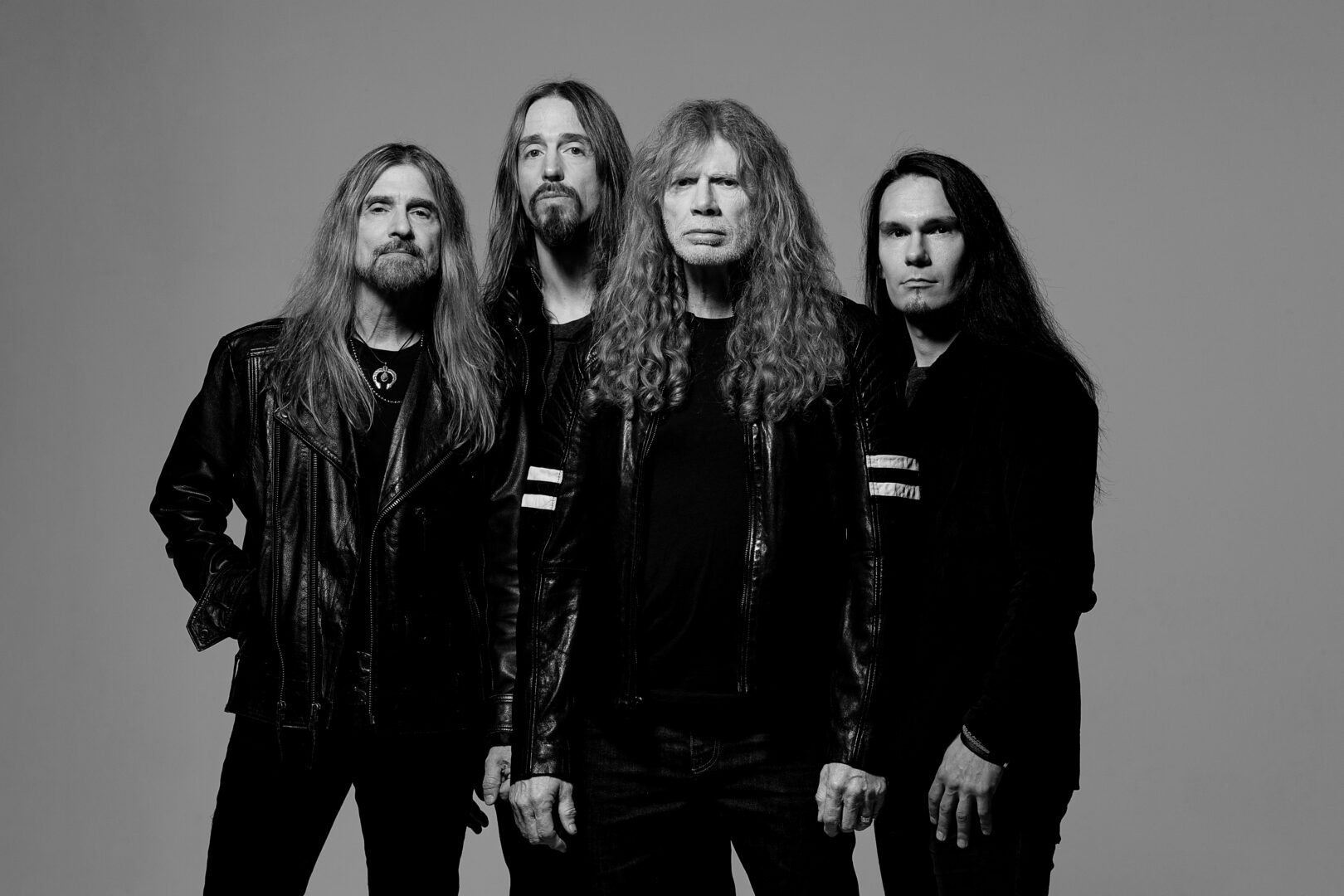
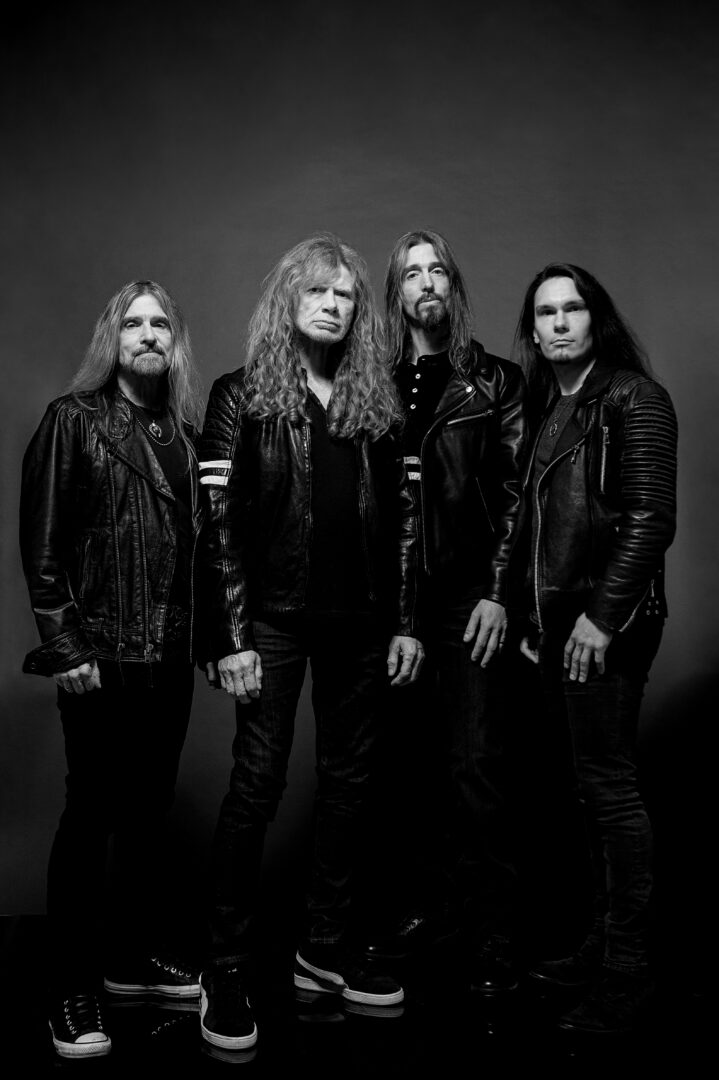
He is the only consistent member of Megadeth since its inception. It’s a tenuous situation for fans who are wary of becoming too attached to the revolving musicians serving time in the band. The current lineup includes two Europeans: guitarist Teemu Mäntysaari (Finland) and drummer Dirk Verbeuren (Belgium) along with bassist James LoMenzo. Mäntysaari is the most recent addition having joined the group in 2023. Megadeth is his first appearance on record. The others have put in at least a decade with Mustaine, LoMenzo over two stints.
Megadeth is the third album co-produced by Chris Rakestraw, who has also engineered for the band on tour. Their relationship started at the time of Dystopia’s recording when Mustaine asked Rakestraw to help him finish the album. Rakestraw’s immediate response was to check with Cameron Webb, who had been engineering for Megadeth, to make sure he wasn’t poaching a gig. That left Mustaine with a positive impression. When one of Megadeth’s monitor engineers died from cancer, Rakestraw stepped in without a hitch.
“Chris was as good in the venue as he was in the studio,” says Mustaine of Rakestraw. “He understands me. We communicate very well. He’s intelligent. He’s a first-class engineer. We work together pretty consistently—I just saw him at rehearsal last night. He’s really great to work with. If anybody plans on using him, please wait till I’m finished.”
With Rakestraw assisting with the music, words seem effortless for Mustaine. Reading Megadeth’s lyrics, he says so much and so accurately. He always has, speaking on topics that are universally relatable, putting into direct phrases what so many are feeling.
“That’s not what it’s like at all,” he clarifies. “The lyrics are the part that’s difficult for me. The music, if it doesn’t sound good, I can change it. Lyrics are totally different, because I have a reputation for being a good lyricist, I’ve got to honor that. It’s also difficult when you’re putting together a song and the song says a part’s too long, and you listen to the song and it tells you to make an edit, and you have to cut out a bunch of words that were meaningful.”
“I never wanted to sing meaningless stuff,” he continues. “I wanted people to walk away going, ‘That’s pretty stimulating,’ driving you to want to look something up. In the beginning, when I was writing, I thought, ‘I’m going to put a couple big words in these songs,’ and that continued on. On one of our recent albums, I had the word enosiophobia, a fear of criticism. I think we all have a little bit of enosiophobia.”
Considering how divisive Mustaine’s words can be, even among the most diehard of Megadeth fans, you wouldn’t think he would be bothered by criticism. Megadeth was ushered in by the worldwide theatrical release of the documentary, Megadeth: Behind the Mask, which, for those who attended, meant hearing the album in its entirety for the first time on a theater-level sound system.
The film sees Mustaine talking about all the Mega-drama, from not having any permanent members besides himself to his ailments, cancer diagnosis and treatment, songwriting process, and his family issues. It’s not a perfectly made film, and as is always the case with Megadeth, it has its detractors. Yet its appeal isn’t restricted to longtime fans but extends to casual ones as well. It doesn’t have the jolting impact of the group’s VH1 Behind the Music episode. If that’s what’s of interest, an extended version of the episode is readily available on DVD via Megadeth’s website. In contrast, Behind the Mask feels like a wrap-up as Megadeth puts its affairs in order.
Not that Mustaine has ever avoided conflict. His unceremonious firing from Metallica—a split that has been a central topic of his entire professional career—takes up many pages of his New York Times best-selling first book: Mustaine: A Heavy Metal Memoir (2010). He thankfully doesn’t bring Metallica up in conversation—even though Megadeth has a version of “Ride the Lightning”—which he wrote during his tenure in the band.
In that timeless memoir, Mustaine ripped off his skin to show readers his true insides. He laid bare every addiction, every bad decision, every altercation, every argument, every trip to rehab (17 total), every physical shortcoming, every religious upheaval—and eventual salvation—and his multitude of problems growing up, enough to forgive nearly every transgression. It’s an essential read.
His upcoming memoir, In My Darkest Hour, has that same unflinching honesty. Its focus is Mustaine’s cancer diagnosis: a squamous cell carcinoma at the back of his tongue, its impact on his mortality, his life’s work, and his family and friends. It also covers the making of Megadeth’s 2022 album, The Sick, The Dying… And the Dead! which was created alongside Mustaine’s radiation and chemotherapy sessions. In My Darkest Hour is his written record of what happened over those years.
A comprehensive but deeply personal account of what it is like to deal with cancer, one of the book’s main points is that the disease doesn’t affect only the person diagnosed, but everyone around them. In My Darkest Hour is not an easy read. Its moment-by-moment descriptions of Mustaine’s experiences from soreness in his mouth to getting fitted for the radiation mask depicted on the book’s cover to undergoing treatments are brutal in their truthfulness. What makes the book even more meaningful is the passages from his wife, his son, his daughter, his doctor, his guitar tech turned personal assistant, and his drummer, Verbeuren. Whether you’re a Megadeth fan or even aware of Mustaine as a person, it is insightful, and it is another essential read to Mustaine’s credit.
In the book Mustaine says, “There were no epiphanies with my cancer diagnosis or recovery, but there was a deepening appreciation for the blessings I have experienced in life… I’m here. I have a chance to spend time with my family. And I have a chance to make more music.”
This observation on a micro level connects directly with Mustaine’s open-minded worldview on a macro level, which becomes sharper every time he crisscrosses the globe on tour. His understanding of different cultures gives him a compassion that comes with tolerance, and appreciation for the liberties he enjoys at home.
“First off, I’m an independent, I think that’s important to explain,” he says. “I voted Democrat. I voted Republican. I voted for people that people like. I voted for people that people don’t like. I’ve seen political challengers that were very bizarre, like Ross Perot. Remember him? America was looking for something like that. They wanted a shake up.”
“Same thing with politics now in America,” he continues. “Politics in America has gotten so nasty. You hear people cussing. Where’s the decorum? Democrat, Independent, Libertarian, Green Party, Republican, conservative, non-conservative, why are you cussing? Why are you guys so angry? You’re supposed to be the best of what we got. You’re supposed to be leaders. I don’t see either side is very reputable, so I got very disillusioned with politics, especially now, because it’s so combative. The parties used to work together. It would be a lot of meeting in the middle. Going into a foreign country and then coming back home here, you tend to be very passionate about your feelings about the motherland here.”
It’s been said more than once that perhaps in another life, Mustaine would have been the kind of politician we could have used. He says he has no aspirations in that area but acknowledges that he is a leader and has responsibilities that come with that role.
“People are really struggling right now,” he says. “I'm hoping that somebody somewhere is going to make a difference. When someone comes into office, we have so much hope, and then bad shit happens. We've never had a president that is batting 1000. There's always some kind of a mistake because we're human. You can never predict the behavior of human beings, because we don't know what they've been through. We don't know if they're stable, they're balanced, if they're living in reality, or not. I tend to be very careful when I'm out in public. Not because I don't trust people, but because I don't want to miss anything.”
“What's going on overseas is beyond my pay grade,” he continues. “But what I know from Megadeth fans we've talked to, they're just like anybody else. They just happen to live in an area that's very difficult to live in. We went to China and they had armed soldiers in the pit. We played in Malaysia, and I watched an armed soldier in the pit hit a fan in the face with his rifle butt. I remember the World Cup years ago, [Andres Escobar] went to a coffee shop in Colombia, and they killed him because he scored an own goal against his team. When I come home from tour, I don't kiss the ground, but I love where we live.”
Photos by Ross Halfin