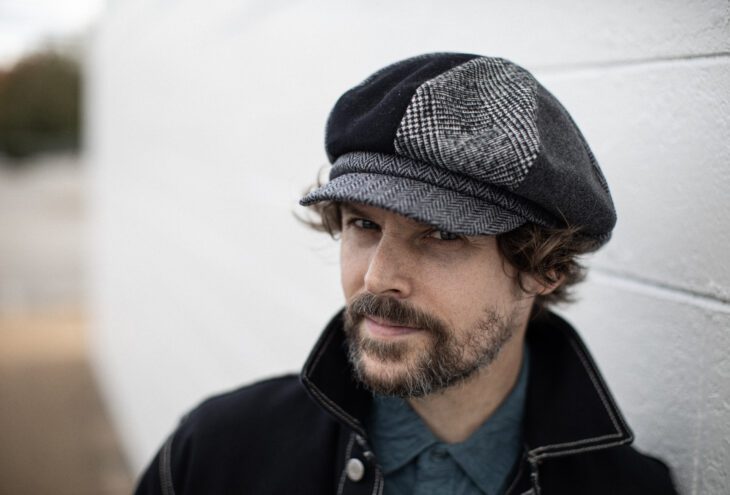
Exploring his father’s recording studio from an early age, Jarrod Lawson started playing the drums at just two years old. Moving with his family to an Oregon farm for a different way of life, Lawson was never pushed to pursue music but was shown major and minor scales and their triads by his father. Encouraged to play inversions up and down the keyboard, Lawson says, “That was such valuable advice. He taught me that, and then just let me go.”
At 13, things shifted. “Something just lit up for me. I realized I had an aptitude for it and my ears worked well,” he says. “I would listen to stuff on the radio, sit down and figure it out. I realized I loved and really wanted to do this.” He still listens to the Stevie Wonder records that first inspired him.
With no manager, no agent, no publicist (and no label) guiding him, he wrote, performed, and produced everything on his first album. Casually releasing Jarrod Lawson in 2014, it blew up immediately. Admits Lawson, “I didn’t have a clue what I was doing. I had zero touring experience, didn’t have a manager, didn’t have a team at all. I literally threw it up on iTunes haphazardly. The next thing I knew, deejays and tastemakers in the U.K. had found [it] and were reaching out with a barrage of questions.” A guest appearance on horn player Farnell Newton’s 2011 Class is Now In Session had already garnered praise from English radio station JazzFM, and the momentum led to Lawson’s debut international performance at Ronnie Scott’s jazz club in London. Says Lawson, “I didn’t do the thing you’re supposed to do—roll out the album slowly and have a big marketing plan—I didn’t do any of that.”
Lawson used to keep a Dictaphone at his bedside for nightly inspirations that needed capturing. He frequently hears a groove, bass line and changes before he even sits at the piano. If he notates the essence, he can let it breathe and come back to it. While a great song needs a compelling lyric that moves him, or a question he hasn’t thought of in the same way before, Lawson approaches writing from all angles. “Sometimes it’s the lyrics, sometimes it’s about the more visceral feeling you get from the song. That’s one way I keep it interesting for myself.”
His third album adds a new blend of sound. Says Lawson, “I’m leaning into that urban direction very intentionally to separate myself from getting pushed into jazz too much. I love jazz, but consider myself more soul/R&B.” The shift came unexpectedly as Lawson thought the record was already finished before his team suggested incorporating some collaborations. Adding hip-hop and rap elements, the project also brought moments of vulnerability. “On ‘Let Your Heart’—one of my favorite songs on the album—I’m not playing any instruments,” reveals Lawson. Hip-hop producer CARRTOONS had already created the track and shopped it around, with no takers. “The moment I heard it,” says Lawson, “I was like, ‘yes!’ I started writing lyrics immediately [and] the hook came to me. The next day I wrote the rest, and we pitched it to JSWISS to make it a rap feature. It’s just my voice and CARRTOONS playing all the instruments.” Having done everything on his previous projects, Lawson initially struggled with the idea. “It was weird at first, but the more I thought about it, I was trying to step outside the box with this album,” he says. “What could be more outside the box than that?!”
Lawson praises advice shared by Quincy Jones (to Jacob Collier). “Don’t try to be cool, be warm. The world needs more warm people.” Adds Lawson, “Everybody’s trying to be so cool. How about we just be warm instead? That’s such a beautiful philosophy.”
With a fan base including Gilles Peterson, Trevor Nelson, Louie Vega, and Michelle Obama, his new album, 14-song Just Let It,is out this month, with features including Raquel Rodriguez, Eric Roberson, Allen Stone, JSWISS, and CARRTOONS.
Contact Fiona Bloom, The Bloom Effect - fiona@thebloomeffect.com
Visit jarrodlawson.com