Three years ago, somewhere between a string of shows across Alabama, Nashville, and Mississippi, this writer did what musicians have been doing for decades: we pointed the car toward Muscle Shoals.
There was studio time booked at Tommy York Studios, a gig waiting up the road at Berkeley Bob’s in Cullman with The Spook House Saints, and—more than anything—a pull toward a place that has quietly shaped the sound of modern music. Muscle Shoals doesn’t announce itself with neon or ego. It hums. And if you’re listening, it lets you in.
At Tommy York Studios, we were lucky enough to cut three sessions with one of the great Muscle Shoals bass players, the late, fabulous Charles Robinson. Robinson carried that deep-pocket authority that defines the region’s sound—less flash, more gravity. David Hood remains the most widely recognized bassist from Muscle Shoals lore, but Robinson belonged to that same bloodstream. Norbert Putnam, the original FAME bassist, had already headed to Nashville years earlier, becoming part of Chet Atkins’ first-call rhythm section at RCA alongside Jerry Carrigan and David Briggs.
Tommy York and Charles Robinson are both gone now. We miss them every day. Time moves fast in studios. History doesn’t.
A Look Inside Music History
After wrapping sessions, we swung back down to Sheffield to visit FAME Studios. Walking into FAME is like stepping into a living photograph—one where the corners still breathe. This was the original home base of the Allman Brothers Band, where the group first came together and cut their earliest recordings. Duane Allman had been working there as a session guitarist, and gradually the orbit formed. Talent attracts gravity. Muscle Shoals perfected that equation.
That gravity reached far beyond Alabama. Years earlier, when we were just starting out in Cambridge and Boston, we met a few folks in Harvard Square who told us we should hear the backup band for a local folk singer named Bonnie Raitt. That night in Central Square, we wandered into a basement rehearsal and met three guys running songs: Freebo, Will McFarlane, and Dick Waterman.
Years later, Will McFarlane became one of those everywhere-at-once Muscle Shoals session players—cutting tracks for just about everyone. When we ran into him again a decade ago in Carrboro, NC, at what was then The Music Loft (now Twin House Music), he had relocated to the Piedmont and taken on the role of preacher. Later, we heard he’d drifted back toward Muscle Shoals. The music always pulls you home. Just mind your language around Will—he’s heard it all.
Take the Tour
FAME Studios offers more than nostalgia—it offers continuity. Much of the room remains as it was, save for thoughtful technical upgrades. You can feel the intent in the walls. Songs weren’t just recorded here; they were discovered.
We were given a personal tour by Greg Matthews of Legacy Music Marketing, who at the time owned the studio. Greg was warm, gracious, and generous with his time, even as his health was failing. He passed shortly after we met. He walked us through 3614 Jackson Highway like a caretaker handing off a torch.
And that’s where the story really opens up—because FAME wasn’t the only game in town.
The Other Room
In 1969, four session musicians—Barry Beckett (keyboards), Roger Hawkins (drums), Jimmy Johnson (guitar), and David Hood (bass)—left FAME Studios and formed Muscle Shoals Sound Studio just down the road at 3614 Jackson Highway. They were known as the Muscle Shoals Rhythm Section, affectionately dubbed “The Swampers,” a nickname given to them by producer Denny Cordell for their deep, funky Southern feel.
If that name rings a bell, it should. Lynyrd Skynyrd immortalized them in “Sweet Home Alabama.” They also appear on the cover of Cher’s 1969 album 3614 Jackson Highway, which effectively baptized the studio with its street address.
The building itself was unassuming—a concrete block structure built around 1946 that once served as a coffin showroom. Inside, history detonated.
Artists who recorded there read like a syllabus of American music: Aretha Franklin, Wilson Pickett, The Rolling Stones, Willie Nelson, Paul Simon, Bob Seger, Rod Stewart, Joe Cocker, Levon Helm, Cat Stevens, George Michael, and Lynyrd Skynyrd, among many others. The first hit from the studio was R.B. Greaves’ “Take a Letter Maria.” Within months, the Rolling Stones were cutting tracks there.
The Swampers weren’t just players—they were pioneers. They were the first major rhythm section to own their own studio, publishing, and production operation. By the time the Jackson Highway studio closed in 1979, they had appeared on more than 500 recordings, including 75 gold and platinum hits.
The Long Fade—and the Return
After closing, the building lived several lives—retail space, appliance store—until public interest surged again following the release of the documentary Muscle Shoals. In 2013, the Muscle Shoals Music Foundation purchased the property and began a full restoration. A crucial $1 million grant from Beats Electronics helped bring the project across the finish line.
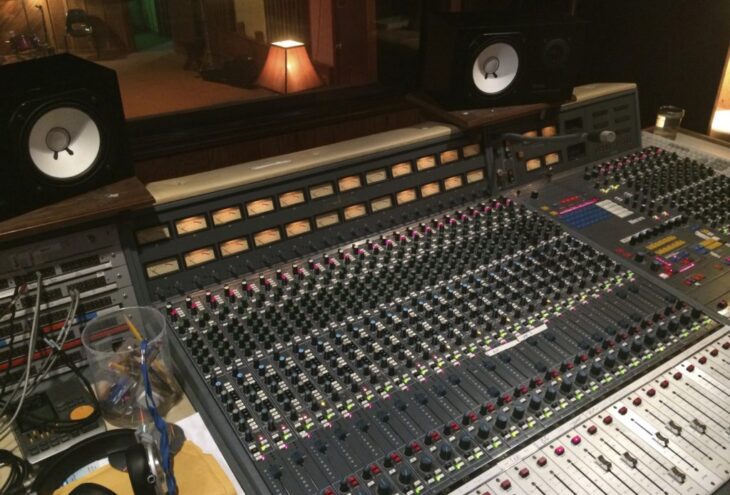
The restored studio reopened on January 9, 2017, its interior carefully returned to its 1970s-era look and feel: guitars and amps, a Hammond organ, Wurlitzer electric piano, baby grand, analog tape machines, isolation booths. It looks—and sounds—ready.
Since reopening, the studio has welcomed over 62,000 visitors from all 50 states and 50 countries. By day, it’s a museum. By night, it’s a working studio again. Dan Auerbach recorded there. Dave Cobb brought Rival Sons. Kiefer Sutherland cut tracks with David Hood. New music continues to pass through old walls.
The Alabama Tourism Department named Muscle Shoals Sound Studio the state’s top attraction in 2017.
Fade to Black
Muscle Shoals isn’t frozen in amber. It’s alive—still recording, still teaching, still reminding musicians that feel beats flash every time.
You don’t leave Muscle Shoals with answers. You leave with better questions—and a groove that follows you home.
Fade to black.