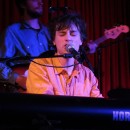
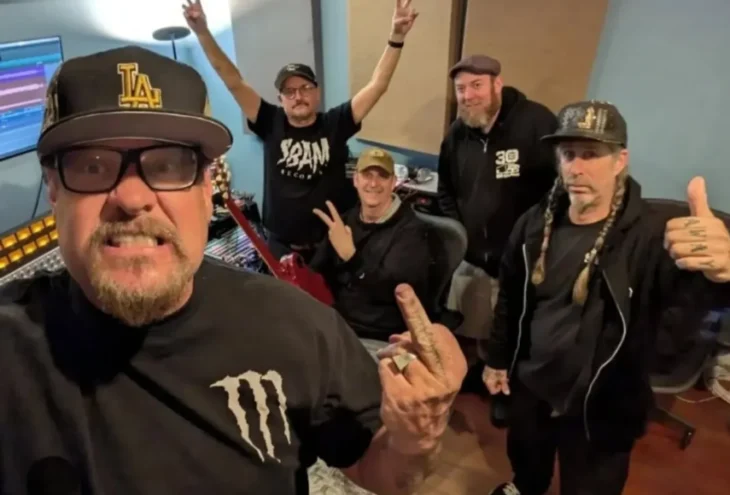
The Members: Tom “Crazy Tom” Davis, vocals; Monty Messex, guitar; Patrick Sullivan, bass; Snare Jordan, drums
Producer/Mixer: Fletcher Dragge (Pennywise)
Recording Engineers & Additional Production: Eddie Casillas (Voodoo Glow Skulls); Mario Caldato Jr. (Beastie Boys); and Patrick Burkholder
The Origin: Fueled by the impulse to ignite rapid, sun-drenched blasts of thrash that thrive alongside abrasive wire-tight chord progressions, DFL (Dead Fucking Last), moved through the velocity-driven SoCal hardcore ecosystem with unforced momentum.
The band emerged as a symbiotic collision, formed through lifelong skate-punk bonds and a shifting creative circuit of collaborators. At various points, this fluid lineup notably included Adam Horovitz (Ad-Rock) on bass and producer Mario Caldato Jr. (Mario C) of the Beastie Boys. Sessions linked to Los Angeles’ G-Son Studios — hallowed ground for epoch -making Beastie Boys recordings such as Check Your Head, and Ill Communication — fed directly into the making of DFL’s debut My Crazy Life (Grand Royal).
The culmination was an album built from compressed micro-moshers: fifteen tracks of velocity, abrasion, and short sound detonations; many barely stretching past the two-minute marker, several collapsing under one. A visceral strain of punk where instinct routinely overthrew refinement. While this approach was forged initially in the studio, it remained entirely uncompromised when they segued to the stage, becoming their credo in both settings. What was captured while tracking simply reappeared live and vice versa — immediate, unfiltered, and driven by a reflex favoring explosive energy over calculated construction.
Consequently, the band’s live shows became direct reactivations of the recordings. Plugging in meant embracing the friction; the velocity and imperfection preserved in real time gave the songs their pulse. Studio and stage seamlessly functioned as separate nodes along the same live wire signal.
This in-the-moment instinct became their internal language —a schematic of speed, abrasion, and performance without unnecessary correction. Remarkably, that voltage never dissipated. Even across a sprawling twenty-plus-year hiatus between their early era and the 2021 YRUDFL EP, their fundamental approach remained entirely intact. Decades away from tracking, simply allowed ideas to accumulate, forming a residual charge the band carried into their present-day sessions.
The Production: That unbroken continuity brings them to their 2026 release Fuck It (SBÄM Records), where stepping back into the studio for DFL is simply a matter of plugging in to find that same live energy. Despite holding onto riffs and sonic bits for years, the studio process is never forced or overanalyzed. Structure follows pure instinct. As guitarist Monty Messex explains, “I usually start with a riff… I’ll mess around and slap the song together.”
Choruses often surface first, with vocalist Tom “Crazy Tom” Davis constructing verses around that framework. “We don’t really talk about how things should come together,” Messex adds. “It usually just works out.”
The process extends directly into the tracking itself. “We record all our songs live, for the most part,” Messex explains. “We sometimes add vocals and guitar leads, but we don’t overthink things. We just want our recordings to capture a moment.”
That immediacy carries through into the gear pieces of choice for the band. Messex still relies on the same white Les Paul Jr. he has played since the Grand Royal era, paired with a Mesa Boogie Mark II combo amp whose tone has become inseparable from the band’s identity. “The guitar has a ‘60s slim neck that I love and a P-90 pickup on the bridge that gets a growl when combined with my Mesa Boogie,” Messex notes.
Even in-studio imperfections are treated as assets rather than mistakes. “The Boogie also gets this live feedback and [stray] radio stations,” he explains, “which just adds to the live nature of our recording.”
Rather than treating sonic interference or bleed as contamination, DFL allows it to breathe inside the music. The unintended ambient noise becomes part of the historical musical document — a raw signal captured in real time. For DFL, this refusal to overcorrect extends beyond recording technique. That loud, living feedback reflects a relationship to time shaped by pure persistence — a continuity of approach that reasserts itself whenever the band plays.
Messex points to the track “Second Chances” as the emotional center of the record. “I’ve had a lot of second and third and fourth chances in life,” he reflects. “Respect for the people we’ve lost along the way, and grateful for the life I have today. Fuck it.”
In that light, the roughness of their recordings is a physical record of the experience. The bleed, the feedback, and the volatile immediacy remain because they refuse to compromise the truth for a cleaner mix. The imperfections are exactly what make the history audible. Ultimately, what survives the decades for DFL is the signal: fast attacks that are sharp, intense, and unmistakably alive whenever they plug in.
Photo Courtesy of Earshot Media