The house sound guy is your friend Venues that have an audience capacity up to about 1,000 people will usually have an installed public address (PA) system through which each band performing will be amplified. The system will also usually be attended to by an in-house audio technician––the “house sound guy.” Every band I have ever worked with has an opinion about the venue audio technician, usually along the lines of, “Jeez, that house sound guy was such a jerk,” and usually blaming that person if the band had a particularly bad show.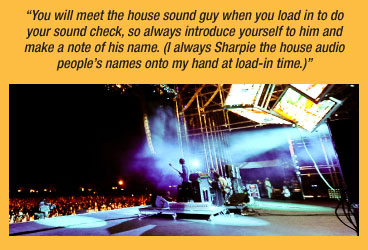
You should not blame the house sound guy—he can only work with what he is given. I still see bands and DJs show up for sound check at venues with substandard, broken equipment and expect the sound onstage and in the house to be perfect. Unfortunately, there is no magic with live sound. You can “fix it in the mix” to a certain extent in your home studio but not on stage. If your instruments sound thin, crackly, buzzy and out of tune when you do your sound check, then that is how they will sound to the audience during the show, only amplified and therefore louder. Make the source (your sound) as good as possible and the house sound guy will be able to give you and your band a better sound, both on stage, and for the audience.
You also need to treat the house sound guy as a friend and colleague, in order that he will understand what your aims are and do the best job possible. You will meet the house sound guy when you load in to do your sound check, so always introduce yourself to him and make a note of his name. (I always Sharpie the house audio people’s names onto my hand at load-in time.) Yelling, “Hey, Mr. Soundman” from the stage is one way to guarantee you will get less than stellar service from the house audio technician.
A good sound check is all about communication. Be polite and keep an eye on the audio techs so you know when to start and, more importantly, stop playing your instruments. There is nothing worse than a band launching into a full-on jam or rehearsal when the house sound guy needs to check other instruments for your band or, even worse, for other bands waiting to sound check. Remember, playing a live show is completely different from recording in your home studio. There you have unlimited time and are in an environment you are comfortable with and used to. You may not be used to the venue you are in when playing a show––the acoustics will be different from your studio and there are also time constraints, meaning the show has to start at a specific time and so you cannot stand on stage all evening, trying to make the monitor speakers sound like your home studio monitor system. However, there is help at hand…
The house sound person (that “jerk”) works at the venue all the time. He is therefore the best person to go to for help and advice with your on-stage sound and any other sound issues you may have. He knows the equipment and the “sound” of the room inside out and so will be able to get you the best on-stage and house sound––if you work together. Having said that, sound check can still be traumatic for musicians, singers and turntablists moving from the home studio to the stage. Massive volume, feedback, the inability to hear yourself—these issues plague any sound check and add to the anxiety of a performing musician. None of this happens when recording in a studio, so why is sound checking in a venue such a negative experience for so many musicians?
Well, physics plays a large part. The speed or velocity of sound in air is approximately 344 meters per second, 1,115 feet per second, or 770 miles per hour at room temperature of 20°C (70°F). However, the speed varies with the temperature of air, such that sound travels slower at higher altitudes or on cold days. So, in a cold empty venue, the sound waves will refract (bend) downward as they travel away from their source––the speakers. This causes a lack of clarity and direction in the higher frequencies as the higher frequency sound waves literally run out of steam as they travel farther. A “dampening” effect then occurs for the low frequencies, meaning the bass does not resonate in the room. The resulting sound is a smeary, bass-light mess. Add in the highly reflective walls, floors, and mirrors in a bar or club, and suddenly you can see (and hear) why sound checks often sound so awful.
A good, experienced house engineer will understand all of this. She will set the desk controls accordingly and you should trust her judgment. As long as your on-stage sound is vaguely decent at sound check there is no need to wander off stage and stand at FOH, criticizing the mix. Believe me, it ain’t going to get any better until the room fills up with excited, paying fans. And by then you will have the sound you want. 
ANDY REYNOLDS is an international concert tour manager, audio engineer and author of The Tour Book – How to Get Your Music on the Road. Reynolds also lectures on live sound engineering and concert tour management at universities and colleges in the U.K. You can find out more about him at http://livemusicbusiness.com.