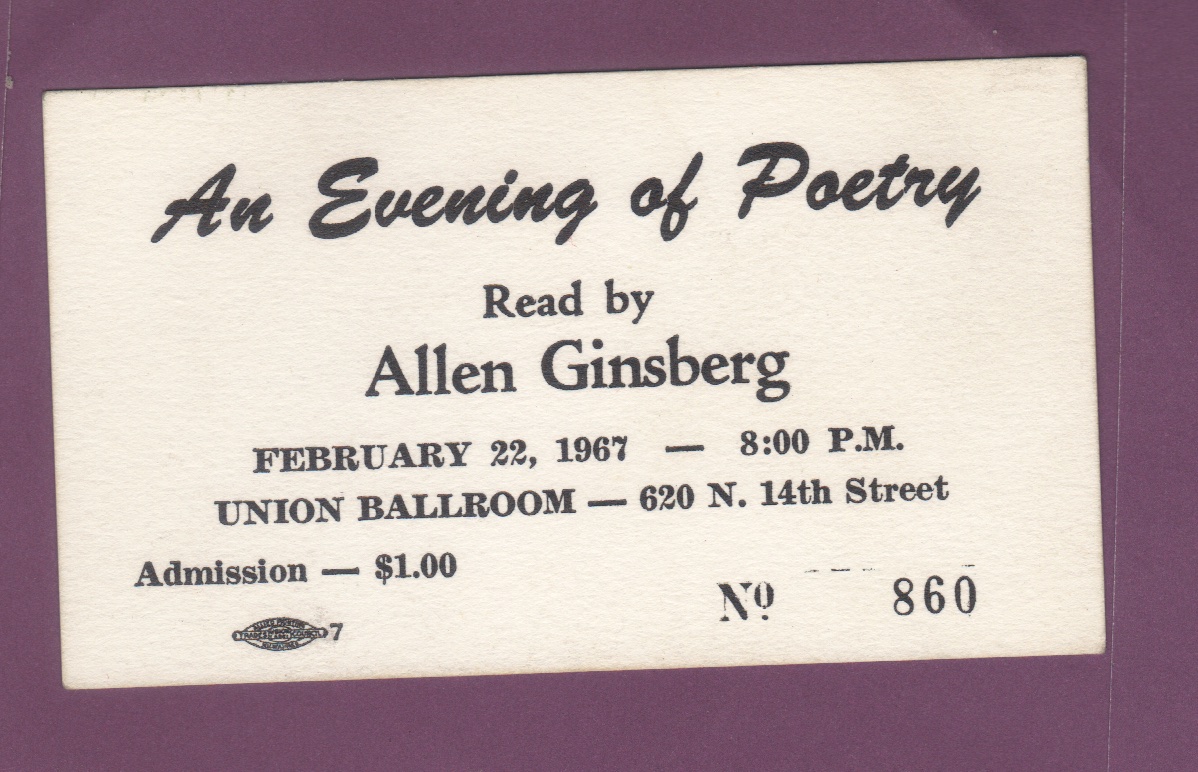
Craft Recordings commemorates the centennial of one of the most influential literary figures of the twentieth century with a special vinyl reissue of Allen Ginsberg's landmark spoken-word album, Howl and Other Poems. Originally released by Fantasy Records in 1959, the recording captures Ginsberg performing many of his most celebrated works, including the era-defining title poem "Howl."
Arriving September 4 on eco-friendly green blend vinyl, the limited edition reissue faithfully replicates the original 1959 package design. The album will also be streamed across digital platforms.
The set combines recordings from the Big Table Reading at Chicago's Shaw Festival with additional sessions recorded at Fantasy Studios in San Francisco. Alongside "Howl," selections include celebrated works "America," "Sunflower Sutra," "A Supermarket in California," and "Footnote to Howl," capturing the radical candor, urgency, humor, and musicality of Ginsberg's early performances.
The release arrives as part of a broader centennial celebration honoring Ginsberg's life and legacy. Additional events, exhibitions, performances, and commemorative programs taking place throughout the year can be found at AllenGinsberg.org.
Born June 3, 1926, in Newark, New Jersey, Allen Ginsberg emerged as one of the defining literary voices of the twentieth century. For Ginsberg, the second half of the 1950s marked a transformative period. Following the first public reading of Howl at San Francisco's legendary Six Gallery in October 1955 and the publication of Howl and Other Poems by City Lights the following year, he found himself at the center of one of the most consequential literary controversies in American history.
Published as part of City Lights' Pocket Poets Series, Howl and Other Poems challenged prevailing cultural norms through its candid explorations of identity, spirituality, and modern life. The resulting 1957 obscenity trial and the court's decision affirming the poem's literary importance became a landmark victory for free expression in the United States.
Three years after the book's publication, Fantasy Records issued Howl and Other Poems, preserving Ginsberg's own readings of the collection at a pivotal cultural moment.
The continued publication of Howl and Other Poems helped establish the Beat Generation as a major cultural movement and solidified the work's place in the American literary canon. Alongside writers including Jack Kerouac, William S. Burroughs, Gary Snyder, Michael McClure, and Philip Whalen, Ginsberg helped shape a movement whose influence extended far beyond literature and into the music, politics, and countercultural currents that followed. In 2019, Ginsberg's recording of "Howl" was selected for preservation in the National Recording Registry by the Library of Congress in recognition of its enduring cultural, historical, and aesthetic importance.
Over the decades, Ginsberg's influence has extended across generations of writers, musicians, and artists. His friendships and collaborations with figures including Bob Dylan, Philip Glass, Patti Smith, and Paul McCartney helped forge lasting connections between poetry and popular music, while his activism and advocacy made him an enduring voice for artistic freedom and social change. Today, his work continues to resonate around the world, speaking to enduring questions of identity, free expression, dissent, spirituality, and the search for human connection.
This special edition of Howl and Other Poems celebrates the timeless power of a work that continues to challenge, inspire, and resonate seventy years after its publication.
Track List:
Side A
- 1. Howl (Live at Shaw Festival, Chicago, IL / January 29, 1959)
- 2. The Sunflower Sutra
- 3. Footnote to Howl
Side B
- 1. A Supermarket in California
- 2. Transcription of Organ Music
- 3. America
- 4. In Back of the Real
- 5. Strange Cottage in Berkeley
- 6. Europe, Europe
- 7. Kaddish
In 2006, I penned the liner notes for the first-ever compact disc issue of Allen Ginsberg Reads Kaddish — A 20th Century American Ecstatic Narrative Poem on Water Records.
Allen Ginsberg (June 3, 1926 – April 5, 1997) is a direct literary descendant of American poets Walt Whitman and Hart Crane. He is a member of the American Academy of Arts and Letters, was awarded the medal of Chevalier de l’Ordre des art et Letters by the French Minister of Culture in 1993, and is co-founder of the Jack Kerouac School of Disembodied Poetics at Naropa Institute, in Boulder, Colorado, the first accredited Buddhist college in the West.
In the 1980’s, I produced a live recording of Allen at The Unitarian Church in Los Angeles, and eventually arranged for him to read at music venues around Southern California over the years, including his debut booking at McCabe’s Guitar Shop in Santa Monica.
Allen was always supportive of my recording and literary projects, offering valuable criticism and praise about my own endeavors usually when noshing over corned beef sandwiches at Canter’s Delicatessen in West Hollywood. Allen and I are also heard on the Phil Spector-produced Leonard Cohen 1977 album Death of a Ladies’ Man.
In 1996 I talked to Ginsberg one late afternoon in Rhino Records’ conference room in Westwood, California, where poet Gregory Corso sat in with us, and the following year, we conducted another extensive interview by phone from his New York City apartment.
When Allen Ginsberg died, The Los Angeles Times asked me to pen a tribute that appeared on the front cover of their Calendar section.
An excerpt from one of my three interviews with Allen was published in the Rolling Stone Book of the Beats in the late nineties.
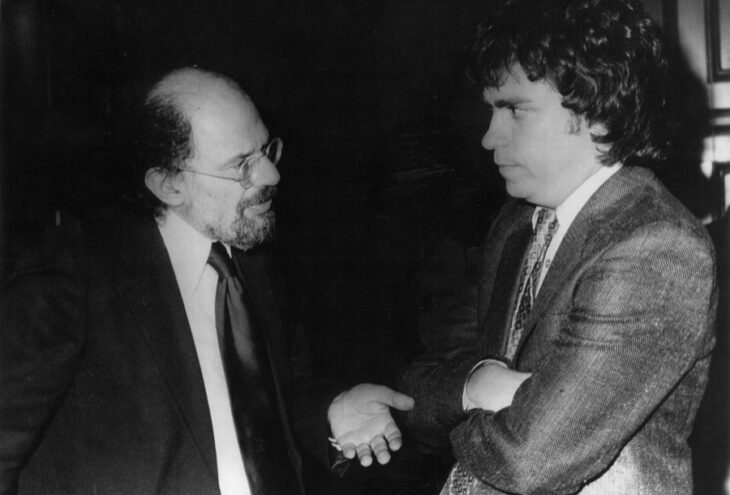
Allen Ginsberg and Harvey Kubernik, 1996 interview.
Q: What kind of impact did FM Radio actually have on you as a writer and reader/ performer?
A: By the time I got around to getting on the radio, it was actually an AM station in Chicago with Studs Terkel; I recorded the complete reading of “Howl” in Chicago, later used for the Fantasy record. It was broadcast censored. ‘59. KPFA in the Bay Area then started broadcasting my stuff in San Francisco, a Pacifica station. Fantasy put out “Howl,” and that got around.
Also in San Francisco, in the mid-’50’s, there was a music and poetry scene. Mingus was involved with Kenneth Rexroth and Kenneth Patchen. And Fantasy Records documented some of that. The Cellar in San Francisco. By that time, I didn’t know how to handle it, so I never did much of that myself, because I was more funky, old- fashioned blues. I couldn’t cut the mustard with free jazz. Then, Jerry Wexler at Atlantic put out Kaddish. It was a radio broadcast from Brandeis University.
Q: Was there ever a conflict of written page origin, then into audio land?
A: We wrote, and we were in the tradition of William Carlos Williams, spoken vernacular, comprehensible common language that anyone could understand, coming from Whitman through William Carlos Williams through bebop. We were built for it. I can talk. I’m an old ham.
Q: Does the vision change once it leaves the paper?
A: No. It doesn’t make much difference. The method of my writing, to begin with, is that I’m not writing to write something that I catch myself thinking I suddenly notice something I have thought of when I wasn’t thinking of writing, and then I write it down if it is vivid enough. And as far as the choice of what to write down or not, the slogan is vividness, which is self-selecting. So, in a sense, the method is impervious to influence by the audience because I’m just thinking to myself in the bathtub.
Q: What about poetry readings and performances? Is it different with a musician next to you or people sharing the stage?
A: I have to focus on my text. I’m still pointing toward the tornado.
Q: You still read from text on stage, from a book, or typewritten. Do you ever read from memory?
A: I rarely read from memory. I sing from “Father Death Blues,” and can sing “Amazing Grace” from memory, but I don’t know what lines are coming, so I have to refresh myself. I’m not particularly interested in memorizing perfectly, ‘cause I think it’s distracting from interpreting the text differently each time. I think you have to have all the dimensions at once, the book thing, the poetry thing, plus the performance, plus the musical accompaniment, and if you have all of them, and they’re all in a good place, that’s fine.
But the reason I don’t try to memorize is that I guess I could, but I’m too busy, and I like to re-interpret the poem each time. Certain cadences are recurrent, and certain intonations are recurrent, but on the other hand, if I don’t memorize it, there’s always the chance that somebody noticing something, and empathizing, puts it a little differently, and brings g out meaning that I didn’t realize before. So, I prefer to have the score in front of me and interpret it anew each time.
Q: Artists from new generations, alternative rock bands, still keep discovering your work and acknowledging your influence.
A: It’s fun. You always learn from younger people. I learned a lot from William Carlos Williams and the elders of my generation. People who were much older than me when I was young. And that inter-generational amity is really important because it spreads myths from one generation to another of what you know, and all the techniques and the history.
All of a sudden, with the phalanx of younger people following Williams’ lead, he became the sage that he was. And I think it gave him a lot of gratification to realize he had been on the right track, and that it wasn’t in vain. And I get the same thing whenever I get to work with younger people. And I learn from them. I don’t think I would have been singing if it weren’t for younger Dylan. I mean, he turned me on to actually singing. I remember the moment it was. It was a concert by Happy Traum that I went to and saw in Greenwich Village. I suddenly started to write my own lyrics, instead of Blake. Dylan’s words were so beautiful. The first time I heard them, I wept.
I had come back from India, and Charlie Plymell, a poet I liked a lot in Bolinas, at a “Welcome Home Party” played me Dylan singing “Masters of War” from Freewheelin’ Bob Dylan, and I actually burst into tears. It was a sense that the torch had been passed to another generation. And somebody had the self-empowerment of saying, “I’ll Know My Song Well Before I Start Singing It.”
Dylan said that Jack Kerouac’s Mexico City Blues had inspired him to be a poet. That was his poetic inspiration. We were being more candid and truthful than most other public figures or writers at the time. We were switched over to writing a spoken idiomatic vernacular, actual American English, which turned on many generations later.
It happens every 100 or 150 years. It did in the days of Wordsworth, who, in his Preface to Lyrical Ballads, suggested that poets begin writing in the words and diction of men of intelligence, or talk to each other intelligently, instead of imitating another century’s literary style.
So, I think what happened is that we followed an older tradition, a lineage, of the modernists of the turn of the century who continued their work into idiomatic talk and musical cadences and returned poetry to its sources and actual communication between people.
We wrote, and we were in the tradition of William Carlos Williams and Walt Whitman, spoken vernacular, a comprehensible common language that anyone could understand. We were built for it.”
That was picked up generation after generation up to people like U2, who are very much influenced by Burroughs in their presentation of visual material, or Sonic Youth, or poets, like Thurston Moore and Lee Renaldo, are interested in poetry.”
(On July 15, 1967, Barry Miles, the author and cultural historian, co-founder of the Indica Gallery and Bookshop introduced Allen Ginsberg to Paul McCartney at his house in London on 7 Cavendish Avenue in St John’s Wood. Mick Jagger and Marianne Faithfull were also there. Jagger invited Allen Ginsberg to the Rolling Stones’ recording session for “We Love You.” Paul and John Lennon were in attendance as well, and contributed backing vocals and handclaps.
“Marveled by the Beatles on the track,” emphasized record producer Andrew Loog Oldham to me in a 2010 interview.
“John and Paul saved ‘We Love You’ in my humble opinion, with the vocals, I mean. Mick and Keith just did not sing like that. John and Paul always remembered and acknowledged people they knew early in the game, like me, from January 1963. ‘We Love You’ and ‘Dandelion’ would turn out to be my last sessions with the Rolling Stones.)”
Q: You did a 1995 poetry reading in England with Sir Paul McCartney.
A: In the late 60’s or early 70’s, I visited McCartney in London. I was on TV that day, a “Pro Pot” rally in Hyde Park, and the cops had stopped me from playing a harmonium or talking on a microphone.
So, I came down from my ladder from where I was talking and gave the cop a flower. That was kind of a knock- out for everybody in London at that time, rather than getting mad. And I was watching that on TV with Mick Jagger at McCartney’s house. And Paul was painting a satin shirt, and he gave it to me as a “performance shirt.” We talked a little.
I had a gig in 1995 at the Royal Albert Hall in London. A reading. I had been talking quite a bit to McCartney, visiting him and bringing him poetry and haiku, and looking at Linda McCartney’s photographs and giving him some photos I’d taken of them. So, McCartney liked it and filmed me doing “Skeletons” in a little 8-millimeter home thing. And then I had this reading at Albert Hall, and I asked McCartney if he could recommend a young guitarist who was a quick study. So, he gave me a few names, but he said, “If you’re not fixed up with a guitarist, why don’t you try me? I love the poem.” So, I said, “It’s a date.”
We went to Paul’s house and spent an afternoon rehearsing. He came to one sound check, and we did a little rehearsal there, again. And then he went up to his box with his family. It was a benefit for literary things. There were 15 other poets. We didn’t tell anybody that McCartney was going to play. And we developed that riff really nicely. In fact, Linda made a little tape of our rehearsal. So, then, we went onstage and knocked it out. There’s a photo of us on the CD. It was very lively, and he was into it. We met each other over the years, and then we met again when he did Saturday Night Live, and he greeted me like an old lost buddy.
Q: Didn’t you see the Beatles play, and there’s some poem you wrote about the event?
A: Yes! I saw them in Portland, Maine. 1965. I was up there with Gary Snyder, and I was with a couple of little children. I had gotten tickets and was sitting way out in the bleachers, and John Lennon came out and said, “We understand that Allen Ginsberg is in the audience. So, three cheers. So now we’ll have our show.” He saluted me from the stage, which amazed me and made me feel very proud with all these young kids at my side. Then I knew Lennon and Yoko Ono lived in New York and visited on and off.
Q: What happens when the beat or the music collides with your words and voice?
A: Elvin [Jones] has a very interesting attitude. He feels that he’s not there to beat out the vocalist. He’s there to put a floor under them. He’s there to support and encourage, and give a place for the vocal to come in, not to compete with the vocal, but to provide a ground for it. He’s very intelligent as a musician. We did it once together in 1969 on the Blake album; there was a military-type drum, and then this recent rap song. I’ve rarely found opposition to the music because the musicians were very sensitive and built their music around the dynamics of my voice.
Q: You write something on a piece of paper. Does the original intention change once there is music and other elements involved?
A: Well, it widens it into a slightly different trip, but the words are pretty stable, and they mean what they mean, so there is no problem. The interesting thing is adjusting the rhythmic pattern and the intonation to the musician’s idea of what is there. That’s pretty good, because I’m good as an improviser where I can take a long line or a short line and fit in sixteen bars without worrying about spaces and closed places.
Q: As far as performance and poetry readings, when you read in recital, aren’t you trying to keep the same original birthplace word vision and not expand or bring in theatrical elements?
A: I like to stick to something that is grounded in anything I could say to somebody, that they wouldn’t notice I was really saying it as poetry. Intense fragments of spoken idiom, with all the different tones of the spoken idiom, which is more musical than most poetry. Most poetry by amateur poets is limited to a couple of tones, a couple of pitches, instead of an entire range, so that the poetry we do fits with the music because it has its pitch consciousness. The tone reading the vowels up and down.
So, I like the idea of seeing the development of the mind, or of the voice, or of the thought, or of the poetic capacity, and I want to leave that trail behind for other poets so they could see where I was at one point, or where I was at another. My oration, my pronunciation, or my singing, my vocalization differs, and it builds.
As I get older, it gets more interesting with more and more tones, and more and more breath, and deeper and deeper voice, and higher and higher voice. But still, the original rhythms and the original ideas are from the original text, so you’ve still got a chronology going. So, people could see the development of the mind. I’m not writing about the external world. I’m writing about what goes through my mind. So, at a certain period I’m interested in this kind of sex, another period, this kind of politics, another period, this kind of meditation, and I like people to be able to dig that there’s a development, and not a static process.
Q: I’m amazed by your paper trail, book catalogues, albums, first edition printings, out of print classics people want signed. It’s like “This Is Your Life” on parade.
A: Not quite. It’s my mind on parade. That’s what the mind is for: to show other people.
Q: It’s obvious that people want to be writers again. I feel that.
A: They want to express themselves. Not just to be a writer to be a writer, but they want to be able to say what they really think.
(Harvey Kubernik is the author of 21 books, including 2009’s Canyon Of Dreams: The Magic And The Music Of Laurel Canyon, 2014’s Turn Up The Radio! Rock, Pop and Roll In Los Angeles 1956-1972, 2015's Every Body Knows: Leonard Cohen, 2016's Heart of Gold, Neil Young, and 2017's 1967: A Complete Rock Music History of the Summer of Love. Sterling/Barnes and Noble in 2018 published Harvey and Kenneth Kubernik’s The Story Of The Band: From Big Pink To The Last Waltz. In 2021, they collaborated on Jimi Hendrix: Voodoo Child for Sterling/Barnes and Noble. Otherworld Cottage Industries in 2020 published Harvey’s Docs That Rock, Music That Matters. His Screen Gems: (Pop Music Documentaries and Rock ‘n’ Roll TV Scenes) was published in February 2026 by BearManor Media. Kubernik is researching a multi-voice narrative study on the Beatles for a UK publisher with a planned summer 2027 publication.)
Photo of Allen Ginsberg and Harvey Kubernik by Suzan Carson
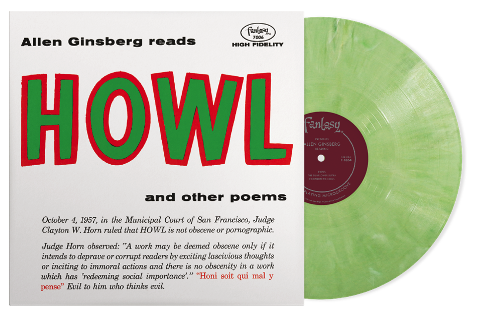
Allen Ginsberg ticket courtesy of the Roger Steffens Archives.