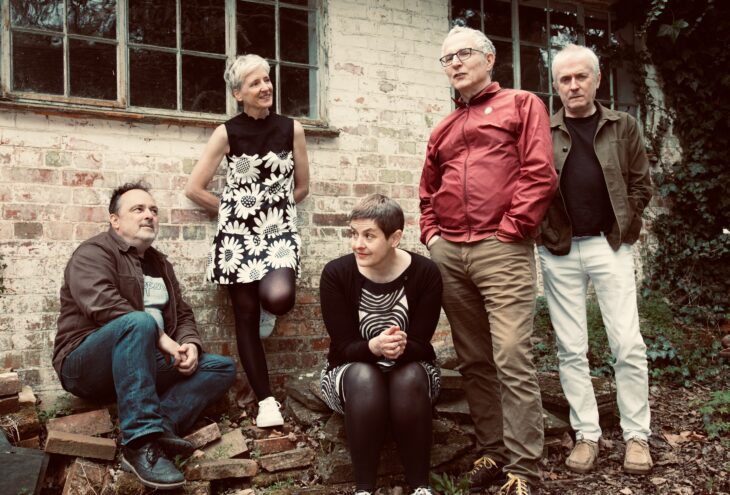
In the 30 years since Heavenly released what had been their last album, Operation Heavenly, the world changed plenty. That wasn’t really the case for their fanbase though. In the 1990s, the English band, who were associated with cult favorite labels Sarah Records in the U.K. and K in the U.S., garnered a following for their juxtaposition of bright indie pop with sharp, feminist lyrics. Today, songs like “P.U.N.K. Girl” and “Me and My Madness” still resonate with young audiences. It’s just that, now, new listeners are finding Heavenly via Spotify and TikTok instead of college radio and Riot Grrrl zines.
After a few years of well-received reunion shows, the band recently released their fifth album, Highway to Heavenly, on Skep Wax, the label owned by founding members Amelia Fletcher and Rob Pursey. “It’s been the most slow-motion comeback ever,” says bassist Pursey of Heavenly’s return. “We come back a little bit and nobody seemed to mind, so we keep on coming back.”
Highway to Heavenly is a continuation of the band’s legacy, with singer and guitarist Fletcher drawing from today’s social and political climate for songs about belonging (“Portland Town”) and resistance (“Deflicted”). “We enjoyed playing all the old songs live and we felt like it would be fun to carry on and that people were keen for us to carry on,” Fletcher says of the decision to make a new album, “but we didn’t want to end up being a covers band of ourselves that just did old songs.”
With Heavenly about to head out on tour—they’ll be in the U.S. between April and June—we caught up with Fletcher, Pursey, and guitarist Peter Momtchiloff for a video call. The interview has been edited for length.
Inventing “Deflicted”
Amelia: When you’re singing these songs and they haven’t properly got words yet, you sing slightly random things. At some point, I sang “deflicted” and everyone thought it was a great word.
Peter: It’s just your bid to get into the Oxford English Dictionary, isn’t it?
Amelia: Cathy [Rogers—vocalist and keyboardist] was particularly keen on us keeping that name. I thought that was a slightly odd thing to do, but she determined that I would do it because it would become a proper word because she would use it in enough places that, in fact, it became something that could feasibly get into the dictionary. So, we are, as well as writing a song, trying to use the word as much as we possibly can.
Connecting with Riot Grrrl
Amelia: When we were very first making Heavenly music, it was actually before Riot Grrrl ever happened. We all were quite overtly feminist in what we spoke about in interviews, but you wouldn’t really have known it from the music. They were more sweet pop songs. We’ve always been into pop songs.
We were over in Olympia touring, I think, our second album and we met all the people who were involved in starting Riot Grrrl. Particularly me and Cathy, but I think all of us, found it really inspiring. In particular, I thought, these things that I’ve been talking about in private, they could go into songs. I hadn’t really ever thought of that. It’s a strange thing. That had a big impact lyrically and a little bit musically on how Heavenly evolved from there. We were pretty inspired by all of what was going on with Riot Grrrl.
Rob:Apart from the feminism, it seemed like this scene in America was doing something loudly that was happening quietly with Sarah Records back in the U.K. So the politics weren’t that different, but the Sarah Records style was to be quieter, almost more parochial, on purpose, which I quite liked.
A Streaming Conundrum
Amelia: In terms of streaming and things like that, we’re quite conflicted. None of us feel that happy about streaming.
From a Heavenly perspective, it’s actually been incredibly good because TikTok and Spotify, for whatever reason, the algorithms like Heavenly. So, we’ve really done well out of those platforms.
Rob: There are lots of things that you can say about Spotify and streaming, which have been injurious to the health of the music scene, but one of them is the bias towards the old. An old song, as a stream, is worth exactly the same as a brand new song. So, the share of the pie goes back to older people, like us, where an old Heavenly song has been hugely increased. You used to buy old songs in secondhand shops or charity shops, all knackered on vinyl. Now those songs never go away.
On a personal band level, that’s really exciting, but it’s also a kind of symptom of something that is not so healthy, really.
Algorithmic Inspiration
Rob: Can I reveal a terrible thing about Amelia that she won’t want me to reveal? When we’re working on our set lists, she’ll go, ‘this one is doing well on the algorithm.’
(Amelia laughs)
Rob: Those songs somehow get promoted.
Amelia: I am algorithm-inspired.
Peter: The algorithm brought a song back into our set which we haven’t thought to play, “Me and My Madness.” I don’t think we even discussed playing it. We just passed over it. The algorithm told us that we were wrong. The algorithm was right. It went very well as a live song. People enjoyed it. We like playing it.
Amelia: It’s probably our most popular song in the algorithm world.