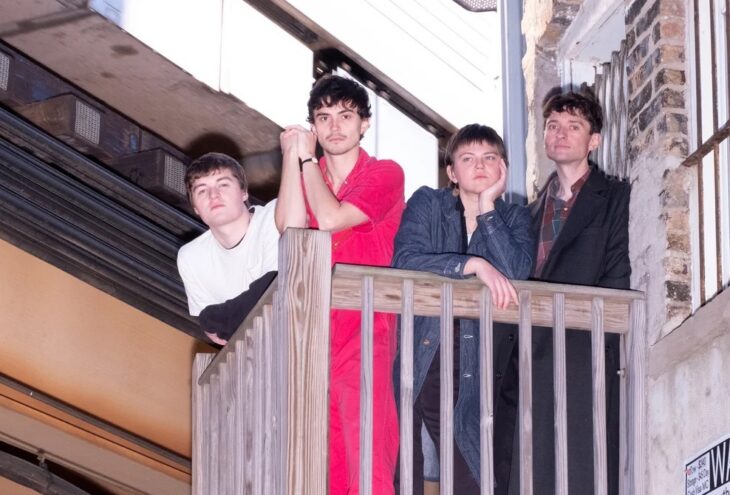
A Song or(four) that Changed My Life: Niko Kapetan: Frank Ocean’s “White Ferrari,” Bailey Minzenberger: Cursive’s “What Have I Done,” David Fuller: Broken Social Scene’s “Guilty Cubicles,” and Korgan Robb: Kamasi Washington’s “Truth.”
The Band Members: Niko Kapetan, lead vocals, guitar; Bailey Minzenberger, drums; David Fuller, bass guitar; Korgan Robb, guitar.
The Storytellers: Niko Kapetan, Bailey Minzenberger, David Fuller; bass, Korgan Robb.
The Songs: Stripped down and spectral, Frank Ocean’s layered vocal performance on his career-defining deep-cut “White Ferrari” rests above sparse soundscapes with a fragmented narrative that folds the listener into a free-flow state of winding introspection. Its experimental structure and haunting, minimalist production brought a unique form of alt-R&B to the mainstream, replacing the traditional quick-fix “hook” with lingering, emotional suspension.
Cursive's slow-burner “What Have I Done” utilizes still, echoing guitars that build toward a clamorous crescendo, where earnest vocals break and call out for an internal reckoning. The track’s unflinching way of presenting discontent and malaise serves as a poignant litmus test for the era, offering an additional tool within the post-hardcore arsenal — revealing how a voice can serve as a” cutter” just as much as a distorted, dissonant guitar chord.
Emotive artistry thrives within the sparse textures of Broken Social Scene’s ambient lo-fi instrumental “Guilty Cubicles.” Crafted with a soothing guitar set alongside a meditative rhythm, the track creates a hypnotic lull where audiophiles swim within a slipstream of nocturnal nostalgia. The melancholic mood-piece served as a foundational atmospheric statement for the indie underground, proving that moving storytelling could emerge purely through texture, repetition and sonic drift.
Where Fuller found weight through minimalism, Robb discovered it through scale and accumulation. Kamasi Washington’s massive, complex jazz composition “Truth,” commissioned by the Whitney Museum and built around a two-chord vamp, improvisationally expands outward, creating an immense music mural. The climactic track, where five distinct melodies of the preceding movements converge into a Harmony of Difference, showcases how interweaving melodic lyrical threads can layer and converge to create a sonic suite of collective transcendence.
Though emerging from vastly different musical lineages and stylistic forms, each track constructs an immersive emotional world through texture, tonal depth, and atmospheric composition — a philosophy that closely mirrors Friko’s own approach to creating music.
The Background: Arising from Chicago’s Hallogallo DIY underground — a scene named after a track by the motorik Krautrock band Neu! and galvanized by a handmade fanzine of the same name — Friko began taking shape just prior to the 2020 lockdown. Originally formed by vocalist and guitarist Niko Kapetan and drummer Bailey Minzenberger, the band fine-tuned their expansive, indie-rock songwriting, ultimately demoing and self-recording what would become their breakout release, We’ve Been, Where We Go From Here.
As the world reopened and live music returned, Friko expanded into a quartet with the addition of bassist David Fuller and guitarist Korgan Robb, allowing the band’s cinematic tendencies to fully emerge, widening in scope and emotional depth. With the recent release of their sophomore album Something Woth Waiting For, the band further deepens these creative throughlines, pushing their expansive songwriting further by leaning into the power of patience. By treating atmosphere as architecture, Friko’s new music creates emotional spaces where memory, abstraction, and nostalgic longing are held.
The Story: To understand Friko is to understand the emotional spaces they build from the music that shaped them.
Across four distinct listening experiences —ranging from deep-alt R&B to expansive jazz murals — a shared sonic language emerges. It is a language built on intense immersion. Each of these tracks arrives with its own sense of being.
Niko Kapetan’s entry point arrived in high school while driving late at night through the Midwestern highways between Chicago and Champaign-Urbana. In the maze of vast cornfields, Frank Ocean’s “White Ferrari” revealed its full weight. “I like the way the song stitched together,” Niko says. “The hip-hop and rap elements mixed with the indie elements... that’s what impacted me at first.” Beyond the genre-bending, it was the structural freedom that stuck. “I wanted to make music that wasn’t just a song in the classic sense. I wanted to lean into that sense of rambling vocals and the idea that a song could be very abstract.”
While Niko found power in fragmented narratives, Bailey Minzenberger found it in the heavy pull of emotional memory. Hearing Cursive’s “What Have I Done” in middle school, the song’s existential themes hit with premature, profound gravity.
“I’m holistically a big fan of melancholic music,” Minzenberger explains. “A piece of music doesn't necessarily have to be sad to feel melancholic. For me, melancholy is just feeling every edge of an emotion.” The track’s slow-burning arc and lead singer Tim Kasher’s frayed delivery provided an unintentional outline for Friko’s own cathartic crescendos. “The lyric ‘I spent the best years of my life waiting on the best years of my life’ is so potent. It captures that feeling of always chasing something just out of reach.”
For David Fuller, the formative moment was Broken Social Scene’s “Guilty Cubicles”— a three-minute ambient instrumental that appeared almost by accident while studying film. “It taught me that a band can be so much more than just a band with one sound; they can do anything they want,” Fuller says. That realization expanded to how he hears space today as a sonic open field. “It blew this whole door open. It’s a meditative song that has grown with me, or I’ve grown around it.”
Korgan Robb also found his throughline of pure instrumentalism in the expansive convergence of jazz. Kamasi Washington’s “Truth,” a thirteen-minute epic composition built on a simple two-chord vamp, showed him how five movements could interweave into one final song on Washington’s Harmony of Difference.
“I was really into bebop and trying to learn how to play jazz, and then this song comes along with a string section, horn section, and two drummers,” Robb recalls. “It helped me focus on what I love about jazz — how those layers are built. It’s one of the most beautiful things I’ve ever heard.”
This same commitment to layering — the idea of stacking distinct emotional threads of varying until they accumulate into a complete world — is the philosophy that anchors Friko’s current work on Something Worth Waiting For. The new tracks draw elements from each band member’s emotive archive, creating a unified soundscape where Kapetan’s abstraction, Minzenberger’s catharsis, Fuller’s submerged textures, and Robb’s improvisational phrasing overlap into a singular atmospheric soundscape.
“On this record, we were exploring patience — not being afraid to sit in something,” Minzenberger summarizes. “Things don’t need to change constantly; it’s okay to just inhabit a moment. We’re pushing ourselves to sit in that space, just like the songs that changed us.”
Photo Credit: Adam Powell