The Band: Chat Pile
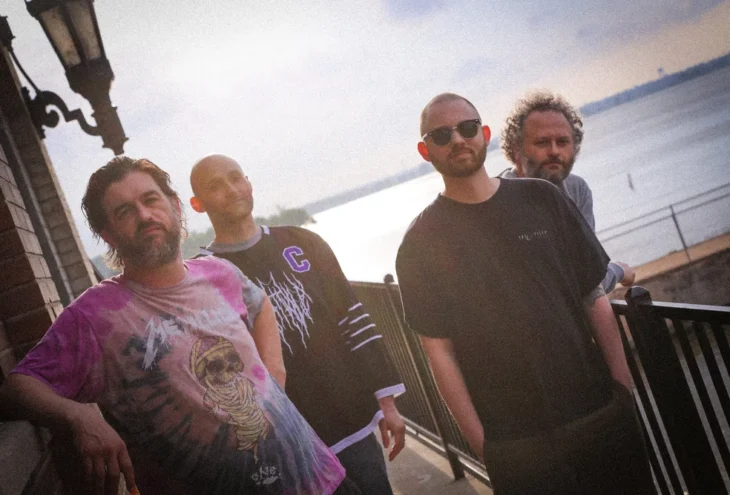
The Members: Raygun Busch, vocals; Luther Manhole, guitar; Stin, bass; Cap'n Ron, drums.
Produced by: Chat Pile
Engineered by: Stin and Chat Pile
Mixed by: Ben Greenberg
Recorded at: Chat Pile’s HQ
Mastered by: Ben Greenberg
The Origin: Tinkering with industrial-grade abrasions and viscous, sludgy hardcore sounds, Oklahoma City’s Chat Pile creates dissonant arrangements that churn alongside thoughts of isolation and existential dread — extracting heaps of broken images from the toxic wasteland of the modern-day human experience through a fractured, disillusioned lens. This distinct perspective initially bored through a few basement-born projects in the heartland’s tight-knit clandestine noise scene; however, it wasn't until Raygun Busch, Luther Manhole, and brothers Stin and Cap'n Ron finally united that they unearthed the dark core of their unsettling songs and somber psychological visions.
Their impact was immediate. Blasting forth a spew of corrosive sounds onto an unsuspecting world after a couple of early EPs, Chat Pile hijacked the heavy underground with their critically acclaimed, dread-infused debut God’s Country (2022) and the bleak undertones of Cool World (2024), which arrived in quick succession. This initial assault — bolstered by their indie film score for Tenkiller and In the Earth Again (2025), a collaborative LP with fellow Oklahoman and guitarist Hayden Pedigo — drove a definitive wrench into the traditional extreme music scenes and opened up a vital new vein of seismic dissonance.
Now, with Chat Pile being spoken of alongside Oklahoma’s iconic lineage of non-traditional musicians, including the kaleidoscopic psychedelia of The Flaming Lips and the art-damaged rot of Debris’ — bassist Stin explains the mechanics of how they excavate their punishing sonics on their recent release, Who Loves the Sun, and shines a bit of light into their creative netherworld.
The Production: Preferring to bypass the rigid time constraints of commercial facilities, Chat Pile retreats into their private HQ studio to handle their entire creative cycle—crafting songs from the early writing and demoing phases straight through to cutting the final tracks. This cloistered environment grants them uncompromised autonomy, a self-directed approach that allows them to create art on their own terms. Bassist Stin explains:
“The most important factor for us is that we can take our time and mess around as much as we want without being on anyone else’s clock or anyone’s watchful eye. We can goof around with all kinds of ideas, make plenty of mistakes, and get uncomfortably vulnerable without the inconvenience of having witnesses.” Stin adds, “It also means we can stretch the creation and recording of ideas over the span of months if we so choose, opening up creative opportunities that may not reveal themselves right away.”
Yet, this artistic autonomy is far from a relaxing retreat; exhuming ideas across an open-ended timeline can often prolong a grueling but deeply rewarding collaborative songwriting process.
“The real friction and excitement for us happens in the writing process where we bang our heads against the wall—and each other—for months at a time until the songs are finished. There’s no singular songwriter in the band, and that means molding ideas into a finished package is a cortisol-heavy journey requiring constant debate and examination.”
When Chat Pile’s exhaustive tune smithing wraps, they return to their recording space to workshop the demos and record the definitive takes.
“Our workflow has pretty much stayed the same since day one,” Stin notes about the multi-phase process. “Luther and [I] bring riffs into the studio/practice space and jam on them with Ron until they become a complete song. Each song requires multiple sessions (sometimes spanning months) to get right. We record the progress of each session, listen back, and make adjustments as needed. Once the instrumental is complete, we give Raygun the finished recorded demo, which he uses to write his vocal parts. We’ll demo his vocals and do that over-and-over until we have an album’s worth of songs.”
With the dark soundscapes heard in their heads successfully laid down, the band shifts focus to cut the official album tracks. This requires switching gears into a completely different mental space—approaching the live tracking as a sharp, highly disciplined performance.
“By the time we are at the final recording phase, there is essentially no spontaneity,” Stin explains. “Then it’s time to actually rerecord all the songs, which we do live sans vocals. We throw on some guitar overdubs, vocals, and then an album eventually emerges. We do track the primary elements of the song live and won’t settle until we get a perfect take. This is where the magic and intensity of our recordings come from. Perhaps most importantly though, we NEVER use a click track!”
When asked how they ultimately know when they have successfully nailed a performance, Stin points to an instinct that goes far beyond mere technical perfection.
“It’s most definitely a combination of all three,” Stin says of technical precision, atmosphere, and gut feeling. “First and foremost, we have to use a take where nobody messed up their parts, but once we collect a few of those, we’re able to listen back and choose which one has the most juice. Often, you just know—everyone in the room will look at each other with excitement, and you know you can move on.”
To construct these harrowing songs into their final form, Chat Pile relies on a highly consistent toolkit. Rather than chasing endless trends, they maintain a utilitarian setup that leans directly into massive, sludge-industrialized sounds. Stin breaks down their core bassline gear:
“On the gear side of things, we’ve more or less used the same basic components on every recording. For bass, it’s a Peavey T-40 run through a Rusty Box, recorded through a 4x10 cab. Guitar is a baritone (primarily a Music Man Axis) run through an Ampeg V4 for primary tracking and a Fender Super Six for overdubs. Perhaps our secret weapon is the use of an e-kit for drums that triggers MIDI samples in the DAW. This makes it easy for us to record in our home studio setup and gives the songs their industrial-sounding edge.”
While this setup remains tried and true, capturing the crushing, physical presence of their latest material required a few key tactical upgrades. Beyond stepping up their front-end, the band also expanded their microphone locker to include warmer textures into their sonic palette:
“For Who Loves the Sun, we splurged a bit and bought a Neve 88M interface, which we used for guitar overdubs and vocals (we still just use a Scarlett 8 input interface for the live takes). I also picked up a Beyerdynamic M160 and M88, which we used on guitar and bass respectively. Up until now, we’ve relied on SM57s and HEAVILY on a couple of Shure SM27s, all of which are still in the mix.”
Yet, managing these distinct, heavy layers of sound eventually proved to be an arduous, sanity-stretching task for Stin, who handled all mixing duties up through God’s Country. To survive the punishing process of balancing Chat Pile’s intense sonics, the band handed over the faders to mixer Ben Greenberg—allowing Stin to step back and let an impartial third party check their work.
“I mixed everything from the first EP up to and including God’s Country but have outsourced the job to Ben Greenberg on the last two albums to help retain my sanity,” Stin admits. “The real answer is that I don’t really know what I’m doing, and I just kind of move stuff around until it sounds right to me. The ONLY effects I use are simple compression and EQ. The fewer factors you introduce, the easier life becomes.”
Ultimately, this handoff allowed the band to preserve their core philosophy: stripping away superfluous studio production to ensure their most brutal elements could break out, allowing listeners to hear their punishing sonics on their own terms.
Photo Credit: Ryan Lawson