In an era when a laptop can summon virtually any synthesizer ever made and give you several hundred more options before breakfast, Wayne Taylor is more interested in what happens when you simply stop adding things.
As Tomorrow The Cure, Taylor creates sparse, atmospheric electronic music built around analogue synthesis, tactile performance and the occasional beauty of leaving a little room between the notes. He is also the guitarist for U.K. doom-metal band Warning, but his electronic work takes a decidedly different route: minimal arrangements, carefully sculpted tones and a deep appreciation for the machines making the noise.
Taylor’s relationship with synthesis began long before he settled into his current analogue-focused approach. Growing up, he was drawn to electronic music through the synthpop of the era as well as film and television scores—particularly Doctor Who—before discovering artists including Gary Numan, the BBC Radiophonic Workshop, Klaus Schulze and Tangerine Dream.
But when Taylor began seriously experimenting with electronic music, the hardware he wanted was largely out of reach. He turned to software instead.
"Throughout the '90s I’d developed a fascination with the instruments used in early British synthpop and the BBC Radiophonic Workshop, music that haunted my childhood," he says. "I didn’t have the money to buy, or the means to record such gear, so in 2001 I bought a basic recording PC, and for the next few years used software simulations of those old synths, just as a means to an end. The soft synths really impressed me, but I still just wanted the physical interaction, character and authenticity of genuine analogue hardware. After several years of arguing with computer screens and mouse-induced RSI, I couldn’t wait to get away from the PC. When I finally did I felt much more connected to the creative process, more interested in the sounds in isolation and giving them space, more eager to control them manually and in real-time like a conventional instrument, and gravitated towards more minimal music—doing more with less.”
That philosophy has become central to Taylor’s work. Rather than treating a synthesizer as an endless warehouse of sounds, he approaches it more like an instrument—something to be physically played, manipulated, and responded to in real time.
"I love the tactile, direct interaction with real analogue synths and the sounds they produce," Taylor says. "Knowing it’s the same old technology; electricity passing through primitive circuits, there’s an authenticity to it, and its character is perfectly imperfect."
That last part is particularly important. For Taylor, the quirks of analogue circuitry aren't flaws to be digitally corrected; they're part of the personality. His music embraces the small variations and imperfections that can make electronic sounds feel less sterile and more alive.
You can hear that philosophy across releases such as Two Voices and Grey Days & Old Ways. Two Voices, released in 2022, was created entirely with Taylor’s AJH Synth Eurorack system, while his broader Dreams Of Wires catalog has explored everything from vintage-inspired electronic textures to sci-fi and horror soundtrack atmospheres. His Sounds of Wires recordings, for example, were performed in real time using between one and four analogue monophonic synth voices, with the sounds created from scratch rather than relying on samples.
That restraint is hardly accidental. Taylor traces his love of minimal synthesis back to the early electronic music that first captivated him. The comparatively primitive EMS Synthi VCS3, in particular, helped shape his belief that a synthesizer didn't need to be surrounded by layers upon layers of other equipment to make something compelling.
"Some of my favorite pieces were done in the early ‘70s on an old EMS Synthi VCS3—a tiny little thing compared to other synths at the time," he explains. "This device was primitive by modern standards, but it inspired me to appreciate the sounds of analog synths on their own, rather than having loads of synths and stacking them on top of each other."
That mindset eventually led Taylor to Eurorack. He began building his own modular system in the late 2000s, gradually accumulating equipment before discovering AJH Synth. The meeting of Taylor's musical philosophy and the company's approach to modular synthesis proved to be a particularly good fit.
"Once I landed on the AJH stuff I never looked back," he says. "These instruments totally hit the nail on the head of what I wanted in terms of sound and physical form."
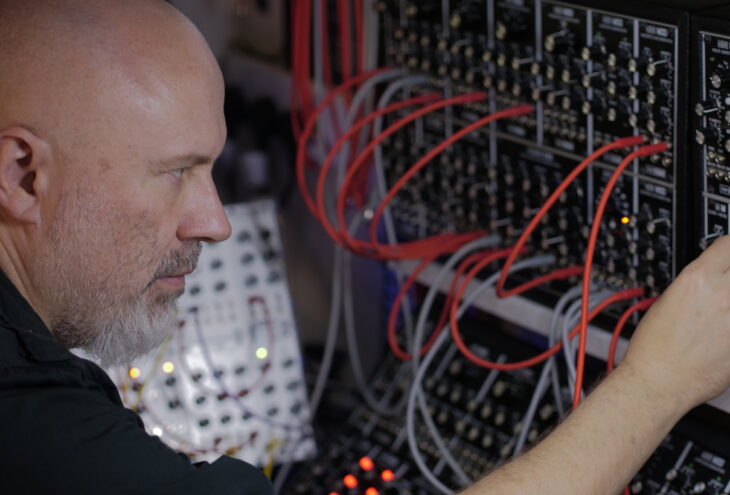
Taylor particularly appreciates the way the modules are laid out for hands-on use, allowing the controls to remain accessible while keeping the patching connections out of the way. In other words, the hardware encourages experimentation rather than turning the creative process into an exercise in menu navigation.
The sound itself, naturally, is the bigger draw.
"At the core of why I like these AJH Synth instruments is the raw sounds that they make," Taylor says. "I like to give these sounds more space in my compositions. Very often I’ll use just two or three voices. I like to keep things simple, and I like the concept of ‘less is more’ and 'doing more with less."
Among Taylor’s preferred AJH pieces are the Vintage Transistor Core VCO, inspired by the oscillator design of the original R.A. Moog Minimoog Model D, along with the Transistor Ladder Filter, Gemini 2412 Filter and Ring SM. His One System release is a particularly direct example of what he can accomplish with the AJH ecosystem, featuring recordings made exclusively with the system and ranging from real-time patch performances to multi-tracked compositions.
Taylor's relationship with AJH Synth has also extended beyond simply using the instruments. He has developed a friendship with founder and lead designer Allan Hall, whose approach to vintage-inspired circuitry resonates with Taylor's own obsession with extracting as much musical possibility as possible from relatively straightforward technology.
"Allan loves this stuff and is very passionate about it," Taylor says. "He will take old designs, then open them up into so many ways they can be interacted with and used."
The result is a modular system that Taylor says feels less like a pile of individual instruments and more like a single, evolving musical ecosystem. Each new module is designed to work with what came before it, both physically and sonically, giving Taylor more ways to manipulate the sounds already at his fingertips.
That sense of continuity is also apparent in his approach to composition. Taylor isn't chasing maximalism. If anything, he seems suspicious of it. In a culture of infinite plugins, endless presets and increasingly sophisticated digital tools, his work asks a much simpler question: What happens if you give one sound enough attention?
Quite a lot, as it turns out.
Taylor's DreamsOfWires YouTube channel has spent more than 15 years documenting that answer through gear demonstrations, performances and musical experiments. AJH Synth itself has highlighted Taylor's work, including demonstrations of its MiniMod system and a live performance at Superbooth.
For anyone interested in hearing the philosophy rather than simply reading about it, Taylor's music offers a useful place to start. His Two Voices project is perhaps the most literal expression of the idea: five tracks created in real time using two monophonic analogue synth voices. The recordings were made with an AJH Synth Eurorack system, emphasizing performance and sound over polished studio perfection.
And maybe that's the larger appeal of Tomorrow The Cure. In a world where technology keeps making it easier to do more, Taylor has found something creatively liberating in doing less. A couple of oscillators, some circuitry, a pair of hands, and enough patience to let a sound breathe can still go a surprisingly long way.