Trends come and go in the studio, but trust is harder to replace. For veteran engineer Tom Gordon, that trust has been earned over decades—and it still points back to the same place: KRK monitors. While the industry continues to reinvent itself, Gordon’s approach proves that the right foundation doesn’t need to change.
For nearly three decades, Gordon—Co-Founder and Chief Engineer of Imirage SoundLab in Reno—has built a career that spans iconic rock releases, major-label collaborations, and the mentorship of aspiring audio professionals. Through it all, KRK has served as a constant in his control room, anchoring his work with a sound he knows inside and out.
Gordon’s résumé reads like a cross-section of modern music history. From working closely with David Coverdale as Chief Engineer for Whitesnake’s Hook City Studio to contributing to 11 anniversary box sets from the band’s catalog, his experience runs deep. His client list stretches even further, including names like Ozzy Osbourne, Dr. Dre, Boyz II Men, The Beach Boys, Willie Nelson, Merle Haggard, Collective Soul, Creedence Clearwater Revival, Bruce Dickinson, and even Milli Vanilli’s comeback project—a testament to both his versatility and longevity in the field.
At the center of Gordon’s workflow is Imirage SoundLab, Nevada’s longest-running commercial recording studio, where he continues to balance high-level production work with education. As an instructor in Recording Arts at the University of Nevada, Reno, Gordon isn’t just shaping records, he’s shaping the engineers who will make them.
That dual role makes reliability non-negotiable.
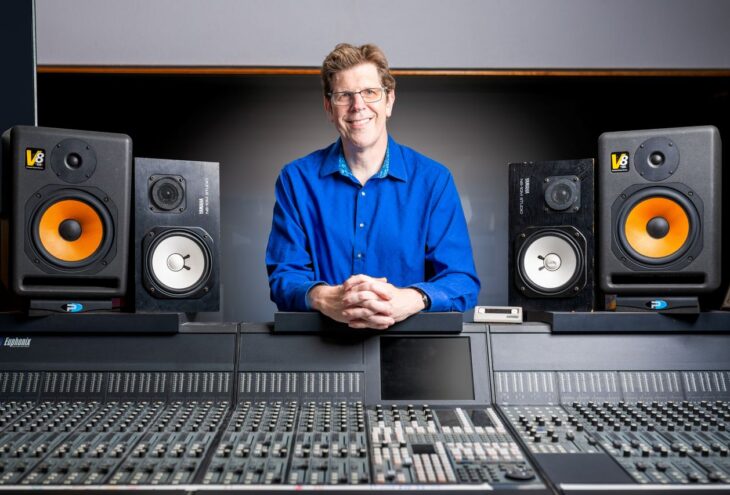
Gordon’s relationship with KRK dates back to the company’s early passive monitor days, long before the now widely recognized V-Series became a staple in studios worldwide. By the early 2000s, he had fully embraced the line, and today his setup incorporates multiple generations of V-Series monitors alongside KRK subwoofers, supporting everything from stereo mixes to custom 5.1 surround environments.
His reasoning is simple—and rooted in experience.
“I've relied on KRK V-Series monitors for more than two decades because they consistently deliver a sound I can trust,” Gordon says. “Whether I'm teaching the next generation of engineers or mixing commercial releases for artists, the V-Series provides the clarity, translation, and long-term listening comfort I need. That confidence allows me to make critical mix decisions knowing they'll translate well in the real world.”
That idea of “translation”—how a mix sounds across different playback systems—remains one of the most elusive goals in audio engineering. For Gordon, it’s also where KRK continues to prove its value. When decisions made in the studio hold up everywhere from car speakers to streaming platforms, it’s not just a win for the engineer, it’s a win for the artist.