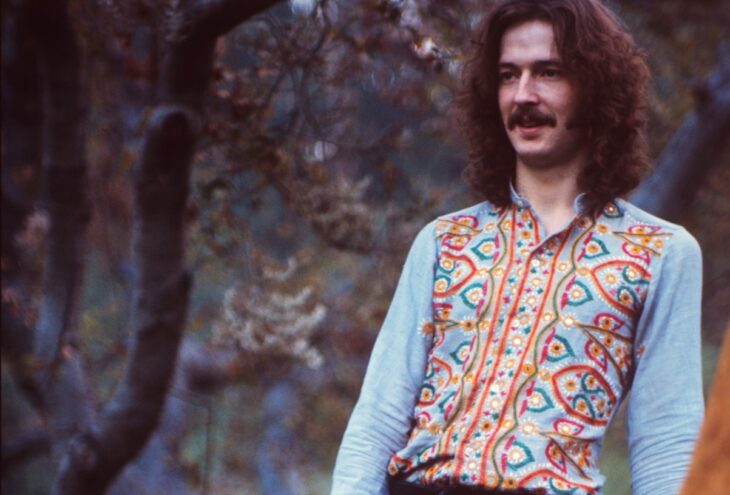
Cream’s 1968 album, Wheels of Fire, will be receiving a Super Deluxe Edition chronicling the full creation and fruition of the supergroup’s—Eric Clapton, Ginger Baker and Jack Bruce—groundbreaking third album.
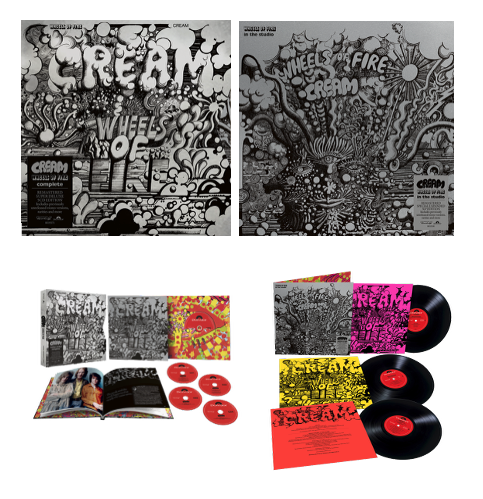
The expanded title, to be released on 5-CDs on June 12, 2026, via Polydor/UMe, features newly remastered mono and stereo versions of the studio album, live performances, and 15 rare recordings, nine of which are previously unreleased.
“All rock lovers will be happy as Cream and the Jimi Hendrix Experience represent the guitar-bass-drums band concept at its absolute apex,” proclaims poet and writer Dr. James Cushing. “Both artists were at their best in concert, and attain levels of improvisation that are the equal of almost any jazz trio at the time. Cream were and are the first and greatest ‘jam band,’ it’s worthwhile to think about how much composition figured into the band’s legacy. Part of what made Cream unique was their three intertwined identities: they were a psychedelic ‘stealth-jazz’ jam band, a blues band, and a British art-song band all in one.”
A Polydor/UMe announcement describes the package:
“The set includes a special, newly remastered stereo version of the nine-track studio portion of Wheels Of Fire. Originally released in 1968 utilising CSG processed recordings, this remastered, de-CSG’d version now presents the album phase corrected, delivering the recordings with greater detail and a crisp soundstage. Also included are newly remastered mono and stereo versions of the studio album. Sourced from the late Cream producer Felix Pappalardi’s personal reference reels, these recordings have never been released before and include many alternate mixes. The collection features remastered versions of the four live tracks recorded in March 1968 and originally released on LP2 of Wheels of Fire, alongside eight additional tracks performed at the March 1968 concerts, including an unreleased live recording of “We’re Going Wrong”, recorded on 10th March 1968 at Winterland Ballroom.
“A newly compiled rarities collection is also included, featuring 15 rare recordings, nine of which are previously unreleased. This collection includes early versions, alternate mixes and single versions. Highlights include WHITE ROOM (EARLY VERSION MONO MIX), DESERTED CITIES OF THE HEART (MONO ROUGH MIX / NO STRINGS) and CROSSROADS (MONO SINGLE VERSION), alongside seven additional alternate stereo and mono mixes, three single versions and two rare live recordings.
“The set is completed with a hardcover book featuring sleeve notes by Jim Faber and photographs of Cream from the era. The five CDs are housed in a gatefold sleeve and, together with the book, are enclosed within a rigid slipcase with a silver lamination finish.”
On June 14th 1968, Cream released their third album, Wheels of Fire, which captured the creative zenith of one of the most impactful bands in music history in a single studio record and another, including an incendiary live set. Twenty-six days later, they announced their demise. At that point, the album hadn’t even been released in the group’s native U.K. Another two weeks would pass before that happened…
Almost 60 years later, the album is being reissued in a lavish package, including, for the first time, the original Mono tapes, thought lost for decades, outtakes, alternate mixes, live tracks, and a newly restored stereo version that removes the Haeco-CSG* process applied to the album in 1968, which blurred the original stereo image.
Cream was a highly influential British rock power trio formed in London in 1966, widely regarded as the world's first supergroup. The band was composed of three virtuosos who were considered the ‘cream’ of London’s musicians: Jack Bruce, bass & lead vocals, Eric Clapton on guitar & vocals, and Ginger Baker on drums & vocals. The three had already achieved success in other prominent groups, including The Yardbirds, John Mayall’s Bluesbreakers, Manfred Mann and The Graham Bond Organisation.
The band’s first two albums, Fresh Cream (1966) and Disraeli Gears (1967), were instant hits with the latter reaching the top five on both sides of the Atlantic, meaning that expectations were high for Wheels of Fire. The album was released in the US by Atco on June 14, 1968, with a UK release on Polydor following on August 9. It was a blockbuster success straight away, charting at No. 3 in the United Kingdom and No. 1 in the United States, Canada and Australia, becoming the world's first platinum-selling double album. However, on July 10, the band announced it would split by the end of the year, citing a loss of direction. Rock fans were very unhappy hearing this news.
The Polydor/UMe media news provide further details of this buried audio treasure.
“The new super deluxe edition of Wheels of Fire includes producer and multi-instrumentalist Felix Pappalardi’s reference tapes, which were thought lost forever, offering a unique look at the evolution of the studio tracks.
“In the mid-’60s, Felix Pappalardi and his wife, Gail, rented a carriage house on McDougal Alley in New York City’s Greenwich Village just around the corner from what would later become Electric Lady Studios. When the couple moved out of that space in the early ’70s, they left behind hundreds of open-reel tapes in a plastic bag, a cache thankfully salvaged by the woman who rented them the space. In that bag were scores of tapes, including those of the Youngbloods, whom Pappalardi had produced, as well as key parts of his work with Cream.
“A seasoned collector named Kore Yoors heard about the Cream tapes about two decades ago, acquired them, and brought them to the attention of Larry Yelen, producer of the Grammy-nominated Eric Clapton: Life in 12 Bars, a pre-eminent Clapton historian and Archival Producer for numerous music documentaries. Together with Grammy Award-winning reissue producer Bill Levenson and British Grammy-nominated A&R expert Johnny Chandler, arrangements were made to purchase the tapes and subsequently have them transferred for inclusion in this project, which has been decades in the making.
“Studio sessions with Pappalardi began in July and August 1967 at IBC Studios in London, months before the release of Disraeli Gears, and continued in small bursts in the US in September, October & December 1967, finishing up in Spring 1968. The album's second disc included three live recordings from the Winterland Ballroom and one from the Fillmore. Clapton's second solo from ‘Crossroads’ has made it to the top 20 in multiple ‘greatest guitar solo’ lists. Even though the band would release one further album, 1969’s brief Goodbye, Wheels of Fire stands as the band’s creative peak and, along with their earlier albums, continues to inspire new generations of musicians with every passing year.
“Haeco-CSG was intended to make stereo recordings that were also fully compatible with mono playback equipment. The unfortunate side effect is that the CSG process “blurs” the stereo imaging. Using available digital audio processing software during mastering enabled the reversal of this Haeco-CSG effect.
“The 5CD box includes a hardcover book featuring sleeve notes by Jim Faber and photographs of Cream from that period. The CDs are housed in a gatefold sleeve, with the book, and are enclosed within a 10”x10” rigid slipcase with a silver lamination finish. The 180g black vinyl release in a gatefold sleeve, with a metallic Pantone finish.”
CREAM
WHEELS OF FIRE
5 CD SUPER DELUXE EDITION
CREAM
JACK BRUCE
Lead vocals, bass guitar, cello, harmonica, calliope, acoustic guitar, recorder
ERIC CLAPTON
Guitar and vocals
GINGER BAKER
Drums, percussion, bells, glockenspiel, timpani, spoken word on “Pressed Rat And Warthog”
With “In The Studio” FELIX PAPPALARDI
viola, organ pedals, trumpet, tonette, Swiss hand bells
“Seeing Cream at the Whisky A Go Go on September 4, 1967 in an intimate environment was a chance to experience, up close, one of the premier bands to emerge out of the English scene in the sixties,” underscored multi-instrumentalist, Chris Darrow. “By then I had seen the Yardbirds, with my favorite guitarist, Jeff Beck, at the Hullabaloo Club and Them at the Whisky A Go Go. The opening act to Cream at the Whisky, Things to Come, was a local group from Long Beach. Their drummer was Russ Kunkel. He and the bass player, Bryan Garofalo, were in John Stewart’s band when I joined his group in the late sixties.
“It was very exciting to see what was going on in England. The English Invasion, led by the Beatles, was the reason that most of us folk and bluegrass musicians had formed our own electric bands.
“The Whisky was an intimate place at that time and the stage was not that much higher than the dance floor. There was standing room only and the music was very loud, due to the Marshall stacks that Clapton and Bruce were playing.
“While the psychedelic scene was certainly most prevalent in California, hearing our music come back to us with songs like ‘Spoonful’ and ‘Rollin’ and Tumblin’’, through a non-American filter, changed the way we reacted back. They were familiar but somehow different. That was the hook.
“Talk about hooks, take Sunshine of Your Love; one of the best guitar hooks in the business. Cream raised the bar of rock “n’ roll at that time. However, their records never captured the raw essence that they showed as a live act.”
During 2016 I conducted an interview with acclaimed engineer, Bill Halverson who recorded Cream’s 1968 Fillmore Auditorium and Winterland Ballroom performances.
Halverson started his music career in 1961 as a trombone player in jazz big bands led by Allen Ferguson and Tex Beneke. Around the same time, he began working with the legendary Wally Heider as an assistant on remote recording projects. These occasional gigs turned into a steady job by 1965, allowing Bill to learn invaluable skills from Heider on live dates at L.A. area clubs and as a second engineer at Heider’s Hollywood recording studio. His credits included work in 1966, Live In 3 and 2/3/4 Time Don Ellis and in 1967 Beach Boys’ Wild Honey, Chuck Berry Live At The Fillmore Auditorium. Berry was backed by The Steve Miller Band. In 1967, The Monterey International Pop Festival, assisting Heider and Bones Howe record that weekend, and recorded Ravi Shankar. In 1968, he assisted in the recording of Johnny Cash Live at Folsom Prison.
“I did Chick Berry live at the Fillmore West in San Francisco before the June 1967 Monterey International Pop festival,” recalled Halverson in our 2016 interview.
“I met Wally when I was in high school. In 1960 I was in a high school all-star big band and we played the Monterey Jazz Festival in the summer of 1960. Wally came and recorded the band because he knew the adult director. We played Bill Holman arrangements. I was the bass trombone player. Wally and I kept up and I saw some of his sessions when he was at United. I was a horn player with the Tex Beneke band. Wally then gave me a job when he was opening studios on Selma and Cahuenga as a gofer towards the end of 1964. I helped out on the Johnny Rivers Live At The Whisky A Go Go album. I helped him do the Monterey Jazz Festival in 1966, and been to the venue. In 1966 my first credit was the Don Ellis big band. I got to assist Wally do Woody Herman. He then asked me to come to the Monterey International Pop Festival in 1967 as sort of his second engineer. In 1966 we did Otis Redding Live at The Whisky album. I had been a horn player and he let me mix the horns through an Ampex mixer.
“I was a big band guy, a vocal group guy in love with the Four Freshman and Hi Los, which really served me helping the Beach Boys and set me up for engineering the first Crosby, Stills and Nash album. My ’66 visual of the Whisky club, before it became the Whisky, it was the L.A. Conservatory of Music and we used the room as well downstairs for rehearsals. We also brought in the truck and equipment for the Beatles when they played at the Hollywood Bowl. By then, I had been around noise.”
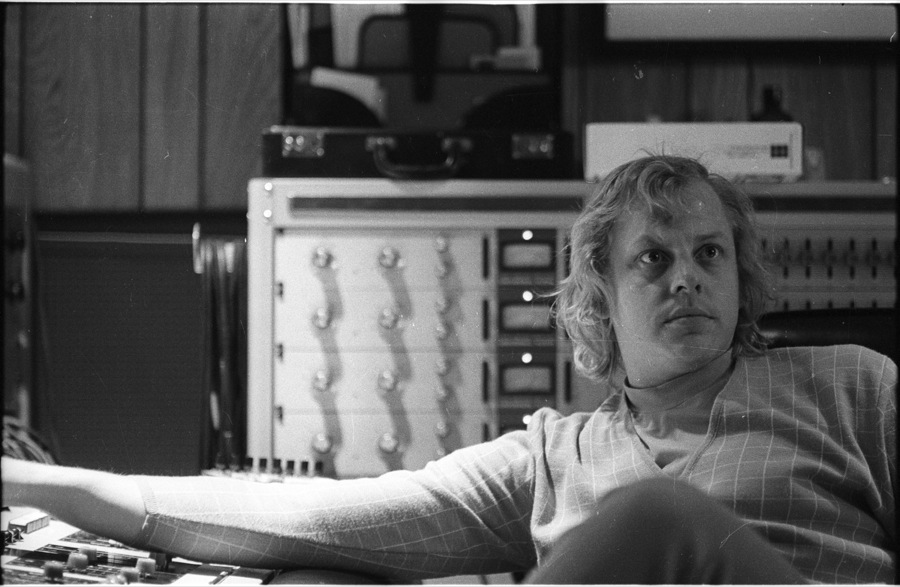
Halverson discussed the Monterey International Pop Festival in June 1967. He captured Cream’s 1968 live sets at the Fillmore Auditorium and the Winterland Ballroom.
“At the Monterey we used 4-track and the original console that he had in the mobile truck, when I first met Wally. It was in the trunk of his Cadillac with a trailer in the back, and he had this old dodge red truck. It was a 12 position Universal Audio Bill Putnam built console. By the time we did Cream Wheels of Fire live it was UA parts, 12- position, but Frank De Madeo assembled it together and it was a 4-track board. I got lucky when doing the Monterey live recording, and Chuck Berry live just before. Heider had some 5 46 Shure microphones, same mic as an SM 57, he had those because they were cheap. I used them on Chuck with Steve Miller as the backing band and it was the only time at the Fillmore that we sat up in the club in the dressing room. Lou Adler and John Phillips talked to Wally about Monterey and said it was a non-profit thing and no one is going to make any money. Wally did it for expenses and was really on a shoe string those first couple of years and what happened was when Cream’s Wheels of Fire went through the roof, then we were up there to San Francisco every other weekend from everybody from (Janis) Joplin to Jefferson Airplane. And then we started to charge and he made some money,” laughed Bill. “Heider was the engineer at Monterey Pop, except for Bones Howe doing The Association and The Mamas & Papas.
“Part of what I think helped Monterey and the guys who got the tapes later was Wally couldn’t stand Ampex tape and always used Scotch. Tapes from 40 years ago on 7 and a half reels I can still play without baking. He would use 201 tapes in recording but the 203 was the one that had 45 minutes on a reel because he would always stagger the machines so you could play for two hours and not miss anything. Scotch tape at 15 ips through a Frank De Medeo designed Bill Putnam components tube console.
“At Monterey there were no sound checks. We’re guessing. One act after another. I learned to guess pretty good. You sort of have an idea where they’re gonna be and you sort of zero it in the first couple of minutes of the first tune. And then the other thing Wally taught me is then you don’t make any radical moves ‘cause when you are mixing it you have to unradical the exact same spot. Which is impossible. So, you just ride heard on it unless something breaks and then you sit and fix it. The thing was that Shure made a wind screen that wasn’t very good. There are some of the vocal mikes at Monterey but we later did Johnny Cash Live At Folsom Prison and used a black foam one.
“The Monterey International Pop crowd was a completely different crowd than the Monterey Jazz festival. I hadn’t done the Haight Ashbury thing and all the light shows.
“At the time I was not too fond of the music yet, either,” admitted Halverson. “The thing that really changed me was doing Cream because that was a jazz band. In reality, it is a rock ‘n’ roll band but for me at that time it sounded like a jazz band just ‘cause of all the free form stuff. [Atlantic engineer/producer] Tom Dowd showed up and I thought he was gonna engineer it, and we set up for the sound check. They had had a real struggle with everything distorting when they tried to record them in England and New York. When I first opened up the mike on the amps it was distorting. I finally found this place by accident in between the four speakers of a Marshall stack where it was just up against the grill cloth. And it was clean. And the side benefit when we played it back was that Eric’s guitar sounded like it was in a separate room, ‘cause the four speakers acted like a baffle. Ginger Baker reminded me of a real good jazz drummer. He had two kick drums and all those cymbals and toms. Heider had a way of just putting a couple of Sony C-37 tube overhead and a couple of 5 46 on snare and hi hat and kicks. Heider also had this pair of Neumann 67 tube microphones that he had a knack for placing them for audience mikes but keeping them out of the way of the PA and doing that. I used those same 67’s at Fillmore and everywhere else for audience.
“[Music business insider/organizer] Alan Parisier was always around in 1968 and ‘69. He was the one who had the initial idea for the Monterey International Pop Festival. I knew he was an heir to something (Dixie Cups). He had the best sound system in town in his big A frame house up above Hollywood Blvd. Before Laurel Canyon. Nailed and hung from the ceiling were two Altec 604 E speakers that were identical to what we had in Heider’s studio. We’d go up there listening to mixes all the time.
“I engineered tracks on Cream’s ‘Badge’ at Heider studio 3 with Jack Bruce, Eric and George Harrison,” recalled Bill. “They overdubbed and mixed in England.”
At Heider, Harrison was trying brand-new equipment [prototype tester custom-made guitar box] that connected into a Leslie speaker. I heard George allegedly brought the item back to England and it’s utilized on the Beatles’ “Let It Be.” “Alan later got me the mix job with Delaney Bonnie & Friends with Eric and Harrison,” continued Halverson, “which later got me the gig of doing ‘Teasin’’ with King Curtis and Eric, which then led to me engineering the first Eric Clapton solo record at Village Recorder.”
David Kessel attended the 1968 Cream concert at the Inglewood Forum in Southern California. The guitarist/ producer of www.cavehollywood.com talked to me about Cream’s memorable booking. “Man, the Cream was really hot and on their game at this gig. I was in Thomas Starr King Junior High School in Los Angeles and was too young to get a driver’s license,” emphasized Kessel. “SOOOH, I enlisted my step-mother B J Baker (a top vocal contractor and background singer on numerous records) to drive me to the gig. My brother Dan immediately said ‘I’m going’ and my step-mom said to my surprise ‘Let’s all three, go.’ She was a hipster and always interested in what kind of music, groups, and artists we were into. We took her to see the Cramps at the Masque Punk club in Hollywood years later. Being from a jazz influenced family [jazz guitarist/record producer Barney Kessel], we were viewing the Cream from several perspectives. They were straddling the line between power blues and an attempt at jazz for the audience. Jack Bruce performing ‘Train Time’ with his real heavy harmonica playing and then Ginger Baker doing ‘Toad’ was quite dramatic live. Ginger flipped his emerald head scarf off to reveal all this red hair while he’s going nuts on the drums. Eric Clapton was totally on that night. Cream that evening was peaking as a band.”
(Harvey Kubernik is the author of 21 books, including 2009’s Canyon Of Dreams: The Magic And The Music Of Laurel Canyon, 2014’s Turn Up The Radio! Rock, Pop and Roll In Los Angeles 1956-1972, 2015's Every Body Knows: Leonard Cohen, 2016's Heart of Gold Neil Young and 2017's 1967: A Complete Rock Music History of the Summer of Love. Sterling/Barnes and Noble in 2018 published Harvey and Kenneth Kubernik’s The Story Of The Band: From Big Pink To The Last Waltz. In 2021 they collaborated on Jimi Hendrix: Voodoo Child for Sterling/Barnes and Noble.
Otherworld Cottage Industries in 2020 published Harvey’s Docs That Rock, Music That Matters. His Screen Gems: (Pop Music Documentaries and Rock ‘n’ Roll TV Scenes) was published in February 2026 by BearManor Media. Kubernik is currently researching a book on the Beatles for a UK publisher with a 2027 publication.
Harvey spoke at the special hearings in 2006 initiated by the Library of Congress held in Hollywood, California, discussing archiving practices and audiotape preservation. In 2017, he appeared at the Rock & Roll Hall of Fame in Cleveland, Ohio, in its Distinguished Speakers Series and as a panelist discussing the forty-fifth anniversary of The Last Waltz at the Grammy Museum in Los Angeles in 2023. Harvey was an interview subject with Iggy Pop, the Beach Boys’ Bruce Johnston, Love’s Johnny Echols, the Bangles' Susanna Hoffs, Victoria and Debbi Peterson, and the founding members of the Seeds for director/producer Neil Norman’s documentary The Seeds: Pushin' Too Hard. During summer 2026, GNP Crescendo is planning to release a DVD/Blu-ray. Author Miss Pamela Des Barres narrates).
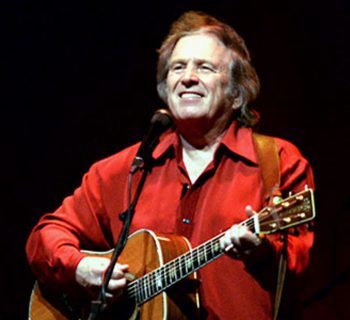
Eric Clapton photo by Henry Diltz, Courtesy of Gary Strobl at the Diltz Archive
Bill Halverson photo by Henry Diltz, Courtesy of Gary Strobl at the Diltz Archive
Album cover Courtesy of UMe