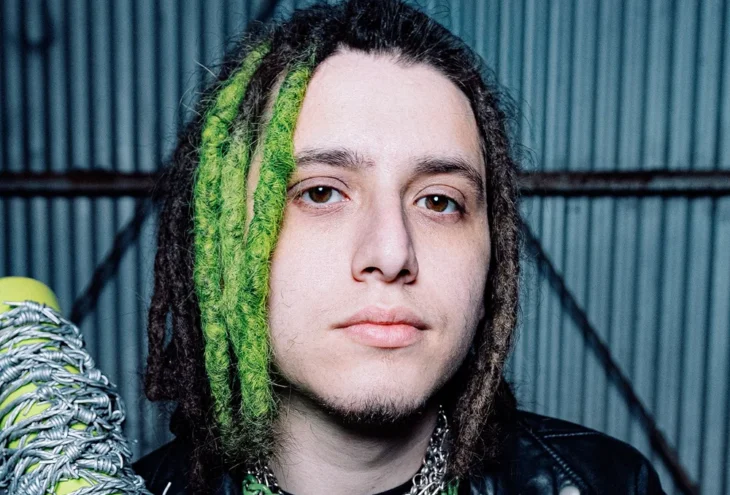
The Artist & Storyteller: AyoDylan
The Song: Jangly and sun-bleached, Elevator Fight Club’s alt-rock track “Emma Stone” casts a bright light on South Florida’s music scene, its sentimental surfer-rock and straight-ahead sonics carrying listeners on a cross-country drive from the Atlantic to the Pacific.
The Background: Finding his footing in the humid sprawl of Florida’s coastal music corridors, AyoDylan began carving out a career within the modern DIY, algorithmic-driven ecosystem — one powered by savvy internet self-promotion. After establishing an early baseline with the pop-punk single “California’s Cold,” the alt-rocker began gaining traction across social platforms and streaming services.
The following year, that moment expanded into millions of views online as he built an unpretentious persona through comedic sketches such as the viral “emo-Hooters” concept, where goth-punk aesthetics turn the tables on chain restaurant Americana. Alongside the humor, his music developed a parallel identity, using pop-culture shorthand in viral tracks ranging from “Betty White” and “Monster Energy Girls” to “Billie Joe” and “Kurt Cobain (Play It Faster).” These songs compress decades of mainstream nostalgia into rock-ready internet anthems with a sense of alt-rock mythology.
Beyond the algorithmic visibility, AyoDylan’s trajectory reflects a larger tension in modern music culture: the gap between digital reach and physical scene-making. While platforms can amplify attention en masse, tangible, in-person connection remains a stronghold for longevity.
This physical presence matters. Even as the digital landscape evolves, the real-life support between bands — and the resulting crossover of their fanbases— is what helps cement artists’ staying power. It creates a kinetic, physical energy that neither the traditional industry pipelines nor the algorithm can manufacture.
From the grunge underground of Seattle to the hip-hop laboratories of Atlanta, regional music ecosystems form when artists recognize themselves in one another’s work before the industry ever takes notice. In Minnesota, that dynamic famously crystallized around Prince and the Minneapolis Sound — a movement that launched Morris Day & The Time and producers Jimmy Jam and Terry Lewis, shaping a generation of artists; in California’s East Bay, it catalyzed bands from Operation Ivy and Rancid to Green Day. Scenes tend to thrive not simply through breakout stars, but through artists existing in orbit around one another — pushing, inspiring, and quietly competing as their identities take shape.
As AyoDylan moves forward with his new EP Knuckle Head (April 15, 2026), he continues blending pop-cultural shorthand with alt-rock aesthetics — such as “Chris Joslin” and “Jane from Breaking Bad” — while remaining acutely aware that it was the authentic Florida coastal scene, and the music it produced, that has stayed with him.
The Story: For AyoDylan, having a strange obsession with bands that haven’t made it yet is part of that early spark — a nostalgic time where music exists without expectation, before success has been defined or measured.
“It's like you can hear the hopes and dreams and know that this music was made fully from the heart.” He explains, “When I heard ‘Emma Stone’ for the first time in 2018, it changed my life. ‘It’s like an indie vibe? Maybe just alt?’ I don't know, but it just sounds like after school, with the windows down to me.”
That feeling for AyoDylan didn’t stay passive; it became embedded in his process. “I force every producer I work with to listen to it. It's even the reason I name so many songs after people,” AyoDylan says. “It was just so different from anything I was used to hearing — it wasn't overly poetic. They referenced things from the real world and didn't disguise the meaning too much. You knew what the song was about the whole time. Which I appreciated and tried to bring that element into my own music.”
For AyoDylan, that candor became his manifesto. While he had mostly seen that transparency in hip-hop and rap, hearing it in an indie context changed his approach to songwriting — favoring observational storytelling over layered emotion. He connects the music to something more tangible: proximity. Elevator Fight Club felt less like distant idols and more like fellow young musicians embedded in the same Florida scene.
“They made music that could ONLY be made by a group of small-town high school kids,” he says. “You can't recreate that if you are not currently living that.”
The band remains an enduring reference point for him — a memory of young kids listening to music on a joyride, and an early inspiration. AyoDylan summarizes, “They were the big dogs in my first music scene. It opened the door to everything, and I’ll always see them that way.”
While music scenes are less visible online than in real life, they remain vital in the rehearsal spaces, local venues, and house shows where artists consistently show up for one another. This mutual presence builds camaraderie and reinforces the desire to keep creating. From AyoDylan’s vantage, Elevator Fight Club’s appeal reinforces a core truth: music loses its power when it becomes fully detached from the people and places that shaped it.
Photo Credit: Bobby Keegan