Cat’s Cradle Carrboro, NC
Contact: windjack@birthdaycakemedia.com
Web: leithross.com
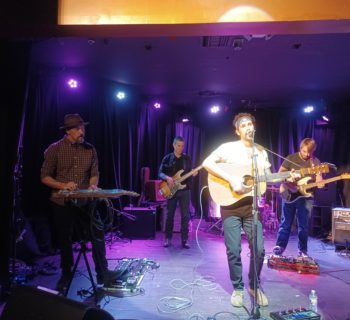
Players: Leith Ross, guitars, vocals; Keiran Placatka, keys; Soona Lee-Tolley, guitar; Zoe Sparks, bass; Vania Lee, drums
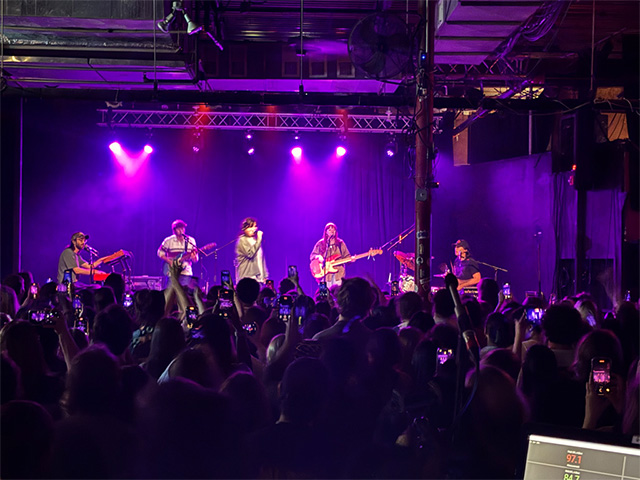
It’s a strangely heroic thing to stand on the wide stage at The Cat’s Cradle, stare into a sold-out room of 700+ true believers, and keep a straight face while assuming—rightly—that everyone in the audience is quietly in on the same joke. But for Leith Ross, the childlike, preternaturally calm 27-year-old singer-songwriter who’s androgynous, age-neutral aura radiates both bedroom vulnerability and cosmic ambiguity, the moment seemed effortless.
Their presence alone sparked a blend of love, adoration, affection, and a soft-focus reverence reminiscent of a boutique-era Beatlemania, now refracted through modern queer-pop tenderness.
Ross opened the evening backed by an ensemble as visually and energetically neutral as Ross themself, drifting directly into a four-song haze “POV,” “Treasure,” “Stay,” and “Terrified.” Each transition was softened by Ross’ hesitant, shy stage banter, as though they were still surprised to find themselves in command of a room that had already devoted itself completely to them. The band, understated yet tightly rehearsed, followed through as Ross moved into the next run of songs, weaving the dreamy “What My Love Is For” into the delightfully off-kilter “Love Watching You Eat Dinner,” then easing the spotlight into a mid-set solo acoustic section.
This shift, which could have exposed Ross’ modest guitar technique, instead became one of the night’s most luminous moments. In a landscape packed with self-focused confessionals, Ross delivered theirs with a sincerity that felt unforced and quietly devastating. The songs flowed one into the next “I’d Have to Think About It,” the beautifully rendered “I Will,” and then “What Are U Thinking About,” “Alone,” and “Grieving”—each one unfolding like a new page in the same diary, each sung with a soft, unguarded honesty that pulled the entire room closer.
By the time Ross reached “I Can See the Future,” the audience was fully suspended in their world. Hands lifted in a gentle wave, voices rose to meet Ross’ own, and the entire room seemed to float on the same wavelength. When the lights finally came up, there was no rush for the exits. Instead, the crowd drifted outward slowly, almost ceremonially
Musically, the night demonstrated how far a carefully arranged ensemble of modestly skilled players can go when unified around a central voice. Ross’ guitarist, initially almost indifferent in approach, evolved over the course of the set, unveiling a series of elegant, lightly improvised solos that became unexpected highlights.
In the end, Leith Ross didn’t simply perform—she conducted a soft-pop séance, drawing hundreds of people into a shared emotional current for the better part of an hour. It was thoughtful, unexpectedly polished, and quietly transcendent—a demonstration of how small, deeply personal songs can expand to fill an entire room with light.