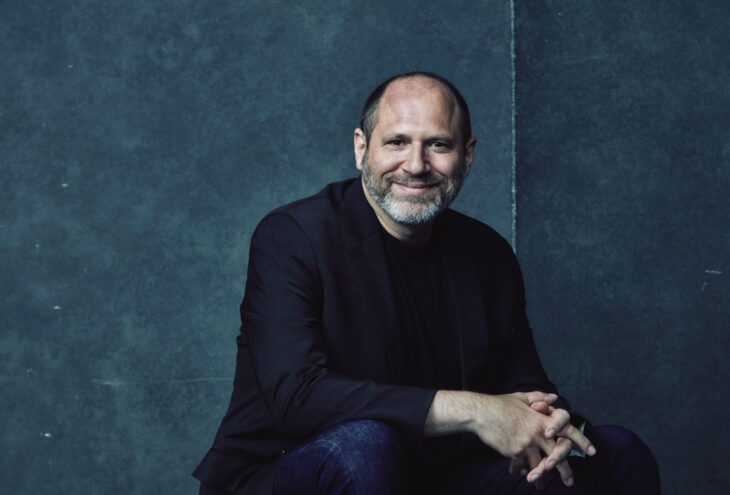
Exposed to music at the highest level from an early age, with his grandfather serving as accompanist to cellist Gregor Piatigorski (and later the Dean of the Berkshire Music Center), and his grandmother a piano teacher at the Curtis Institute of Music, Hans Schuman was always encouraged to explore the arts. When he first asked his father for drum lessons, his dad agreed, on the condition that he also study the piano. While his time playing the piano was short-lived, looking back, Schuman appreciates the opportunity to learn the basics. Years later, the fundamentals came full circle after graduating from the Berklee College of Music.
“I graduated from Berklee, [moved] to New York, and just wanted to play. Someone I knew was friendly with a principal at a downtown Brooklyn high school [and] I was asked to do a little in-school event. I was looking for any gig possible,” says Schuman. “I brought jazz pianist Cyrus Chestnut and a bassist friend of mine and thought, ‘man, we’re gonna kill it, their minds are gonna be blown.’ It couldn’t have been more the opposite and it was somewhat humiliating. They couldn’t have been more disengaged.”
Confused as to how their performance could have been received so poorly, Schuman admits “it stayed with me.” He wrestled with how he might make jazz more palatable and relatable for the students. “It was the early ‘90s, the height of gangster rap popularity,” he says. “I didn’t feel like that music was necessarily uplifting, didn’t feel it necessarily reflected who we are and, by my definition of artistic excellence, it didn’t really meet the standard that represented anything of great substance. That has nothing to do with the genre, it just has to do with exposure.” Schuman continues, “I often make analogies between music and food: there’s nothing wrong with sugar and junk food in moderation, but if that’s all you’re getting and you have no information about nutrition, it’s going to be a tough road. I was 25 years old, young and idealistic, [thinking] there’s gotta be something I can do.”
Reading some of James Baldwin’s work at the time, Schuman was inspired by Baldwin’s commitment to the civil rights movement and his desire to use his talents for a higher purpose. Tennis legend (the first and only African-American male to win the singles title at Wimbledon) Arthur Ashe’s autobiography (Days of Grace) was also a big inspiration, with Ashe speaking of his influence beyond the court and wanting to contribute to society. “He used his platform for the betterment of society with regard to his preferred causes or concerns,” shares Schuman. “It rubbed off on me—this idea of using your skills or talents in ways that are of service in some way.”
With no money to get things started, Schuman chose to sell his grandmother’s Steinway piano. “I was 24 or 25 and I was broke. I’d spoken to a lawyer that specialized in starting not-for-profits and I needed Bylaws and the 501(c)(3) to get started. Some family members did write a check, and my grandmother had left me her Steinway. The Curtis Institute of Music is really unique. There’s no tuition and, at least back in the ‘30s when my grandmother [was there], every student that attends Curtis is gifted a grand piano. I don’t know if they still do that, but she was gifted this Steinway and kept that in her apartment her whole life. She taught at Curtis, but also had private students come to her apartment. When she passed, she left me the piano and my aunt and uncle paid for it to be shipped from Philadelphia to Brooklyn. I lived in a brownstone at the time, on the second and third floor, [with] a staircase that curves. Obviously, the instrument had great sentimental value to me, and I wanted to honor her in some way, but I thought, ‘okay, if the piano doesn’t make it around the corner, I can sell it.’ Needless to say, the piano would not make it up the curved staircase. That was her way of giving me her blessing,” concludes Schuman. While bittersweet, the rationale of using the proceeds for a non-profit music organization felt like a nod to her musical legacy, and the synchronicities didn’t end there.
“Friends in Brooklyn had a brownstone on the first floor, with a stoop that allowed the piano to be wheeled straight into the living room, using it as a sort of showroom,” Schuman continues. This was pre-internet, and selling things meant placing an advertisement in Sunday’s New York Times. “I ended up selling to this young husband and wife whose son was nine years old and a prodigy. This was to be his first serious instrument,” says Schuman. “The kid played for me and it was so beautiful. It was like the piano was reborn under his fingers. I know she [grandma] would not object to this at all.” With the proceeds of the sale, JazzReach was born.
Launching the non-profit was a challenge, having no experience starting or running a non-profit, or any administrative knowledge, but Schuman had a handful of great friends to lean on. A close friend since high school (and his college roommate) was the first development director for Jazz In The City in San Francisco (presenter of the San Francisco Jazz Festival), now known as SFJazz. Schuman received his help reading through grant samples, and helping to polish sponsor and donor request materials. The heaviest lift—outside of finances—was how to refine JazzReach’s programming and presentation for young audiences. Explains Schuman, “how do we meet them at their level without going too low [or] too high? I’d seen a lot of half-assed arts education presentations where the artist is speaking, they play a song, and then the leader of the group gets on the microphone…I didn’t want to be that. It’s like a default setting.” Introducing students to the power of live music, the organization provides a touring repertoire of engaging, high-quality jazz for students in grades four through 12, integrating the music of the Metta Quintet alongside live narration and video projections.
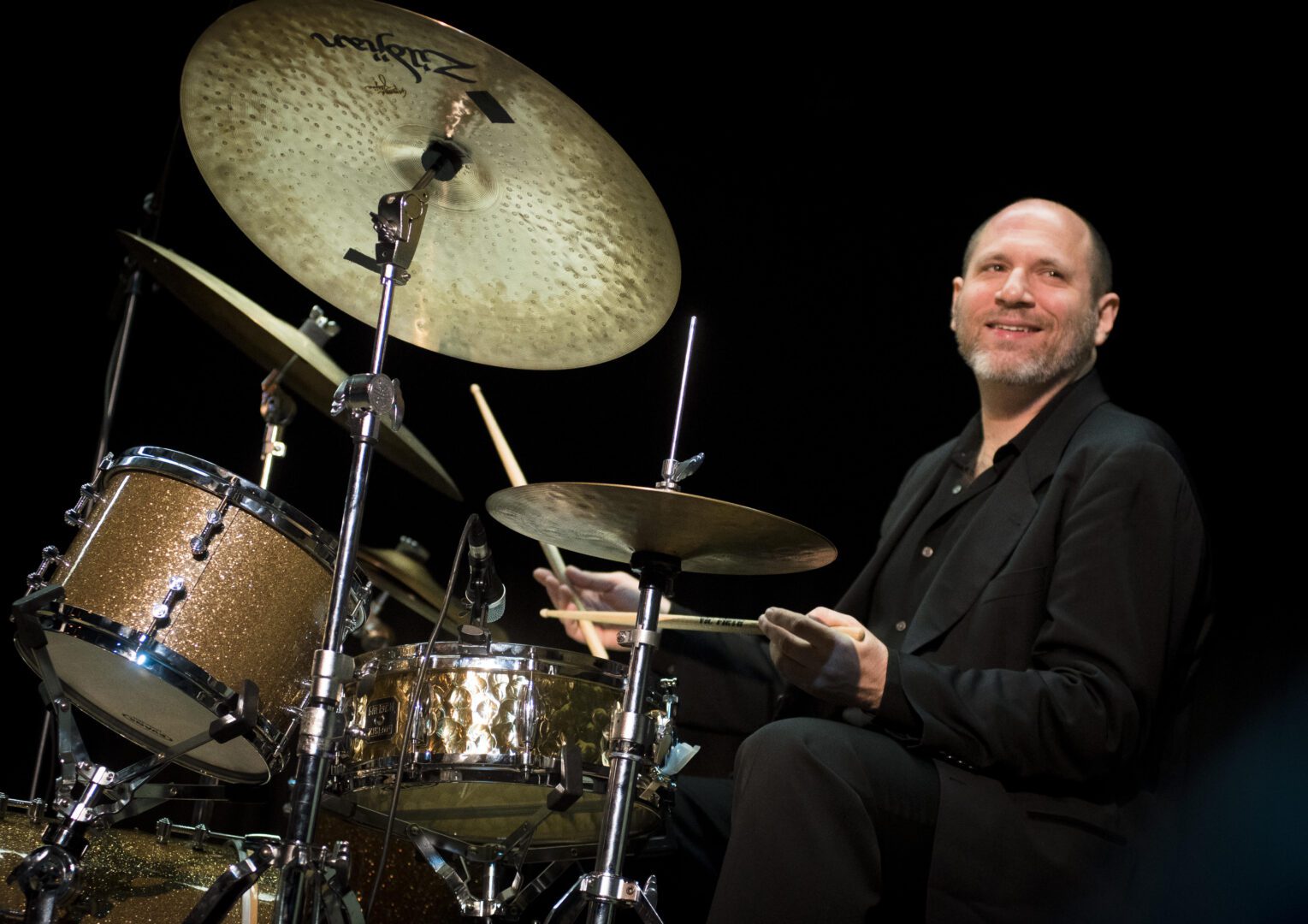
The concept included joining forces with concert halls and performing arts centers to deliver a fully immersive experience, to build audiences for jazz, and to deepen their understanding of the genre (and the themes presented). “I wanted the kids to be bussed to the theater partially due to the fact that my field trip experiences in elementary school were among my most memorable. I can’t tell you about long division, or how to spell chrysanthemum,” admits Schuman, “but I can tell you that I did go hear the symphony, and I remember going to the concert hall. I wanted kids to have more than just some random anonymous group coming into [the] classroom and saying, ‘everybody snap on two and four.’ Coming into a theater [with] velvet seats [also] contributes to the memory.” The beauty of working with arts organizations instead of directly with schools (apart from a decrease in red tape and administration), is that emphasis remains on the educational piece as there is no need to rely on a draw to be booked. Most of the programming is funded through grants and there is a degree of insulation built in for the JazzReach organization, since venues outside of direct arts programs are generally very limited in space and opportunity allotted for jazz each year.
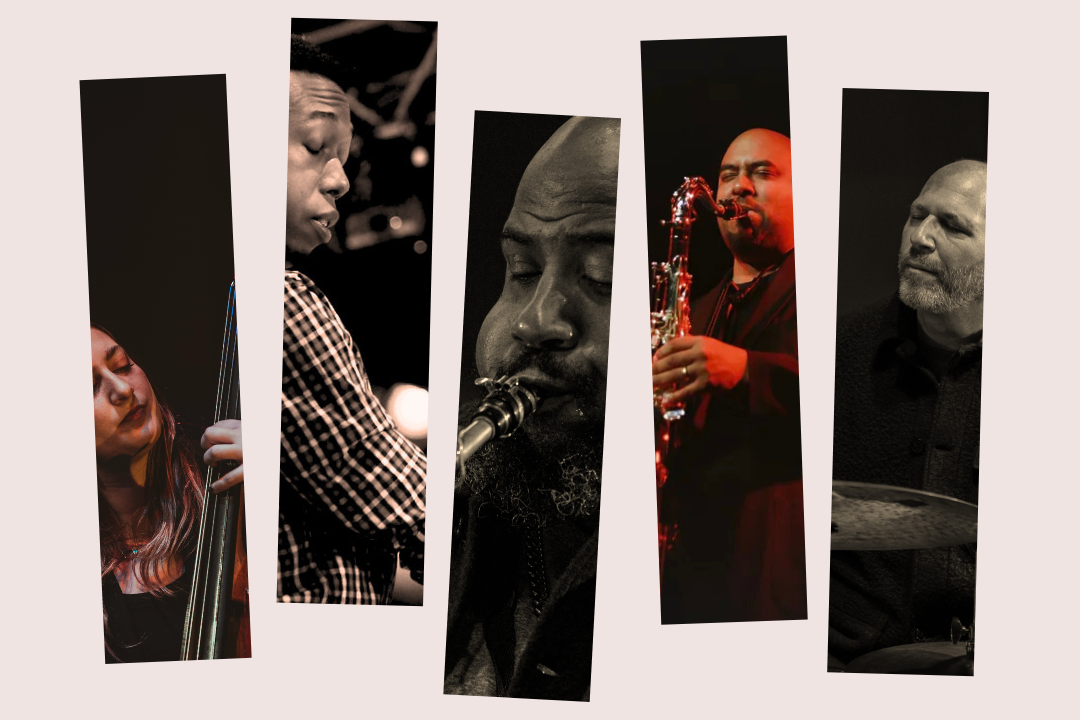
With performances centered around the Metta Quintet, a resident ensemble loosely modeled on the Kronos String Quartet, Metta remains active through stage performances, recordings, as well as arts education. Comprised of top-notch musicians (having occasional rotations due to tour and performance conflicts, with some members phasing out over time), the Metta Quartet has been a core part of JazzReach since inception. Productions are all scripted, which Schuman shares is key to connecting with and engaging young audiences.
The creation of JazzReach productions follows a standard format. “I’ll pick a subject matter, write the script, and can then envision the integration of music and video as I’m writing the script. Then I work with composers and arrangers and video projection designer people,” shares Schuman. “Oftentimes we’re underscoring the narrator when they’re talking, [but] the script is the content is used to contextualize the music in terms of making the music more relevant, interweaving American culture, and trying to break it down in a way that’s more bite-sized, engaging, immersive and entertaining. The music’s not stopping. All of our educational programs are within that model: scripted [and] narrated, [with] video projections and live music.” Despite being scripted and relatable for youngsters, the content is never dumbed down. “We’ve done a lot of educational programs for evening concerts and they’ve been really well-received. I write the scripts in a very digestible tone, but it’s not language that’s clearly targeting a very young audience, [so] it’s adaptable to an evening adult audience.”
With a focus on building audiences and deepening understanding (instead of just training musicians), JazzReach programs use the jazz ensemble as a metaphor for democracy: an example of a shared space with empathy and room for dialogue and contribution from everyone. JazzReach performances are multi-racial, multi-generational, and genre-fluid, helping to model inclusive collaboration to illustrate the ideology that forms the basis of jazz music, as well as a providing a healthy example of the definition of community.
With mainstay theater performances through field trips, JazzReach does go into schools on occasions when bussing is not available, funding is limited (through their JazzReach Up Close program), or for additional audience development and instrumental instruction. Add-on programs include clinics, master classes, lecture demonstrations, and on-site multi-day residencies to work with students on their repertoire (like high school jazz ensembles), culminating in a concert for their families and teaching faculty. Says Schuman, “the kids love it because they are rarely pushed this hard. We do it gently, but with urgency. They step up and sound better than they ever have, and you can see it in their eyes that they didn’t know they could sound that good in such a short span of time.”
Despite being in its third decade of work, Schuman keeps organizational overhead extremely low, with just two staff members supporting him: a Director of Programming to handle seasonal bookings, and a Production Manager to run the shows. The mission and focus at JazzReach has always remained to provide access and exposure to music for young audiences through live multi-media educational programs. “[While jazz is] first and foremost an American art form, sadly and ironically, it’s the American students that have the least access to their own cultural heritage,” laments Schuman. “I’m in no way opposed to bringing our programs to other countries, but this country has a lot of work to do with regard to its appreciation for the arts.
“We’re certainly still trying to grow. As I look to the next 20 years, I think it’s critical that there be a succession plan in place and that there be strategies for a JazzReach without me,” concludes Schuman. “I certainly wouldn’t want it to just sort of be this little vanity project. It is how I’ve spent the bulk of my life, so in effect it’s my legacy. I say that not out of vanity, but out of the fact that the mission is still relevant. There’s still great urgency to make sure that kids have access and exposure to music and the arts. There are strategies that are embryonic at this point. There are plans [we are] trying to implement, but they’re pretty ambitious. Stay tuned…”
The JazzReach mission has been embraced by many organizations since it launched, but the work to keep the organization running never ends. “We have to work every day to continue cultivating a demand for what we do,” admits Schuman. “I think the 30-plus years is a testament to our success. Presenters are still booking us [and] I’m delighted. When you don’t know if you’re capable of doing something, every little step you make in the right direction is further affirmation that maybe you do have what it takes. Maybe you’re not the only one who believes that this is important?“
With the noise of the world, Schuman says it has been “critical to be able to navigate and forge onward in light of the challenges that continue to face us.” The organization has navigated the aftermath of 9-11, two recessions, uncertain grants, and the COVID lockdown (where they pivoted to create online content), and Schuman’s passion and commitment to sharing jazz with young people has never waned. “There’s 30 years behind me that says what we do is great and worthy of support,” shares Schuman. That said, it can be a challenge to constantly work to keep things running. “Visualization is really important. Whatever the goal is, whatever the objective, I’ve found if you can visualize it, then that means you can believe it. It’s hard for me to visualize something and not see it realized. If it’s living in my head, I somehow have to manifest it because otherwise it’s just going to sit there dormant and that produces the woulda, shoulda, coulda, the what ifs, or I should have done that. The capacity to visualize the objective fulfilled is what should fuel the work it’s going to take to fulfill it. [In] everything we’ve done, the seed is always the visualization. The creation of anything, any artist—whether they’re a choreographer, a playwright, a dancer, an actor, or whatever—they’re creating something and it starts with visualization. It is the imagination, creating something from nothing, which is relevant to the jazz situation. You’re dealing with an improvised medium. To a great extent, everything we’ve ever done has been improvised, in terms of what I should do. You don’t know if you can actually do it or can pull it off, or who might wanna support us. How do we get their number? How do we find them? Everything is sort of like, let’s just try it. In effect, that’s what you’re doing in the process of improvisation.”
As a prominent educational non-profit, JazzReach has served students for over 30 years, sharing jazz education across the country and connecting with over a million youngsters to date. With support from John Mayer, Billy Joel, Norman Lear, and others over the years, the organization is currently finalizing a production for 2026 that commemorates the music, contribution, and legacy of John Coltrane during his centennial anniversary.
Learn more at jazzreach.org, or see overviews at youtube.com/watch?v=VPMnOfqOaEc and youtube.com/watch?v=4lpwWygSvMk.
Quick facts:
- Hans Schuman first received drum lessons at Creative Drum Shop at age 13 and was inspired by Steve Smith ’76 (Journey) at a drum clinic.
- JazzReach includes 12+ touring productions annually that blend music, narration, and immersive visuals to bring the story of jazz and its social significance to life.
- JazzReach started in 1994 in a small Brooklyn home office, and founder Hans Schuman hasn’t missed a single performance since inception.
- JazzReach’s programs have been embraced by 200+ communities across the United States, and continue to resonate with educators, families, and arts organizations.
- JazzReach serves students in grades 4 – 12, partnering with arts presenters and school programs for two to six weeks every year in Los Angeles alone.
- JazzReach’s multi-racial, multi-generational, genre-fluid performances, aim to model inclusive collaboration that defines jazz music and healthy community.
Contact Jon Bleicher, Prospect PR, jon@prospectpr.com