Experience Hendrix/Legacy Recordings To Release Legendary 1970 Berkeley Performance Available on 2LP Vinyl, CD and Digital Platforms
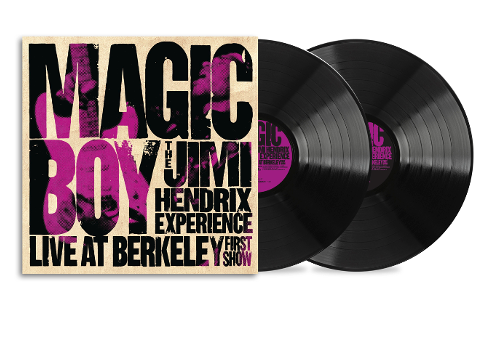
Magic Boy: The Jimi Hendrix Experience Live At Berkeley (First Show) will be out on October 16 on Experience Hendrix, L.L.C. and Legacy Recordings, the catalog division of Sony Music Entertainment. Produced by Janie Hendrix, original Experience recording engineer Eddie Kramer, and John McDermott, this historic 1970 concert is receiving a proper release for the first time, and will be available on 2LP vinyl, CD, and all digital platforms.
The final lineup of the Jimi Hendrix Experience (Hendrix on guitar/vocals, Mitch Mitchell on drums, Billy Cox on bass) performed two sets on May 30, 1970 at the Berkeley Community Theatre. For almost three years, the musician had been an international superstar and was widely hailed as the highest-grossing live act in rock. At this point in his career, Hendrix had decided to only tour on weekends because his primary focus was on building Electric Lady Studios, his own state-of-the-art recording facility in Greenwich Village. Demand for these two East Bay concerts far outstripped the venue’s 6,600 total available seats, leading to several thousand fans being turned away. Many swarmed the plaza in front of the theater, breaking windows and rushing the doors before the first performance. Others scaled the walls to gain entrance through the roof. Concertgoers who had purchased tickets were forced to elbow their way through the angry mob while being pelted by rocks. Promoter Bill Graham’s security force had never witnessed this level of aggression before. The Experience, who made it inside safely via a back door, ripped through repertoire both familiar and foreign to the audience. The audio was captured onto tape by Hendrix’s front-of-house engineer Abe Jacob, who had worked with him on previous tours.
In 2021, my brother Kenneth and I wrote Jimi Hendrix: Voodoo Child. During the endeavor, I interviewed Janie Hendrix, Eddie Kramer, Abe Jacob and Billy Cox about the May 30, 1970 Berkeley concert.
Janie Hendrix: Jimi had a relationship with Berkeley. When my father was in the service, Lucille (Jimi’s mother) sort of lost track of Jimi and he ended up in Berkeley, with a wonderful family that wanted to adopt him. My dad wasn’t having any of that. “No, I want my son back. Thanks for taking care of him.” So Jimi did have a little bit of roots there.
Eddie Kramer: Thank God Abe Jacobrecorded so many great live Jimi shows during his career. And Jimi wanted to make sure the shit sounded good. I recorded Jimi at Woodstock and Miami Pop. And you had to be on your game. ‘Cause you only had one shot. (laughs).
Berkeley 1970 is definitely up there as one of the finest. Abe Jacob actually did the basic recording. Of course, Abe and I go back many years, and we would always talk about stuff like how to record Jimi. I was very lucky to have him do some of those shows. I never had the opportunity to record Jimi live but I always did all the mixing with him of course, starting with Band of Gypsys which we did together and was very interesting.
There is a history there of working together. I know what is needed to make it sound right. Certainly in today’s market you want it to not only have the vintage feel but it’s gotta punch, you know.
I think Jimi reacted to audiences and areas of the country, wherever they were. With a different attitude because the audiences were different. Jimi was a guy who fed from the audience. And if the audience was receptive and giving back.
What happens at the Fillmore East, or Berkeley 1970, or wherever there is a great theater with fabulous acoustics, he’s like a sax player. A great jazz sax player would walk around the room and just blast to find the best place for that sound to come back.
Abe Jacob: Bill Graham did the Berkeley 1970 show. He was a very dynamic individual. And he had a terrific personality. Sometimes it wasn’t the personality you wanted to deal with. But his philosophy was always for the audience. He would do anything he did for the band and for the artist as long as they gave a performance to the audience. ‘He told me‘Bands have management and agents. Everybody else has somebody representing them. I’m here to represent the audience.’
For Berkeley 1970 we got the Wally Heider truck. It was in the San Francisco area where I was from, it naturally worked out that I would be in the truck and Mike Neal would be doing the mix inside the theater.
We kept it simple. When we toured the sound system for the Jimi Hendrix Experience was eight microphones. I mean, that was it. Miking was a little different for recording because we obviously had to mike the guitar and guitar to put it on tape, which you didn’t in the live venue. Pretty much the drums, two vocal mikes, some audience mikes for ambience and that was it. We had eight tracks available and everything went on a separate track so it made it easy for Eddie Kramer to mix it later on. I just put a mike in front of what they played.
The basic philosophy was that the sound that came off the stage was what you wanted to present to the live audience and that also what you also what you wanted to present when you recorded it.
The one memory I have and it has been reported, was that it was such a small room, people trying to get in and we opened the back doors of the recording truck, and people gathered outside the theater to listen to our monitors in the truck. And it probably prevented a riot.
Jimi, Mitch and Billy were billed as the star attraction at the Atlanta International Pop Festival July 3-6th. They headlined on the 3rd.
Billy Cox: By this time we’re getting used to these crowds. You know, it really didn’t have anything to do with race. It was being linked together cosmically, I guess. I was in Jimi’s head. He started off “All Along the Watch Tower” in the wrong key. I started off in the wrong key with him. Because wherever he went I was right on him. Then Jimi got on the microphone and went to the original key and I was on him right then and there. When we got off the stage he said,” you were right on me like white on rice.” “No. I was right on you like a rat on cheese.” And we laughed at that.
We were cosmically linked musically, because we rehearsed, practiced at hotels, making mistakes and learning. We went to recording sessions early so we could get some rehearsal time so we could do some new riffs. And that’s the type of relationship we had.
People enjoyed the songs, more so than the old songs. Like “Foxy Lady” and “Purple Haze.”
I liked playing with Mitch. I came from a jazz influence in being from Pittsburgh, Pennsylvania, a jazz hub like Philadelphia and New York. My uncles played horn. I was at home playing with Mitch and equally at home playing with Buddy who was R&B-oriented. Jimi picked probably two of the greatest drummers he ever could have had.
Never had a set list. Jimi always starts the song off. He was the boss. So wherever he wanted to go that’s where we went. Normally from “Foxy Lady” to “Voodoo Child,” to “Freedom” and “Straight Ahead.” Jimi starts it first and we know where he is gonna go and where he went. We practiced so long and we knew all the keys. So if Jimi wanted to extend it, he would look back, we knew what that cue was. Maybe he would raise his hands to the left or to the right. We knew the cue. He was the boss and we knew where he wanted to go.
The fascination with this Berkeley performance and its lore steadily grew over the years when two early posthumous releases featured recordings from that set; "Hear My Train A Comin'" made it onto Rainbow Bridge (1971) and the electrifying rendition of "Johnny B. Goode" can be heard on Hendrix In The West (1972). The 1971 concert film Jimi Plays Berkeley includes extracts of “Purple Haze" and "Star Spangled Banner," stoking the fires further. Magic Boyfinally assembles the performance in the order it was experienced by attendees. The album provides fans with the opportunity to hear Hendrix confidently shift between familiar favorites such as “Fire” and “Voodoo Child (Slight Return)” to then-brand new material like “Ezy Ryder" and "Freedom" before they had been completed in the studio.
Hendrix also incorporated Band Of Gypsys material into the set list; "Message To Love" and “Machine Gun" were executed with returning drummer Mitch Mitchell’s unique flair. These Berkeley recordings have been newly remixed by Eddie Kramer from the original multi-track tapes, and mastered by multiple-Grammy Award winner Bernie Grundman. Janie Hendrix, President and CEO of Experience Hendrix, L.L.C. commented, “Jimi called himself a ‘Magic Boy,’ so this title has a very personal meaning. He was always reaching for something new—exploring, experimenting and pushing his music forward. At Berkeley, you can hear that journey happening in real time. He gives the audience the songs they already loved while opening the door to where he was headed next. More than fifty years later, that magic is still there. Magic Boy lets us experience Jimi’s brilliance, energy and imagination all over again.”
Magic Boy vinyl tracklist: LP ONE SIDE A 1. Fire 2. Johnny B. Goode 3. Hear My Train A Comin’ SIDE B 1. Machine Gun 2. Freedom 3. Red House LP TWO SIDE A 1. Message To Love 2. Ezy Ryder 3. Star Spangled Banner 4. Purple Haze SIDE B 1. Voodoo Child (Slight Return) Magic Boy CD tracklist: 1. Fire 2. Johnny B. Goode 3. Hear My Train A Comin’ 4. Machine Gun 5. Freedom 6. Red House 7. Message To Love 8. Ezy Ryder 9. Star Spangled Banner 10. Purple Haze 11. Voodoo Child (Slight Return)