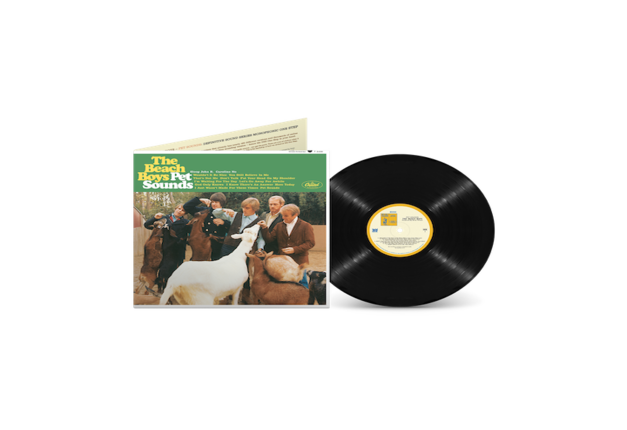
Providing deeper insight into the making of the album, The Pet Sounds Sessions Highlights due from UMe compiles standout material from the 1997 Grammy-nominated 4CD box set, The Pet Sounds Sessions, which documented the legendary 1965–66 recording sessions. The new collection features 25 alternate takes, a cappellas, and tracking sessions, all making their vinyl debut. Available as a 2CD set and across multiple 2LP configurations
The new audiophile pressings present Pet Sounds with the highest standards in sound and packaging, ranging from high-end to ultra high-end editions. The Vinylphyle Edition is pressed at RTI on 180-gram black vinyl and cut from the original mono and stereo analog tapes by Joe Nino-Hernes at Sterling Sound. The stereo mix, originally overseen by Brian Wilson and produced and engineered by Mark Linett in 1996 for The Pet Sounds Sessions box set, is included alongside the original mono album cut from the original 1966 assembled master reel. The release will have an initial pressing of 3,000 copies.
Each Vinylphyle album release is mastered in all-analog from original sources when available by leading vinyl cutting engineers and pressed at Record Technology, Inc. (RTI) California. The series emphasizes consistent quality control across mastering, plating, pressing, and printing.
In addition, Interscope-Capitol’s Definitive Sound Series (DSS) edition presents Pet Sounds in its original mono configuration using the state-of-the-art One Step process, which eliminates multiple steps in the plating process and delivers the recording's intricate arrangements and vocal harmonies with remarkable clarity. Pressed at RTI on Neotech VR900 D2 180-gram vinyl, the AAA [All Analog Mastering] was cut by Chris Bellman at Bernie Grundman Mastering from rarely used circa-1972 original analog tapes. Limited to 6,000 individually numbered copies, the release draws from the early-1970s Brother Records pressing, long noted for its sound quality. Each copy includes a certificate of authenticity documenting the mastering, plating, and pressing process.
I first encountered Brian Wilson in 1962 at Rancho Music record shop in Studio Village in Culver City California when the Beach Boys were doing an in-store appearance, autograph party and “playing live” to promote their new record “SURFIN’.”
During 1965 I talked to Brian, clad in a blue Navy pea coat and white Levis, one afternoon after junior high school. He introduced me to his wife Marilyn at Fisher’s Hamburgers inside the Town and Country Market in the Fairfax District. I was planning to attend at Fairfax High School, and before she married Brian, Marilyn and her sisters Diane and Barbara Rovell graduated from the same institution. Our parents were both from Chicago.
In mid-May 1966, I purchased my first copy of Pet Sounds at The Frigate record shop in Los Angeles on 3rd St. I was with David Wolfe. We went back to his families’ duplex on 4th St. I lived on 5th St. We took off the Peter, Paul & Mary In Concert LP and listened to the Capitol Records Duophonic (artificial stereo) album.
I later learned that it was pressed in mono and done at the label’s mastering room where equalization and phasing were added to the original tape transfer.
In 1967 Jim Roup and I watched Brian lead a rehearsal of the Beach Boys developing “Good Vibrations” for a North American tour on Sunset Blvd. at the former site of The Moulin Rouge club which became The Hullabaloo, The Kaleidoscope and The Aquarius Theatre. I had just left the set of The Monkees in nearby Gower Gulch and walked inside the building like an invited guest.
In 1969 I saw the Beach Boys with Flame at the Whisky A Go Go, and in 1971 David Wolfe and I went to a Beach Boys concert at The Santa Monica Civic Auditorium where Flame was the opening act. We drove to San Diego the next night to catch the band at the San Diego Sports Arena. I was amazed how “current” they sounded and spell-bound by “It’s About Time” and “Long Promised Road.”
I was at the 1972 Beach Boys gig at The Long Beach Arena, where manager/songwriter Jack Rieley invited Brian up from the audience to perform “Day in the Life of a Tree.” Their 1969-1972 repertoire was from Sunflower and Surf’s Up.
By 1973 the group’s live show was turning into an oldies act, but the Holland-inspired shows at the Hollywood Palladium and Winterland Ballroom in San Francisco were still fun.
In 1974 I wrote the review in The Los Angeles Times Sunday Calendar sectionof the Beach Boys’ Endless Summer double album released by Capitol Records. Marilyn Wilson read the review and invited me up to the Wilson Bel-Air home for some dessert.
From 1977-1980 I covered the Beach Boys for Melody Maker, and conducted interviews in 1977 with Brian and Mike Love.
On The Pet Sounds Sessions 4 CD-box set Capitol issued in 1997, produced by Mark Linett, David Leaf and Andy Paley, that provided the foundation of the 2026 Pet Sounds release, I’m thanked in the liner notes.
In 2004, Brian supplied the back cover jacket testimonial for my first book This Is Rebel Music, published byThe University of New Mexico Press.
During 2007 I wrote the program booklet text and conducted extensive interviews with Brian for his Pet Sounds 40th anniversary tour.
For the 2009 book That Lucky Old Sun for Genesis Publications, I did the interview with Wilson for his collaboration with Sir Peter Blake, and also thanked on the 2011 Capitol Records SMiLE box set.
In 2014 Brian penned the introduction to an award-winning book my brother Kenneth and I wrote and assembled on SMiLE-era photographer, Guy Webster, Big Shots: Rock Legends and Hollywood Icons, published by Insight Editions.
There are many records in Brian Wilson’s catalogue that were important events in my life. I had a special friendship with Brian.
Since 1969, I probably had 20-30 lunches or dinners with Brian, often with poet/songwriter Stephen John Kalinich. The first songwriter signed to Brother Records in 1967. Kalinich co-wrote songs with Dennis, Carl and Brian Wilson, including “Little Bird” and “Be Still” with Dennis on Friends.
In a March 2026 conversation, Stephen reminded me of numerous eateries where I joined him and Brian, that even with my memory, I had forgotten about. Various pizza joints, steak houses, the chocolate milk shakes at Stan’s Drive-In coffee shop and the trays of French fries at Tiny Naylor’s with carhop service so we could eat in Brian’s white Mercedes-Benz.
In the mid-seventies Brian would pick up Kalinich at his apartment in Brentwood, write songs, go get something to eat, and a couple of times they’d invite me to join them at the Delores Drive-In on Wilshire Blvd.
More French fries. More acne.
My most vivid lunches with Stephen and Brian were at Warren Stagg’s H.E.L.P (Health, Education, Love and Peace) restaurant in 1969-1971. H.E.L.P. was a popular organic-vegetarian restaurant located in Los Angeles on 3rd St. by Fairfax Ave.
“At the H.E.L.P. restaurant, Brian, Mike and I loved the seaweed salads and boysenberry shakes,” Kalinich recalled. “Mike suggested the somewhat comical concept of Rent-A-Poet for me to help expose his lyrics and my poetry around town. Mike was extremely kind to me. He took me all around Beverly Hills, introducing me to people like his tailor and Sky Saxon of the Seeds, when I was working at a flower shop in Brentwood. Mike also offered me the usage of his car at the time, a Rolls Royce if I needed it. It felt like I was in a surreal dream. Carl produced my first record ‘Leaves of Grass’ at Studio B at Capitol Records in Hollywood.”
At H.E.L.P. Brian and I would devour carob cookies and date nut with cream cheese strawberry sandwiches. H.E.L.P. also had an on-site bakery, and a book store that sold crystals and candles. Henry Diltz, Liberty Records A&R man Dan Bourgoise, Del Shannon, Miles Davis and Phil Ochs frequented the restaurant. Health advocate Gypsy Boots was a fixture along with photographer Heather Harris, actor/musician Bill Mumy, and writer/musician Marina Muhlfriedel (now Marina del Rey of Vivabeat), who loved the sauteed veggies on brown rice with extra garlic, bancha tea, and banana bread. Future Richard Pryor record producer Robert Marchese helped make the fresh juices on the premises.
Members of the Byrds would land at H.E.L.P.
I spoke with Roger McGuinn, the former Jim McGuinn. In 1967 he changed his first name to Roger around the same time musician/photographer Tad Diltz became Henry Diltz. They both had become involved with Subud, a spiritual practice in quieting the mind that was a movement in the 1920s from Indonesia.
“There was a Subud house in downtown Los Angeles on Hope Street. The Beach Boys used to hang out there,” emphasized McGuinn. “I remember that. Then, Brian Wilson formed his own chapter at his house during his ‘sandbox phase.’”
In 1967 Brian wrote “Vegetables” and during 1969-1971 operated a health food shop, The Radiant Radish on Melrose Ave. Brian was an active co-owner of the store and stocking shelves of organic produce and work behind the cash register.
Mike Love turned to Transcendental Meditation in the late 1960s to strengthen his own inner harmony. Mike studied with TM’s most famous practitioner at the time, Maharishi Mahesh Yogi, at his ashram in India along with the Beatles, Paul Horn, Mia Farrow and her younger sister Prudence (the inspiration for the Beatles song “Dear Prudence”), and Donovan.
“It’s a personal growth program,” Love told me in a 1974 interview conducted for Melody Maker.
“Transcendental meditation has been very helpful in unfolding our individual capacity for creativity. We met the Maharishi Mahesh Yogi in December 1967 when we did a United Nations show in Paris.”
“Just before the spring of 1968 Mike Love suggested a United States tour of the Beach Boys promoting Friends and a lecture on meditation by Maharishi Mahesh Yogi,” wrote Kalinich.
“Mike was deep into Transcendental Meditation. The group wanted me as the opening act doing poetry. They bought me a new wardrobe at the Sy Devore shop but promoters didn’t want a spoken word artist on the bill. They did a few concerts and the tour was cancelled. The Beach Boys then went on a 1968 tour of the South with Buffalo Springfield and the Strawberry Alarm Clock. In February 2026, I read poetry opening for the Strawberry Alarm Clock at The Whisky A Go Go.”
On the Brian Wilson 2004 album Getting In Over My Head, one tune, a duet between Brian and Paul McCartney, "A Friend Like You," is a Wilson and Kalinich composition.
During the 2014 Record Store Day, the Light in the Attic label issued the Wilson/Kalinich LP A World Of Peace Must Come, that was recorded in August and September of 1969. The tapes were promptly lost, not to be heard again until 2008. Following the CD-only reissue in 2008, it was the first time this timeless snapshot of an era was available on vinyl.
In March 2026, a Stephen Kalinich, Carl Wilson and Dennis Wilson song “Rainbows” is heard in the theatrically released Project Hail Mary science fiction drama movie that stars Ryan Gosling. Their composition was initially on the Dennis Wilson 1977 solo album Pacific Ocean Blue.
In 1977 Brian told me in an interview for Melody Maker, “I don’t carry a notebook or use a tape player. I like to tell a story in the songs with as few words as possible. I sort of tend to write what I’ve been through and look inside myself. Some of the songs are messages.”
Last century I was with Brian at Capitol Records in Hollywood and we went to their mastering room. Brian was overseeing and reviewing a mono pressing of Pet Sounds for a planned 20th anniversary edition. Brian got on a table putting his left ear as close to one of the big speakers as physically possible.
In 2007 he clarified this method to me. “I mixed in mono because I can’t hear in one ear. Made me concentrate more and get the best for that one ear. I always loved mono. Transistor radio. With mono you have one single sound source. We were doing stereo but I could only hear the mono and I always put the vocals up front in the mix. Mixing in mono is good for my left ear. My right ear is broke. Done and over with. I liked to mix with big speakers. You can hear the overall sound better. I would then take acetates home and play them on my little record player.”
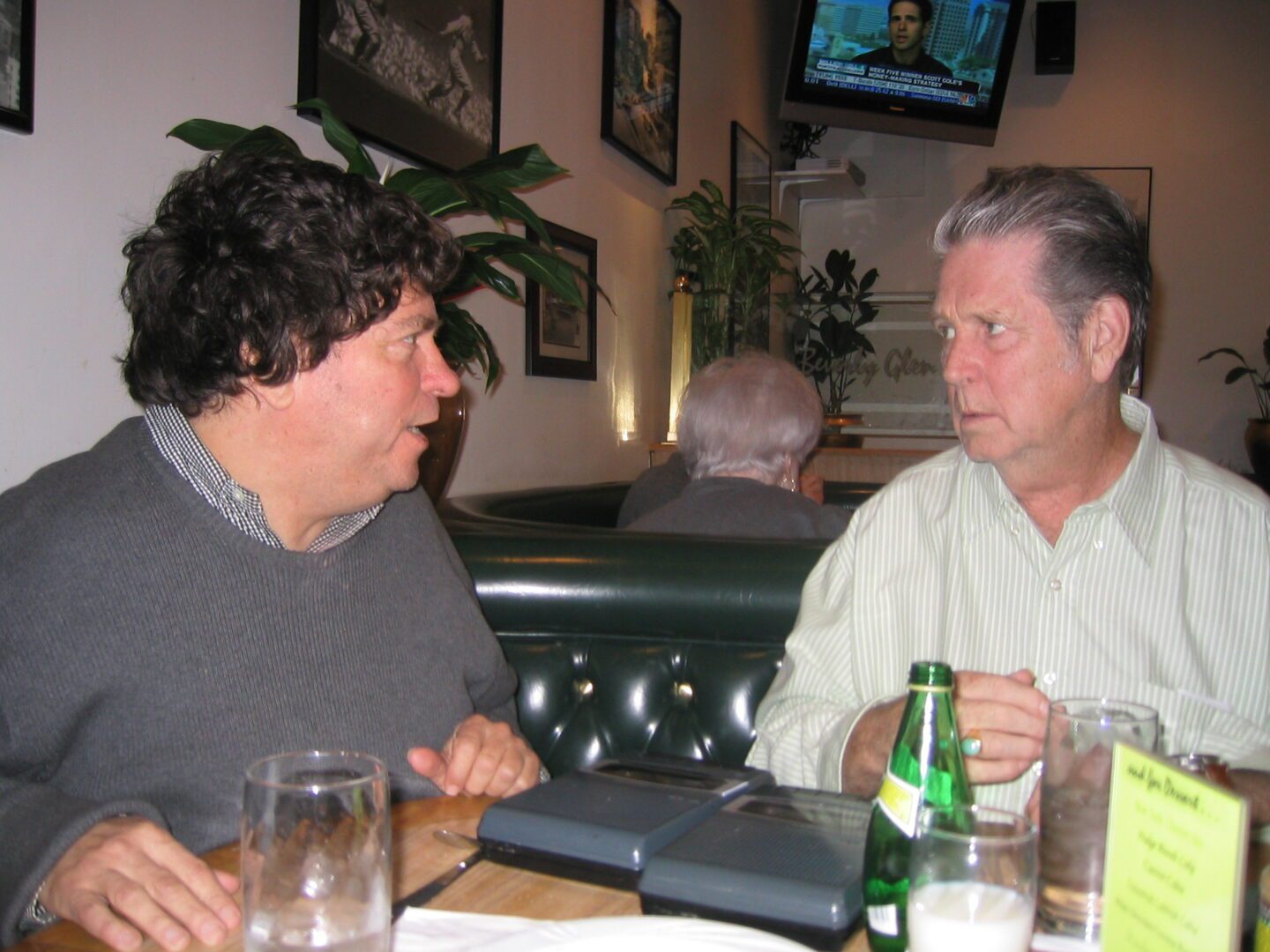
The last time I spoke at length with Brian was at a delicatessen in Bel-Air last decade. My brother Kenny and our father Marshall had been at a park in Westwood and Brian was walking next to them.
After Brian chowed down his breakfast, we went outside into the parking lot. He asked, “How come you never asked me to sign any of our albums?”
I quickly visited Brian at the Wilson home. We hung out in his music room, and then returned to the delicatessen. He autographed a handful of CD’s and comically quizzed me after handing over the stack, “What is your favorite album by the boys?”
I responded, “It’s not Pet Sounds. It’s Beach Boys Today.”
Below are my Pet Sounds-themed interviews with Brian 1977-2014.
Q: I know the Beatles’ Rubber Soul made a big impression on you when first released in 1965.
A: “Michelle” and “All My Lovin’” are two of my favorite Paul McCartney songs. “Norwegian Wood’ completely blew my mind, and marijuana was around for Pet Sounds. Well, when I first listened to Rubber Soul, I then went to the piano and all I could see were my keys. I locked in with the keyboard and wrote [with Tony Asher] ‘God Only Knows’ in 45 minutes.”
Q: You once said your favorite “John Lennon” songs are “Across the Universe” and “Because.” I hear the influence on the Beatles from “Wonderful” off Smiley Smile.
A: I’ll say the influence was on “Here, There and Everywhere.”
Q: The opening vocal intro on the Beatles’ “Paperback Writer” was informed by “I Get Around.”
A: Maybe it inspired them. I hope it did. I really do.
Q: You also had a tent on your home premises. Terry Sachen, who co-wrote “I Know There’s An Answer” with you and Mike Love on Pet Sounds, worked with you, and put it together. He ordered the fabric.
A: We had a tent. An Arabian tent. Cushions. We would eat sandwiches and smoke pot and just laid around, you know. And, I got some ideas late at night when my wife went to sleep. I stayed up and thought of ideas like that.
Q: You actually wrote around 1963 the instrumental “Pet Sounds” for a James Bond movie, Dr. No.
A: It got turned down, Harvey. They turned it down! They turned the damn thing down. It got submitted. If you can do the twist then “Pet Sounds” got turned down. “We don’t have any interest in that song.” “Fuck that shit, I’m gonna put it on Pet Sounds.” That’s why it went on Pet Sounds. The James Bond people turned it down. And, when we play the “Pet Sounds” instrumental on stage now I turn around and face my band and take the piece in.
Q: Every night you and the band perform “God Only Knows” and the song always garners a standing ovation from everyone in the crowd. Why?
A: Because we’ve had a little practice, Harvey. (laughs) Second of all, Carl (Wilson) is gone, and third of all, I have to carry what he used to carry. I have to carry the damn weight. I have to carry the ball. I don’t remember the recording session of it. Too far in the past to remember. I mean, here is your part…O.K. Here is your part…O.K. And, somehow, we got “God Only Knows” done. And, the record spoke for itself. And it was a religious experience.
“Carl and I were into prayer. We held prayer sessions in our house on Laurel Way. “Dear God. Please let us bring music to people.” It happened. A cool trip. A lot of people say to me that Pet Sounds got them through high school or college.
Q: “Caroline, No” is your favorite song on Pet Sounds. The recording was pushed up a beat.
A: And guess whose idea that was?
Q: Your father, Murry Wilson.
A: Yes. He said to speed it up a half a note and you’ll have a real special song. I did it and it worked. What can I say?
Q: “The Little Girl I Once Knew.” John Lennon really praised the record in a 1965 interview in England. I read that he called it “the greatest record I’ve heard in weeks.”
A: That is my very favorite introduction in a song in my whole life. It kills me every time.
Q: Because the way the music is suspended on the front end of the track?
A: Yes. It might have been the first time the music stopped and started again on a record. I wrote the intro at the studio before we cut the thing. And, (session musician) Larry Knechtel, it was his idea to keep the music rolling. And we tried one, and then I put a second guitar overdub on top of the other guitar. And the rest of it was history.
Q: What about teaming with lyricist Tony Asher for Pet Sounds?
A: A cool kind of guy. A little more soft spoken. His attitude is just right for creativity and just right to work with. I might call him up as a matter of fact. That might be a good bet for me. Just before we began collaborating on Pet Sounds, I asked him what it was like writing commercials for an advertising company. It seemed like interesting work. I said, “You should be good with words if you can do that.” And, he said, “I’m pretty good with words.” Out of nowhere I said “Would you like to work with me on some songs and write some lyrics?” “I’ll give it a try.” Then, Pet Sounds, like that. 1966 was a very big year for the Beach Boys.
Q: What was the difference collaborating with Van Dyke Parks on SMiLE to lyricist Tony Asher whom you worked with on Pet Sounds?
A: Well, Tony Asher worked a little slower working with me than Van Dyke who was faster.
Q: Why did you select Van Dyke Parks? He emailed me and said the first time he talked to you was at a party.
A: I met him in 1965. We met initially at a lawn party held by Terry Melcher at his home off Benedict Canyon, overlooking Beverly Hills. Later Van Dyke came up with David Crosby on a visit to check out my new home recording set up. Van Dyke was brilliant at talking. I picked him because he was good with lyrics and pretty good with music, too. I can’t answer what drew me to him.
Q: Do you recall the origin of “Heroes and Villains?”
A: I sure do. The song started at my Laurel Way house. [Brian and Marilyn never lived in Laurel Canyon as represented in a 2018 documentary. In 1966 they resided in Beverly Hills]. We had a sandbox and a piano. The actual recording took five or six weeks. I love “Heroes and Villains.” The magic of Van Dyke’s lyrics and my lead vocals. It’s a pretty youthful lead. Because the damn thing is so together and cohesive. It comes together so beautifully that people can’t resist lovin’ it.
Q: I know you used different studios for various sessions. Van Dyke told me he had never seen anyone before you move from studio to studio with master tapes.
A: I liked the Capitol rooms, and I liked the instrumental sound, but I didn’t like the vocal sound. I didn’t like that kind of echo chamber. Tell me I’m an idiot! I just didn’t like the vocal sound, so we switched over to Western, and Gold Star. Western had a big room, and Phil Spector was over at Gold Star. Western had a good bass sound and a better vocal sound. Sunset Sound also had a great tack piano, too. I did things at RCA with engineer Dave Hassinger. “Help Me, Rhonda.” Capitol did have a good violin sound.
Well, we recorded the background tracks at Western. And then we went over to CBS for the vocals on 8-track. I felt confined with 4 tracks. 8 track was fantastic. You could put the cello on one thing and the Theremin on another. It was fantastic. I was also able to record tracks at Gold Star, Western, Sunset Sound, CBS--- and bring the tapes to each studio.
It’s a whole different trip because it’s the same song but you’re going to a different studio. Truth is, going to different studios didn’t really matter. All that matters is the vocals, because I tried to do vocals first and then the music. I didn’t like to do that a lot. It was tracks first because you had to have something to sing too. Chuck Britz at Western made suggestions and was like a co-producer but only got credits for being an engineer.
Q: You were a regular Gold Star visitor and customer for many years. In that room you produced the Beach Boys’ “Do You Wanna Dance,” “I Just Wasn't Made For These Times,” “Wouldn’t It Be Nice,” and the original version of “Heroes & Villains” at Gold Star. And, a version of “Cabin Essence” earmarked for SMiLE.
A: Basically, it was their echo chamber. More than anything else. I liked their drum sound. I loved their tack piano, too. It was a great studio next to the Musicians Union on Vine St. I liked the whole vibe. I liked the owners Dave Gold and Stan Ross and engineers Larry Levine and Doc Siegel.
On Pet Sounds andSMile I had Phil Spector’s players: Lyle Ritz the bassist was also a ukulele player. He was a trip and played good stuff. Carole Kaye on bass. She was previously on “California Girls.” Ray Pohlman. Fender bass. Hal Blaine was the greatest drummer I ever worked with. Don Randi, the keyboardist.”
Q: Brian, talk to me about implementing strings into your work.
A: I liked Jack Nitzsche’s string arrangements with Phil Spector. Sid Sharp was the guy I called for violins for my sessions. I like strings. It’s good to use strings. Strings bring you in more. Like Nelson Riddle and Frank Sinatra. But you need some spaces and holes. I like horns, too. Brass. I liked to use two saxes, baritones, and a trumpet.
Q: I was at Capitol records studio in 2004. Paul McCartney said how much he liked the bass lines on Pet Sounds. I know you employed the bass as a principal instrument. Like on “Here Today,” where you conceived the idea of the bass playing an octave higher on the rhythm bed track.
A: Because the bass parts resound better in a studio and you can take three hours to get one line if you really needed it. You could take forever and get a goddamn line, you know?
I asked Larry Levine what Phil Spector did with his bass players and Larry said Phil uses a standup and a Fender both at the same time. And the Fender guy used a pick. So, I tried it out at my session and it worked great! You also get a thicker sound putting the two basses together. I start with drums, bass, guitar and keyboards. Then we overdub the horns and the background voices.
Q: Both you and Paul McCartney as songwriters and musicians go away from the root chord and establish counterpoint sound. It’s a structure both the Beatles and the Beach Boys did. Can you talk to me about veering away from the melody from the root chord as a writer?
A: I learned that from Motown. I learned how to play bass from Motown for Christ sakes! I learned how to play different type of roots on certain chords. I love Stevie Wonder. We did his “I Was Made to Love Her.”
On Wouldn’t It Be Nice” Barney Kessel did the introduction to the song and Glen Campbell was also there. And, I said to myself, “I’m going to have these guys play directly into the board instead of going out into the studio.” And they plugged their instruments into the recording console direct. That’s how we got that sound. I also did that on “California Girls.” My brother Carl played a 12-string on that and we plugged him into the console and he did his thing. Every now and then I’ll do that. It sounds more mellow and it is something I can’t quite describe but it is much more mellow than an amp.
Q: You brought in the Theremin instrument in Pet Sounds for “I Just Wasn’t Made For These Times” and more prominent in “Good Vibrations.” I know during Pet Sounds you talked to Barney Kessel at Western recording who was with a Theremin player for a science fiction soundtrack. You requested Barney to do a session the very next day and to bring the Theremin guy. Barney said, “I’ll ask him and see if he’s available.”
A: Yes. I first discovered it when I was a little kid. My mom and dad had a friend who had a thing where you put your hand out and get a sound that goes higher and lower. And then I found out about what they call a band Theremin where you slide your finger across a band. And I used it. It is an instrument that you use sparingly.
Q: In late 1965 at RCA studios on Sunset Blvd. in Hollywood, you first met Andrew Loog Oldham when he was producing a session with the Rolling Stones at studio A on “What to Do” for their Aftermath album. The influence of stacked vocals. Mick Jagger said to Andrew, “What do you want me to do? Beach Boys?”
Andrew mentioned to me that you told him you would one day, “write songs that people would pray to.”
A: Yes, I did. I don’t remember when I first felt that. I know music was more than people applauding and buying records. Even when Pet Sounds came out a lot of people told me it got them through high school or college. The most amazing comment I got from one guy who said ‘that’s the most spiritual album I’ve ever heard.’
Q: I know the song is everything with you, “what key is it in?” Al Jardine said to me in 1965 you really started thinking about the band members lead vocals.
A: Yes. “I’ve got to get these guys leads that they can sing on the road.” Like, Al’s vocal on “Help Me, Rhonda.”
In ‘Good Vibrations,’ Mike’s singing got us famous. Because his voice has a quality to it that goes hand and hand with the song. Mike’s bass part on “Good Vibrations” was the one. Mike’s voice on it was the thing that sold me on it. He was the appropriate singer for the song.
“Carl Wilson is my favorite rock ‘n’ roll singer. He had a resonate voice and he had a lot of energy and power in his voice. In which I didn’t have or Mike, or the other guys. Carl and Dennis were both my brothers and my artists.
“Dennis as a singer... First of all, he had an energy. Right? Second of all he had a nice quality about his voice. Coupled energy with a sweetness and that was his whole trip.
“Bruce Johnson. He is not an energy singer. Bruce is a sweeter singer and a better falsetto.
Q: At a “Good Vibrations” rehearsal in Hollywood, you were running around teaching the group vocal parts because you weren’t going to be on stage shows with them. Remember this?
A: Yes. I wanted it to be done right and I wanted them ready to go for tour. I knew it could work on stage. I never thought “How is this gonna work live?” When we rehearsed everyone was very cooperative. When the boys were touring in 1966 that was when I first started writing even more parts for them.
Q: You flew to Michigan to see “Good Vibrations” played live for the first time. Isn’t that correct?
A: Right. In front of an audience. I just remember saying, “That’s fantastic.” Ten-minute ovation. What was it like? I was proud as hell. I took a bow. I knew the group could perform the material on stage. When it went to number one it did give me some confidence I could write in sections.”
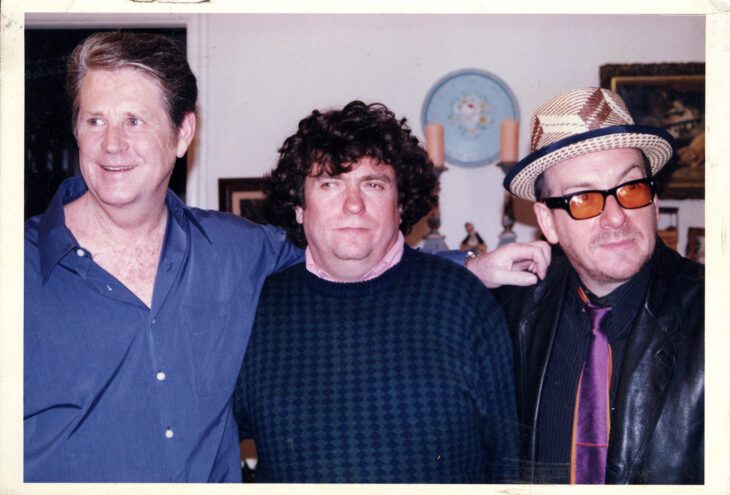
During 1999 I invited Elvis Costello up to the Brian and Melinda Wilson home. John Anderson and Maggie Magee were directing and producing a Brian Wilson documentary taping. The duo has made six films with Brian through Anderson Productions.
Elvis mentioned he saw the Beach Boys in May 1972, and recently produced a cover version of a Pet Sounds selection, “Don’t Talk (Put You Head on My Shoulder)” with vocalist Anne Sofie von Otter.I filled Brian in who Elvis was. He was delighted about Elvis and her doing the song. Brian touted percussionist Frank Capp and guitarist Billy Strange on his original session while Melinda gifted Elvis with a copy of Brian’s current album.
In 2004, I went to a Burbank rehearsal room where Brian and his band were preparing to debut SMiLE in the UK. I watched with actor Tony Dow, songwriter/producer Andy Paley and guitarist, bassist, author, music teacher Carol Kaye.
On November 4, 2004, SMile was presented in Los Angeles at the Walt Disney Concert Hall venue. To record collectors, natives of Los Angeles, the congregation and for Brian Wilson and Van Dyke Parks, bio-regional psychic relief and closure was omnipresent that evening.
In a November 2023 dinner conversation, after interviewing Carol Kaye for a documentary about her career, I wanted to know if she met any of the Beatles.
Carol put down her fork. "Paul McCartney called me many years ago when he found out I played on the 'Good Vibrations' sessions. We traded picks."
(Harvey Kubernik is the author of 20 books, including 2009’s Canyon Of Dreams: The Magic And The Music Of Laurel Canyon, 2014’s Turn Up The Radio! Rock, Pop and Roll In Los Angeles 1956-1972, 2015's Every Body Knows: Leonard Cohen, 2016's Heart of Gold Neil Young and 2017's 1967: A Complete Rock Music History of the Summer of Love.
Sterling/Barnes and Noble in 2018 published Harvey and Kenneth Kubernik’s The Story Of The Band: From Big Pink To The Last Waltz. In 2021 they wrote Jimi Hendrix: Voodoo Child for Sterling/Barnes and Noble.
Otherworld Cottage Industries in 2020 published Harvey’s Docs That Rock, Music That Matters. His Screen Gems: (Pop Music Documentaries and Rock ‘n’ Roll TV Scenes) was published on February 6, 2026 by BearManor Media.
Harvey spoke at the special hearings in 2006 initiated by the Library of Congress held in Hollywood, California, discussing archiving practices and audiotape preservation.
In 2017, he appeared at the Rock & Roll Hall of Fame in Cleveland, Ohio, in its Distinguished Speakers Series and as a panelist discussing the forty-fifth anniversary of The Last Waltz at the Grammy Museum in Los Angeles in 2023.
During 2025, Kubernik was interviewed in the Siobhan Logue-written and -directed documentary The Sound of Protest,airing on the Apple TVOD TV broadcasting service. The film also features Smokey Robinson, Hozier, Skin (Skunk Anansie), Two-Tone's Jerry Dammers, Angélique Kidjo, Holly Johnson, David McAlmont, Rhiannon Giddens, and more.
Harvey was an interview subject along with Iggy Pop, the Beach Boys’ Bruce Johnston, Love’s Johnny Echols, the Bangles' Susanna Hoffs, Victoria and Debbi Peterson, and the founding members of the Seeds for director/producer Neil Norman’s documentary The Seeds: Pushin' Too Hard. In summer 2026, GNP Crescendo will release the film on DVD/Blu-ray). Author Miss Pamela Des Barres narrates.
Photo of Brian Wilson, Harvey Kubernik and Elvis Costello (top) by Maggie McGee
Photo of Brian Wilson and Harvey Kubernik by Mark London
Pet Sounds visuals courtesy of UMe.