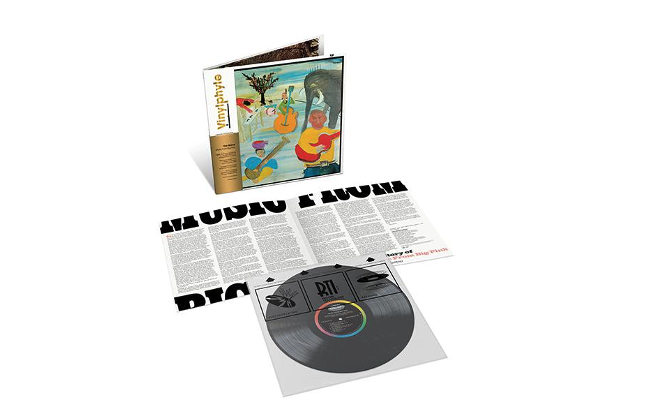
The Band’s Music From Big Pink is the latest addition to UMe’s Vinylphyle series exemplifies its mission to present essential albums across genres with uncompromising sound quality and packaging. It’s been meticulously mastered by Joe Nino-Hernes and pressed at RTI on 180-gram black vinyl. Similar in presentation and execution to Blue Note’s acclaimed Tone Poet series, the production and packaging seek to honor the stature of the recording and include tip-on wrapped gatefold jackets in satin matte finish, printed on clay-coated board, with archival poly sleeves and four-panel inserts featuring newly commissioned liner notes by Rick Florino. Music From Big Pink was cut all analog from the 1968 original album master.
Since launching in November 2025, Vinylphyle — billed as “a premium vinyl experience for people who love vinyl” — has delivered best-in-class pressings of an eclectic range of landmark albums spanning genres and eras. Each release features all analog mastering from original sources whenever possible, world-class RTI pressings, and deluxe packaging designed to provide a definitive listening experience for discerning collectors and music lovers alike.
Order all Vinylphyle titles here: https://udiscover.lnk.to/vinylphylePR
Originally released on July 1, 1968, Music From Big Pink seemed to spring from nowhere and everywhere at once. Drawing from the American roots music panoply of country, blues, R&B, gospel, soul, rockabilly, the honking tenor sax tradition, hymns, funeral dirges, brass band music, folk, and rock ‘n’ roll, The Band forged a timeless new style that forever changed the course of popular music. At a moment when psychedelic experimentation dominated the cultural landscape, Robbie Robertson, Levon Helm, Rick Danko, Richard Manuel, and Garth Hudson looked instead to the deep well of American roots music, creating an album that felt both radically new and deeply familiar.
Named after the salmon-colored house in West Saugerties, New York where many of its songs were written, Music From Big Pink emerged from a period of creative isolation following the group's celebrated tenure backing Bob Dylan. Recorded primarily at New York’s A&R Recording and Los Angeles’ Capitol Studios, the album transformed songs like “The Weight,” “Tears of Rage,” “This Wheel’s On Fire,” and “I Shall Be Released” into something entirely its own.
Released during a turbulent season of war and socio-political unrest and arriving amid other era-defining works by The Beatles, Jimi Hendrix, and The Rolling Stones, Music From Big Pink astonished critics and fellow musicians alike. Although it peaked at No. 30 on the Billboard 200, Music From Big Pink is now widely regarded as one of the most important recordings in popular music history.
Making Americana before the term even existed, The Band created a debut album that not only launched one of rock’s most influential groups but helped redefine what American music could be.
The Band – Music From Big Pink
Side A
1. Tears Of Rage
2. To Kingdom Come
3. In A Station
4. Caledonia Mission
5. The Weight
Side B
1. We Can Talk
2. Long Black Veil
3. Chest Fever
4. Lonesome Suzie
5. This Wheel’s On Fire
6. I Shall Be Released
The Band’s debut long-player with John Simon at the helm, Music from Big Pink, was released by Capitol Records in July 1968. Simon’s sessions for the album, engineered by Tony May, Don Hahn, and Shelly Yakus, began in New York at Phil Ramone’s A&R Studio in the fall of 1967. Upon its release, Music from Big Pink didn’t so much “drop” as detonate, yet another catalytic disruption in a year fraught with change.
“John Simon,” underlined songwriter and record producer Al Kooper, founder of Blood, Sweat & Tears, “went from doing the first Blood, Sweat & Tears album to doing Music from Big Pink. . . I put him right up there with George Martin, Jerry Ragovoy, and Phil Spector. John had an understanding of the singer-songwriter. He was an erudite musician. And that was the important thing.”
Simon was able to employ the coveted Capitol echo chambers, as well as their custom-made EMT plate reverbs and the fabled isolation vocal booth.
“I thought the sound was really important to me, too,” Robbie Robertson expressed to me in a 2017 interview.
“It still is. My first attraction to rock ’n’ roll was just as much [about] the sound. . . So, when I heard these early Sun and Chess records, I thought, “What is going on here?” . . . . Because records before that, you didn’t think that much about the sound. It was a vocalist and some music in the background.”
Just before Music from Big Pink was completed, some executives at Capitol Records balked at releasing an album by “the Crackers,” the name on the contractual agreement. A group decision was made to simply call themselves “The Band.” Friends and neighbors routinely referred to them as The Band, evoking that potent sense of community that defined their musical identity. Strategically, it was good for business; the LP could be easily filed in bins domestically and internationally.
All that remained was the cover art, which, in keeping with their contrarian sensibilities, was absent a title, the artist’s name, and an identifying photograph. Not exactly Marketing 101 for a debut recording, but it turned out to be a whole lot more. Bob Dylan painted the now-iconic cover, a childlike evocation of musicians at work and play. The gatefold sleeve from photographer Elliott Landy opened to reveal a touching portrait of the group and their families, hardy, plainspoken folk who looked like they’d stepped out of a Willa Cather novel.
When I spoke to Al Kooper in 2017, he recalled, “I heard Music from Big Pink when it was finished at [The Band’s manager] Albert Grossman’s office. I went, ‘Holy shit! This is ridiculous.’ I didn’t think it was gonna be like that. I had no idea what that was gonna be like. . . I kicked myself for not going to the sessions since I was invited.”
“When we hooked up with Bob Dylan,” continued Robertson in our 2016 conversation, “it was made clear to Bob and to Albert, ‘this is a whistle stop for us.’ We are on our own path. We’ll do this in the meantime, but we’re going to do our own thing. . .
“After we did the thing with Bob, [he] wanted to do more. But he had this accident and . . . Albert had no idea what we were or what we could do. No idea. He liked us. He thought it was really interesting what we did with Bob. But he said, ‘I think I can get you a deal for doing an album of instrumentals of Bob Dylan songs.’ So, I said, ‘All right. Let me talk to the guys about that.’ And I thought, ‘Albert has no idea.’
“When we recorded Music from Big Pink, Albert was astonished by the results of that record. And he so embraced it and made it his own, and all that other stuff vanished. He was like, ‘I knew it all along.’ It fit so perfectly into his scenario.
“Bob and The Band were so close to Albert. We had been through everything together. Like I say in my book [Testimony], we were like war buddies. And we had gone to the edge together. And because we had done all that stuff and The Basement Tapes, and through all of this, [we] still had no idea of what this was going to be when we did it. That was thrilling.”
On July 1, 1968, Music from Big Pink was shipped from distributors of the Hollywood-based Capitol Records to reviewers, radio stations, retailers, and rack jobbers, including Sam Goody, White Front, Discount Records, Musicland, the Wherehouse, Wallichs Music City, and Korvettes.
Playboy magazine published a rather interesting review of Music from Big Pink in their November 1968 issue: “While nobody in this untitled group really sings well, it doesn’t matter; their instrumental conceptions and their togetherness are a gas on the likes of Robbie Robertson’s ‘To Kingdom Come’ and Richard Manuel’s ‘We Can Talk.’ All in all, it’s one of the best folk-rock sets we’ve heard.”
The release of Music from Big Pink in the summer of 1968, a little over a year after the Beatles’ Sgt. Pepper radically altered the music landscape, underscored the myriad ways thoughtful musicians were seizing the moment, heedless of commercial considerations.
In the late summer of 1968, I first met singer and songwriter Jackie DeShannon at the Laurel Canyon Country Store. She was doing a new album in Hollywood called Laurel Canyon for Imperial Records.
I recognized Jackie from a 1965 Shindig! ABC-TV appearance and newspaper coverage in the KRLA Beat. After I complimented her on “When You Walk in the Room” and “Needles and Pins,” Jackie said, “Have you heard the new LP of The Band? I just recorded ‘The Weight’ from Music From Big Pink atLiberty Studios. Harvey! Have you heard their songs?”
This was a woman who knew Elvis Presley and Eddie Cochran, opened for the Beatles on one of their American tours, and had songwriting credits with someone named Jimmy Page on a Marianne Faithfull LP I owned. I had heard her voice for half a decade on local AM radio stations KHJ, KRLA, and KFWB.
In her alluring Southern drawl—she was born in Kentucky, as Sharon Lee Myers—Jackie DeShannon gave me a stern directive I never forgot: “Boy, you need to go to Hollywood over to Wallichs Music City and get this album!”
“The Weight”wason the KHJ playlist, while the regional FM stations, KPPC and KMET, blared The Band’s LP constantly. I got paid from my after-school job at Clinton Laboratories and purchased Music from Big Pink at the Wallichs store. It sounded ancient, yet modern, and I wore the grooves out. One afternoon, I even schlepped out to Encino in the San Fernando Valley to Make-A-Tape on Ventura Boulevard, and, for a few bucks, got a copy transferred to an eight-track cartridge.
“In the summer of 1968, when Music from Big Pink was released, I had left the Kaleidoscope and was a member of the Nitty Gritty Dirt Band,” recalled multi-instrumentalist Chris Darrow in a 2016 interview with me. “B. Mitchel Reed, a disc jockey on KMET-FM in Los Angeles, spun the record for a week on his radio show. That’s when I first heard the album, and I loved it.
“I earlier became aware of the personnel of The Band through a drummer friend of mine, John Ware. He had grown up in Oklahoma and had taken drum lessons from Levon Helm. The songs on the album were great, the playing was organic, and the church-like, mystical sound of Garth Hudson’s Lowrey organ sealed the deal. My favorite song is the classic, ‘The Weight.’”
Music from Big Pink arrived here in the late ’60s, a time when many native Americans were choosing self-imposed exile from their roots and realities. The Band, however, were five spiritually hungry young men who had left Canada, ‘The Land of Snow,’ committed to a respectful wandering. Their first album, Music from Big Pink, was simultaneously a celebration of and a rededication to the traditional values which many Americans were in various stages of discarding.”
“The first Band LP and the earlier Basement Tapes evidence an environment where confinement and freedom are linked together,” theorized writer, poet, and deejay, Dr. James Cushing. “There is a sense of community, but not everyone is on top of everyone. Both Dylan and The Band had left traditional recording facilities in New York City and Nashville and were now working in a place where human agency and not record labels determined the product.
“I remember that, in 1968, we all had a sense of expectation for this album, since it was the closest thing to ‘a new Bob Dylan album’ since John Wesley Harding. But one of the marvelous things we all quickly discovered, devouring Big Pink was Jaime Robbie Robertson, who not only played great guitar but had studied songwriting craft with Dylan.
“In hearing the debut Band LP and seeing the album graphics, one gets a sense of the rustic world that informs these recordings. But it’s important to remember that the actual environment played a big part in the reality (not the myth!) of Big Pink. When you actually visit the Hudson Valley, you notice the large number of churches and bars in the area—places to sin, places to gain forgiveness. And between November and March, it’s covered in snow. It’s a world that’s been going on for two hundred years.
“West Saugerties and the surrounding vicinity give context to the hymn-like aspect of ‘I Shall Be Released’ and ‘This Wheel’s on Fire,’ two Dylan tunes that he gave to the newly christened Band to record. Also, Big Pink can be seen as a return to a place of cold weather, the promise of lots of snow. In other words, it’s a place not unlike the Mesabi Range in northern Minnesota, where Dylan grew up.
“Bob Dylan’s shadow does not loom or lurk around the album. It’s a light. And the light shines at the very beginning and the very end. And the light shines on all the songs in the middle. . . Curtis Mayfield’s influence on the high-pitched vocal on ‘I Shall Be Released’ is obvious. Robbie Robertson had seen Mayfield with the Impressions in the early sixties and loved Curtis’s guitar work and vocals.
“The more you listen, the more mysterious it becomes and the less you can explain what is going on. The visuals on the album and the rustic vibe were new as well.”
“The first time I heard ‘The Weight’ was on theObscene Steven Clean show, over the airwaves of KPPC-FM, the short-lived underground radio station out of Pasadena,” remembered author, historian, and record producer Gene Aguilera.
“It was Big Pink music. It was “Mountain Music” by The Band. American roots music brought to you by Canadians. After shaking down East L.A. to find the 45 (on the familiar Capitol Records orange-and-yellow swirl label) I was had—hook, line, and sinker. 1968 was a formidable year that saw album releases by the Beatles, Van Morrison, Hendrix, Cream, the Stones, and the Doors; yet the auspicious debut of Music from Big Pink was like a breath of fresh country air. Yes, they were Dylan’s backup band—but Mr. Jones repaid his debt by inking three chestnuts and painting the front cover.”
“I heard about The Band’s Music from Big Pink record, and anything associated with Bob Dylan was gonna get my attention,” wrote record producer and multi-instrumentalist Don Was in a 2016 email to me.
“It appealed to me on a deep emotional level. And it transcended fashion. And fashion is the thing that keeps life cycles brief in popular music.
“In 1967, in Detroit, I was back at school and talking to Doug Fieger [later founder of the Knack]. I pulled Doug aside, and he put me on headphones, and it was the first time I heard Are You Experienced and Fresh Cream. I was on headphones from the Beatles’ Sgt. Pepper is going forward. And then, in 1968, Music from Big Pink on headphones!
“Detroit in the summer of 1968. I never heard anything like it in my life. Even though all the elements were familiar, no one put it together like those guys. They tapped into something. We call it Americana now. It evokes something from Stephen Foster. But I always felt The Band tapped into something really primordial. I can’t quite explain it, but something that was a thousand years old. The music addresses the DNA. It was speaking to me in a special way.”
The Band’s maiden voyage vinyl certainly made a big impression in the United Kingdom.The weekly music British periodical Disc and Music Echo bannered Dylan’s Band as a cool rave LP of the month in its November 9, 1968 issue: “Piano and organ together—shades of Procol Harum—give a fine and rich sound. Bass and drums are unbelievably tight and exciting. And the guitarist is something of a genius. In fact, the feel of the whole album is one of controlled magnificence.” Ringo Starr, George Harrison, and Eric Clapton all hailed the platter.
“I loved The Band’s debut LP,” emphasized record producer Andrew Loog Oldham in a 2017 correspondence with me.
“I felt they were changing the size and depth of the pitch we played on; they did what the first Paul McCartney album and subsequent Ram [1971] were supposed to be. Not that Ram was bad. It was a British breath of fresh air, the way that Paul McCartney stripped it all down. That’s one thing. But here we are in the early summer of 1968 when the first Band album arrives. After what America had been through: Robert F. Kennedy getting killed in Los Angeles in early June 1968, and previously the murder of Martin Luther King Jr. in April 1968; recovery from the music of England from 1967 and ’68, and us, the Rolling Stones in ’67; and all the psychedelic bullshit, then this LP appears. It was the real Heaven’s Gate. Michael Cimino should have filmed The Band’s songs.”
During 2016, John Simon emailed me after I asked him about Music From Big Pink and collaborating with The Band.
“I loved making those albums. That's all I felt. It's fucking great. The genre called ‘Americana’ is essentially just a spawn of The Band.”
(Harvey Kubernik is the author of 21 books, including 2009’s Canyon Of Dreams: The Magic And The Music Of Laurel Canyon, 2014’s Turn Up The Radio! Rock, Pop and Roll In Los Angeles 1956-1972, 2015's Every Body Knows: Leonard Cohen, 2016's Heart of Gold Neil Young and 2017's 1967: A Complete Rock Music History of the Summer of Love.
Sterling/Barnes and Noble in 2018 published Harvey and Kenneth Kubernik’s The Story Of The Band: From Big Pink To The Last Waltz. In 2021, they wrote Jimi Hendrix: Voodoo Child for Sterling/Barnes and Noble.
Otherworld Cottage Industries in 2020 published Harvey’s Docs That Rock, Music That Matters. His Screen Gems: (Pop Music Documentaries and Rock ‘n’ Roll TV Scenes) was published on February 6, 2026 by BearManor Media. Kubernik is currently researching a book on the Beatles for a UK publisher.
Harvey spoke at the special hearings in 2006 initiated by the Library of Congress in Hollywood, California, discussing archiving practices and audiotape preservation.
In 2017, he appeared at the Rock & Roll Hall of Fame in Cleveland, Ohio, in its Distinguished Speakers Series and as a panelist discussing the forty-fifth anniversary of The Last Waltz at the Grammy Museum in Los Angeles in 2023. Harvey Kubernik attended The Band’s farewell concert in San Francisco).
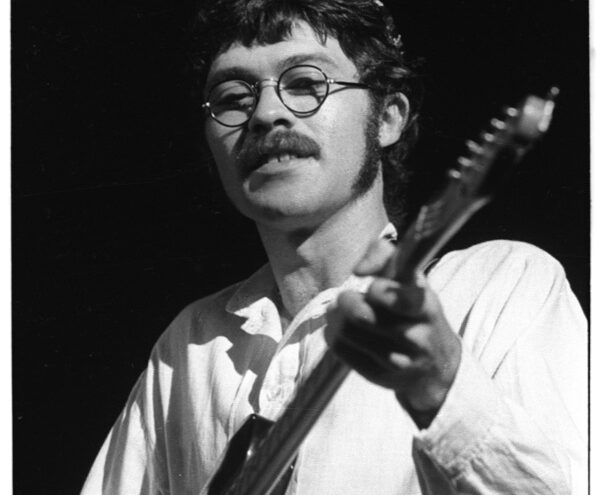
Photo of Robbie Robertson by Henry Diltz, courtesy of Gary Strobl at the Diltz Archives