
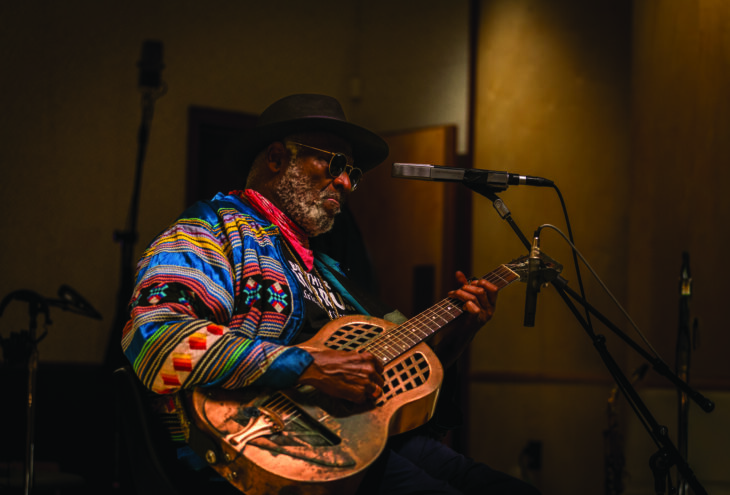
“Jazz will give you back your mind. Reggae will give you back your body. But blues, the blues will give you back your soul.” – Taj Mahal
Known for catapulting the traditional American blues sound onto the world stage and blending genres to expand its impact, Taj Mahal incorporates Caribbean, West African, Hawaiian, and Pacific Island sound, alongside an early folk and roots tradition. First reviving interest in acoustic blues in the late 1960s and ‘70s with albums Taj Mahal and The Natch’l Blues, he is recognized today for his deep, relaxed vocals, multi-instrumental mastery, and an ever-present passion for the genre. At 84 years young, the legendary blues artist has no intention of slowing down. With over 40 albums, studio recordings, and numerous live, collaborative, and compilation albums in his catalog, Time is his first release with The Phantom Blues Band since GRAMMY-nominated Maestro, in 2008.
Shares Mahal, “We created quite a bit of music in and around the second album [2000’s GRAMMY-winning Shoutin’ In Key, following GRAMMY-winning Señor Blues], so we stacked that up. Title track ‘Time’ is an unreleased Bill Withers song that came through friend Steve Berkowitz, with other project contributions including Otis Redding, Ziggy Marley, and musicians Jon Cleary and Mick Weaver.”
As for favorites, Mahal says, “It’s like children, grandchildren—and now great grandchildren—they’re all beautiful, they’re all fun, you know what I mean? I just love what we’re doing. I don’t put out music I don’t love.” Adds Mahal, “I don’t have a locker full of tunes that haven’t been put out. Almost every album I’ve done is what was recorded. If the album gets reissued, we might [add] a bonus track or two.” The process is authentic and in the moment. “Never record anything that you don’t love. Del Shannon got tired of quacking like a duck [and] literally just left the stage one night,” adds Mahal. “Every time you step up to play is a time you get to play, so you better figure out what it is that you want to do.”
Mahal’s early family-centered environment remains at the core of everything he does, and he holds his parents in the highest regard, recognizing their sacrifices. Working day jobs in a factory and as a teacher, they were also very musical (his father a jazz pianist and mother a gospel singer), providing a foundation of jazz, gospel, and Caribbean music at home. Says Mahal, “That first radio was this great portal that relatives came through playing horns and pianos. I was really lucky. To think what my people from everywhere contributed, and how they lived their lives? It’s really important.“
Interestingly, Mahal originally wanted to run a farm (he holds a degree in animal husbandry and agronomy, follows a farm-to-table philosophy and, as a long-time supporter of Farm Aid, remains passionate about food sovereignty and sustainability). “As a young black man at that time, I did not have the kind of collateral that it would have taken to get involved in a farm,” says Mahal, “and I certainly wasn’t gonna have my parents mortgage their house for me.”
“I was not going to be unhappy whether the music happened as a way of life to make a living, or it was alongside of whatever I chose to do because that was a personal thing with me, a spiritual space.” – Taj Mahal
Studying the work of Son House, Robert Johnson, Muddy Waters, and Howlin’ Wolf, Mahal leaned into their raw, traditional styles and foundational songwriting, singing with R&B dance band The Elektras (1961) before forming The Rising Sons alongside Ry Cooder (while at the University of Massachusetts Amherst). Attracting attention in the 1960s as part of the blues revival, the band signed to Columbia Records after moving to Los Angeles but never saw commercial success. Mahal stayed with Columbia as a solo artist (releasing Taj Mahal and The Natch’l Blues in 1968), drawing acclaim for his originality, which has gone on to impact blues, folk, and world music internationally.
Songs come in as downloads (sometimes fragments, sometimes the complete piece) and Mahal knows he is channeling the work. “The first job was to get out of my own way,” he says. “That’s a major job for humans in modern time. You’re more powerful than you’re allowed to think. There’s this you, the creator of all creation. Who is he, she, they, it? [Make] room for that creation to be there and for you to communicate spiritually, globally throughout the diaspora, throughout humanity. Put that antenna up and start communicating like that.” Mahal also feels it’s important to “look beyond your sphere” to discover new sound to add into your repertoire,
The real magic appears in front of an audience, reveals Mahal. “The music is part of everything we do, [but] the audience is a part of the performance. We can rehearse [and] it sounds great to us, we’re having a great time,” he says. “But it’s even bigger when the audience is there. Everybody brings their spirit and resonating chamber, and it just gets bigger and bigger.”
Of the new record, Mahal says, “I’m very proud of the guys that played with me here. The Phantom Blues Band is an exceptional bunch of musicians. They know the language of whatever we do, and I’ve never heard them stumble or complain about a challenge musically I’ve ever put it in front of them.”
Having recorded steadily since the late 1960s, receiving five GRAMMY Awards, 2025’s Lifetime Achievement Award, Blues Hall of Fame induction, and a United States Congressional Honor, Mahal is known as a ‘musician’s musician.’ Having collaborated with Keb’ Mo, Bonnie Raitt, Ry Cooder, and many others, his genre-blending approach has paved the way for further roots revivalism, and his worldwide impact on artists continues. Teaming up with Keb Mo (as “TajMo”), the “Room On The Porch Tour” begins September 1 (See tajblues.com/tour).
Photo by Mike Coeyman