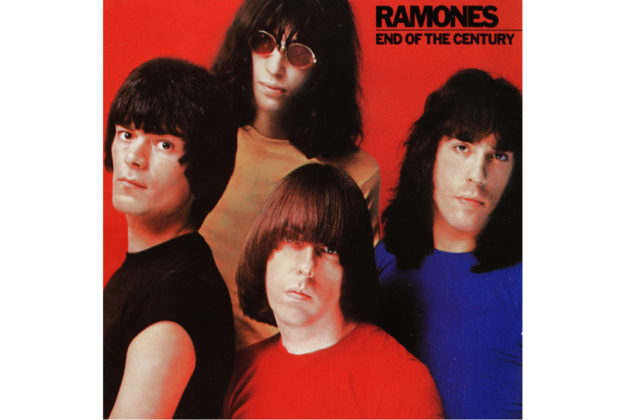
I also remember Joey recording his vocals with a unique setup in the studio.
Boris Menart, an engineer on the EOTC sessions, notes, “[One] thing Phil did was when they recorded Joey’s vocals, because he was so used to standing onstage holding his microphone, he would sing with one microphone on the stand and another microphone right above him that would record as well. He was so used to standing holding a mike in front of his face when he was singing he was sort of comfortable like when he was onstage. In the mix, we would bring his vocal back so he wasn’t right on top of it.”
Joining this tumultuous brotherhood on some of End Of The Century’s tunes were several guests.
“The supplemental musicians on End Of The Century,” confirms Dee Dee, “the guests had to save it. They made an impression on the way things were recorded, and we’re lucky we had ’em. I think I played my bass parts, and Mark played most of the drums, but everybody tried to help make the record. Thank God Ed Stasium was there, Jim Keltner, and the Kessels.”
Longtime Ramones associate Ed Stasium served as musical director on End Of The Century and deserves an office in the United Nations building for his efforts. “Ed was a very skillful guitar player and producer,” Dee Dee mentions. “Phil didn’t have to say too much to us. Phil could ask Ed, and he would translate to avoid conflicts. Musicians don’t take well to criticism. I was having a good time, no matter what. The more people who were there, the safer I felt.”
“Ed Stasium is into hard rock, he’s easy to work with, a pleasant guy,” underlines Johnny Ramone. “I never remember having a problem with him on anything, ever. He was a nice guy, always a joy to work with.
“It was stressful. I wanted out of the band. I was getting pains in my chest….usually I can deal with the stress, but…”
“Johnny Ramone was the new Link Wray,” emphasized Dan Kessel. “We were proud to be Ray-Men. Johnny was a phenomenal bandleader. Dee Dee and Marky were both extraordinary too. And Joey was inspirational.
“When we were recording, David and I would thrash on our acoustic guitars all night long until our hands were bloody and raw. We’d mainly just keep playing rhythm, staying out of Johnny’s way, following Marky and Dee Dee. Other times we’d play more nuanced things, rhythmically or harmonically, as requested, when Phil was building on the arrangement.
In 2002, multi-instrumentalist Dan Kessel emailed me about the guitars utilized for the EOTC adventure.
The arsenal for Spector/Ramones included: an Ibanez custom prototype for proposed Barney Kessel model, played extensively by Barney on world tours and recordings throughout the 1970s; A pair of Everly Brothers model, Gibson J-185 acoustic guitars (utilizing both Nashville and standard tunings); A Rickenbacker 370 model electric 12-string, with custom treble booster; A Danelectro 6-string bass guitar (used on Pet Sounds, Elvis Presley sessions, the Righteous Brothers ‘You’ve Lost That Lovin’ Feelin’, and Phil’s production of Ike & Tina Turner’s “River Deep, Mountain High.”)
In addition to this, a Gretsch 6120 Duane Eddy model electric guitar; an Epiphone Casino hollow body electric (a gift from John Lennon).
“We used Barry Goldberg on the piano and organ on practically all the sides,” Spector stated in his email to me. “And he was wonderful. The boys really liked him too. Everything Steve Douglas played was immediately rock & roll musical history. It was that good, and there was absolutely nobody like him.”
If you were to ask Barry Goldberg, songwriter-producer (as well as the keyboardist with the Electric Flag and Bob Dylan sessions and live gigs), he had one of the most incredible times of his life playing organ, keyboards, and what he calls “a celesta kind of Buddy Holly thing” on the record.
“Phil called me up in 1979,” marvels Goldberg, “and said, ‘I’ve got something really important for some sessions.’ But he didn’t tell me what it was. I didn’t know until I walked into Gold Star.
“I found out when I walked in and saw all the Ramones, right. I loved the Ramones. They were rock & roll. And I started talking to them, and they found out I played keyboard on the Mitch Ryder stuff, and they loved ‘Devil With A Blue Dress On.’ They accepted me.”
Drummer Jim Keltner played on “Baby, I Love You.” Jim had known Phil for years and worked with him many times, including John Lennon and Leonard Cohen studio efforts.
“The Ramones played great together. Their drummer Marky was remarkable,” Keltner volunteers. “They had lots of power and energy. It made sense that Phil would produce a record for them. I mean, he’s always been punk.”
“You either loved it or hated it,” Joey told Uhelszki of End Of The Century.

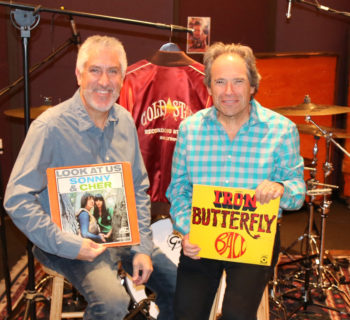
David Kessel, Dan Kessel, Rodney B, Blake Xolton, & Joey Ramone at GOLD STAR
“The thing was, Phil had never worked with a band before, especially a band like us; his artists were more of his own conception,” Joey continued. “The Ramones were a band, and we had our own focus, and Phil had his own focus, and in some ways it was a clash. The thing is, Phil likes to dominate and manipulate, so it was a little strange. But on the other hand, I felt like I was performing for the master, you know what I mean? I learned stuff from Phil; it was the kind of experience few people have.
“It’s a historical record,” concluded Joey to Jaan, “and one of the last ones Phil actually completed. He’s a very passionate, high-drama person. I still admire him. Of course, I can say this now looking back on the situation—but during his episodes nobody was enjoying, or having any of it . . . . All work ceased and we were all pissed off with his drinking, his antics, high drama, and the insanity.”
Contrary to popular belief, the End Of The Century sessions with Phil Spector didn’t fracture some already-established bond between the Ramones, nor was it as dramatic as depicted in the folklore around the LP’s initial release. Although, according to what Joey told Uhelszki, it was true that Phil pulled a gun on Dee Dee—after Dee Dee had taken a swing at him. Spector had been packing heat after he was robbed just before the project began.
“The Ramones were a pain in the ass too, come on,” Dee Dee admits. Still, he adds, “Playing with the Ramones was wonderful—it was probably like bungee-jumping.”
When the record was first released, it received great acclaim from much of the mainstream press (notably Rolling Stone and Time, which deemed it one of the best rock albums of the year) and would go on to become the Ramones’ biggest chart success (#44 on Billboard).
Though punk fans remains divided on the album’s merits, there is a growing cult of admirers who embrace it.
According to Martin Banner of punk fanzine Flipside, “The best thing about End Of The Century for me is that they stayed true to their heroes. The Ramones loved the bass-guitar-drum churn of the early Beatles, the Wall of Sound of the Spector girl groups, The Beach Boys’ perfect, three-minute pop gems, and the roar of the ’60s garage bands. They fused them all into one amazing, underrated record. It’s a rock ’n’ roll car-crash of Spector-sized ambition and Ramones’ energy that sounds better and better with each passing year.”
In the end, End Of The Century (the title was Spector’s) was the by-product of environmental historic tensions; faith-based initiatives; stress; instrument collision; contracts; passion, fury, and confusion; freedom of will; paychecks; a continuing musical education (for everyone involved and hopefully everyone listening); the Professional Musicians Local 47 union; alcohol and soft drinks; herring, tongue, and hearty, delicious corned-beef sandwiches from Canter’s deli; and particularly the harsh melodic tunes on oxide-soul contracts played by a nervy rock ’n’ roll band, aided by a few deck hands, produced by a maverick music man that definitely made a retail, fiscal and cultural impression.
"Unlike most every single other remnant of the old school's olden guard dismissive of – no, make that threatened by the new sonic Spirits of '76, Phil Spector recognized in those very seismic shifters a rebellion 'n' roll that had far too long been gone from the Top 40," insists Gary ...make that Gabba Pig Gold.
"It should come then as no shock whatsoever that the band he chose to lift out of the new waves onto his Wall of Sensation was the one which, with its lead singer's inflections alone, mixed Peter Noone and Ronnie Ronette with the six-string buzzsaw of sand, surf and far-from-California sun.
"Most unfortunately though, it has since been cruelly misreported – often by some of the very participants themselves – that the unholy union of Phil to Ramones produced little but the last bonafide artistic gasp from either; lurid tall tales of Mannlichers and Manischewitz clouding what in truth was one of the most courageous, not to mention loudest months in Gold Star history. Suffice to say the album which resulted, though polarizing to many within the Ramones' blinkered fanbase, stands today as perhaps the final Big Bang in all of American rock, not to mention a sorry signpost towards what the dreaded digitized Eighties should have sounded like had End Of The Century spent at least as much time on chart-tops as, say, The Wall or The River.
"Instead, what we can, and should hear to this day within its groove is thirty-four minutes of pure, powerful pop with a sly wink and nod to the past via a brave, bold barreling towards the high-risk future all involved were facing, if not facing down. No, EOTC didn't make any Ramone a fortune or a household name, leading man Phil soon after vanished forever back behind his Wall of Shadow and, alas, the Century they all sang of turned out to be quite some denouement to them, and to us. But, personally speaking, I still proudly file my vintage-1980 pressing right there alongside Odessa and Self Portrait: totems to the very ethic of possibly-flawed masterworks the world – not to mention your record collection – is so much the better to have in pride of place."