On August 3, 1966, stand-up comedian, social critic, satirist, and philosopher Lenny Bruce (October 13, 1925-August 3, 1966] was found dead at age 40 inside his Hollywood Hills home from an acute overdose of morphine.
His residence was on my route to The Preview House on Sunset Blvd. in Hollywood where I distributed admission tickets and sold newspapers.
Many folks in the neighborhood were saddened when reports of his death first broke on television screens.
Nearly sixty years ago on August 21, 1966, over 500 mourners paid their last respects at Eden Memorial Park Cemetery in Mission Hills, California. Principal Eulogy was read by Phil Spector who also paid for the funeral.
Lenny Bruce was certainly not forgotten around Southern California after his 1966 burial.
In August 1968, The Los Angeles Free Press presented the Murray Roman-hosted LennyBrucemas at Venice Pier. Roman was a standup comedian and writer on The Smothers Brothers Comedy Hour television series.
Over 20,000 people attended. The Barry Goldberg Reunion, Black Pearl, the Alice Cooper band, Pacific, Gas & Electric, Illinois Speed Press, C.T.A. (Chicago Transit Authority), Sweetwater, and the Outlaw Blues Band provided the musical entertainment. Radio stations KRLA, KMET, KPPC and KPFK were all involved promoting the event.
Around Lenny Bruce’s freedom of speech advocacy, the lingering obscenity busts, and numerous arrests, Lenny’s bold stand-up comedy performances and public observations were not routines, but podium examples of unfiltered verbal reality coupled with reflections about race, religion and relationships.
“Lenny Bruce started as a comedian, turned into a prophet, and ended as a martyr,” suggested author Dennis McNally in a 2026 email.
McNally in 2025 penned THE LAST GREAT DREAM How Bohemians Became Hippies and Created the Sixties.
“Although he used street language, he was never truly obscene. Instead, he pursued a mission to expose fraud, particularly as it manifested in daily sexual and religious life. Unfortunately for him, one of his favorite topics was the Roman Catholic church. A considerable number of district attorneys in America were of that faith, and they took offense, because Lenny was indeed blasphemous. They suspended the first amendment as it applied to him and crucified him with an endless succession of obscenity trials.
“Broken, he overdosed and died. But his heritage of seeing the lie in daily life affected an entire generation,” summarized McNally.
In 2003, a court case conviction from 40 years earlier was overturned with a posthumous pardon by New York governor George Pataki, who exonerated Bruce in a statement saying, "a declaration of New York's commitment to upholding the First Amendment."
I would prefer to write stories and tributes that celebrate arrival: The 50 and 60-year anniversaries of epic albums, landmark music events and/or birthdays, not just focusing on day of death or obituaries.
I’ll do them on occasion upon editorial request, but they are multi-voice narratives with unique bio-regional information from my archive of personally conducted interviews.
However, let’s be realistic: We all know about the passing of President John F. Kennedy on November 22nd 1963, but how many people even remember his birthdate of May 17, 1917?
So, here’s a 60-year memoir on Lenny Bruce who was a local fixture in Hollywood, saluting his departure from this particular world-is-a-stage in 1966.
As Keith Richards told me during a 1997 interview on Sunset Blvd., “If you’re gonna cover something you better do it differently.”
He was obviously alluding to the Rolling Stones studio and live repertoire, but this specific task is a mission.
Lenny Bruce was a frequent guest on black and white television shows I watched on my parent’s television set on 5th St.
In 1957 I viewed the Teddy Bears, (Phil Spector, Marshall Lieb and Annette Kleinbard) on the local KTLA TV program Rocket to Stardom, sponsored by salesman Bob Yeakel, who used to hawk Oldsmobiles during the broadcast from his showroom. Lenny Bruce with Joe Maini, Jack Sheldon, Dennis Hopper and Jim Keltner also appeared on the show.
During 1963-1972, my family and I would see Lenny Bruce, Richard Pryor, Al Jarvis, Miles Ciletti, Nik Venet, Jack Nitzsche, Steve Allen, Rodney Bingenheimer, Micky Dolenz, comics, B-movie actors, actresses, directors, screenwriters, prostitutes, pimps, surfers and Vine Street-based American Federation of Musicians 47 Union session men like Don Peake, Sonny Bono, David Kessel, Leon Russell and Don Randi, at the Hollywood Ranch Market on 1248 N. Vine St. Their big sign read WE NEVER CLOSE.
“We all went to the Hollywood Ranch Market,” exclaimed Randi. “The tater tots and the chicken gizzards! In the late fifties they even had a donut machine there!
“I saw Lucille Ball one late night. In a full fur mink. Desilu Studios was nearby. She gave me the biggest smile.”
"In spring, 1964, I glimpsed Lenny as he was going into a theater at La Brea Ave. and Hollywood Blvd," reminisced author/musician Jan Alan Henderson in a July 2023 interview we did.
"We were going to ABC Books to buy the first books on the Beatles on the way to Le Conte Junior High in East Hollywood.
"My mother knew Lenny's wife Honey as they were neighbors. My mom was a volunteer for the United Way and the Bruce household was in the district. Lenny was the one who fought for First Amendment rights."
From 1966-1969 I attended Fairfax High School in Los Angeles near the border of West Hollywood. Lenny’s daughter Kitty, was in my younger brother Kenny’s grade, sitting next to her in Spanish class. Kitty is the God daughter of Phil Spector.
I met Kitty again in June 1972 after a Rolling Stones concert at the Fabulous Forum in Inglewood when she had a waitress shift at Shipp’s restaurant on La Cienega Blvd.
In 2014, Brandeis University acquired the personal papers of Lenny Bruce from a collection kept by Kitty Bruce. It houses photographs, news clippings, recordings, manuscripts and other material. A generous gift from the Hugh M. Hefner Foundation made the transfer possible.
In 2016, a two-day symposium at Brandeis University was held which presented a keynote address by Brandeis alumna Christie Hefner—daughter of Playboy Magazine founder Hugh Hefner—on free speech, comedy, and Bruce’s legacy impact on social change.
Her appearance was a part of Comedy and the Constitution: The Legacy of Lenny Bruce. She commented on the special and deep friendship her father had with Bruce, and their joint passion for free speech.
“In Hef’s battles, he had a large company behind him and a powerful platform in the magazine. Lenny had none of that. Just friends. And Hef was one of those friends.”
Playboy magazine first introduced me to Lenny Bruce in the sixties.
40 years ago, I spent a delightful afternoon at a jazz event held inside the Playboy mansion in Holmby Hills. Longtime Bruce supporter and advocate Hugh Hefner briefly reminisced about his friend.
I complemented the host about a video I watched from an October 1959 television episode of Playboy’s Penthouse, where Lenny was introduced on screen with two Playboy playmates. He smiled and lamented, “Lenny Bruce sadly died for our sins.”
Numerous stand-up comics, performance artists, lyricists and musicians owe a tremendous debt to Bruce’s albums, books and watching documentaries on him.
In his autobiography Life, Keith Richards wrote about listening to Lenny Bruce albums as a teenager. “I thought from there I could get a thread to the secrets of the culture. He was my entrée into American satire.”
Bruce’s club act in San Francisco made an impression on singer and songwriter Grace Slick, before she joined Jefferson Airplane. In the Great Society she penned “Father Bruce” one night after his show.
“I met Lenny Bruce in 1964, ’65,” recalled photographer and musician Henry Diltz, then a member of the Modern Folk Quintet.
“We played some gigs together. MFQ did a week opening for him. And Lenny said marijuana, I call it God’s herb, would be legal one day because he knew too many law school students smoking it. We used to say, ‘Someday it will be legal. Because someday we’ll grow up and we will be the lawyers, judges and the senators.’”
A radio clip of a news broadcast in "7 O' Clock News/Silent Night" by Simon & Garfunkel has a station audio of Bruce's death.
Another selection on S&G’s Parsley, Sage, Rosemary and Thyme, "A Simple Desultory Philippic (or How I Was Robert McNamara'd into Submission)," where songwriter Paul sings, "... I learned the truth from Lenny Bruce, that all my wealth won't buy me health."
Tim Hardin's fourth album, Tim Hardin 3 Live in Concert, released in 1968, includes the song "Lenny's Tune" about his friend Bruce.
When bluesman John Mayall first moved to the United States in the summer of 1968, he lodged in Laurel Canyon for a short period in the basement of engineer John Judnich’s house.
Judnich was a confident of Lenny Bruce and his right-hand man. John owned the Tyco Brae sound company supplying the Pinnacle Dance Concerts at the Shrine Exposition Hall. While visiting Judnich’s pad, Mayall also catalogued and notated rare Lenny Bruce tapes for Judnich.
John Mayall's 1969 live album The Turning Point opens with the song "The Laws Must Change," with the lyric "Lenny Bruce was trying to tell you many things before he died."
Multi-instrumentalist and songwriter Al Kooper, at age sixteen went to the recorded February 4, 1961 Lenny Bruce at Carnegie Hall midnight show.
So, I wasn’t surprised when Kooper’s music mate Bob Dylan in 1981 placed "Lenny Bruce," on his Shot of Love album. It describes a short taxi ride the two men shared. In its concluding line, Dylan sings, "Lenny Bruce was bad, he was the brother that you never had."
At the opening night November 7, 1974 theater premiere of Lenny, a biographical drama film about Bruce starring Dustin Hoffman and directed by Bob Fosse, I was somehow invited to stand in the movie business guest list box office window line with Dylan, Lucille Ball and her comedian and actor husband, Gary Morton.
During 1998 I interviewed Chrissie Hynde. In our conversation we talked about Dylan. “I'll tell you another great Dylan album, that was not one of his most popular ones, was Shot of Love. The song, ‘Lenny Bruce.’ Jim Keltner is the perfect drummer for any band if you ask me. He's great with Bob Dylan and played on that recording. Keltner is a genius drummer.”
The sonic legacy of Lenny Bruce can also be heard in Genesis’ "Broadway Melody of 1974,” and the R.E.M. song "It’s the End of the World as We Know It (And I Feel Fine),” where Lenny is mentioned twice in the lyrics. In the Stranglers “No More Heroes,” there is a reference to Bruce, “Whatever happened to dear old Lenny?”
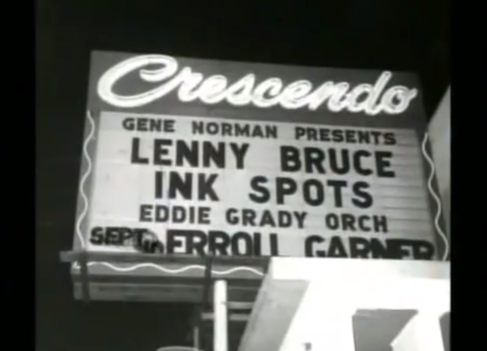
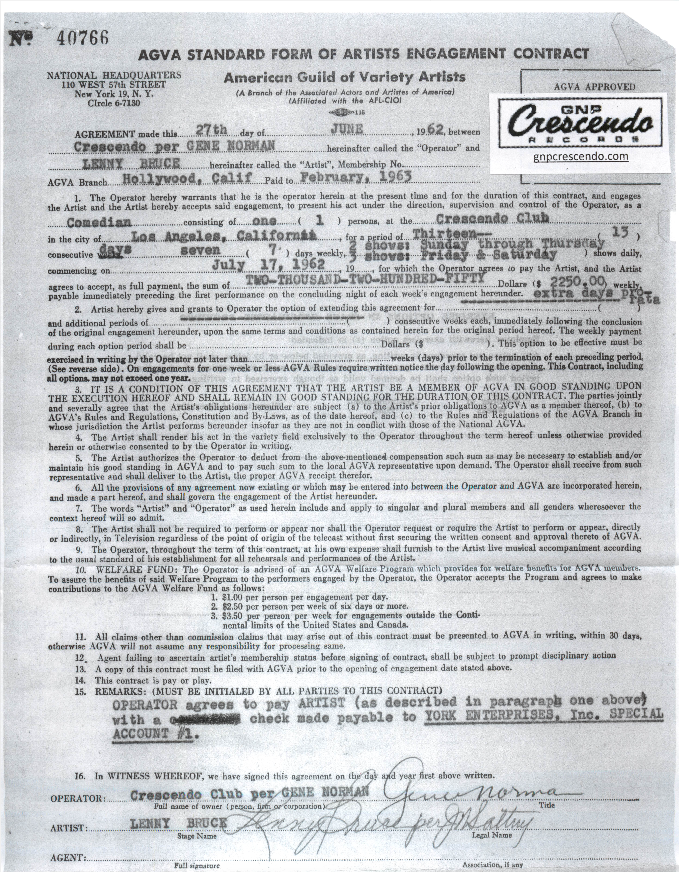
In my 2009 book, Canyon of Dreams: The Magic and the Music of Laurel Canyon, I spoke with jazz deejay, music impresario, GNP Crescendo Records founder, Gene Norman, who owned the Crescendo and Interlude venues. Norman booked Lenny Bruce and was a friend of his.
Norman and his son Neil lived at the top of Sunset Plaza Dr. for 60 years and they would have Christmas parties at their residences.
Every day after school His son Neil Norman would skateboard all the way down to Sunset Boulevard right past Lenny's house. Occasionally, Lenny would wave at Neil as he went by.
They knew each other well since Lenny worked for Gene frequently at Norman’s clubs. Neil was at many of Lenny's shows and they would often walk down the Strip on Lenny's breaks to get Wil Wright's Ice Cream on Santa Monica Blvd.
Norman headlined Bruce at his niteries and stood by Lenny when he was engulfed in legal woes.
“The Crescendo had been a restaurant and had a wonderful décor,” recounted Gene in a 2008 interview with me.
“The Interlude opened a year after the Crescendo. I started with comics. Woody Allen, Lenny Bruce, Mort Sahl, Bob Newhart, to name a few.
“Lenny Bruce got arrested in the parking lot during his gig. I was a little concerned about Lenny’s language because I had never seen that, but I recognized his originality. Sometimes we had trouble with Gerry Mulligan and Lenny Bruce at the beginning. I got them out of jail because I was friendly with the sheriff. Because I was on the radio and TV, and if they had an event, I would always help them.”
In a letter to The Los Angeles Times Calendar section on August 21, 2016, former Los Angeles sheriff deputy Wilmer Abram confessed to a vice squad assignment monitoring Lenny Bruce one night on Sunset Strip at a comedy club, most likely the Crescendo.
“As he began his act, he spotted me and my lieutenant and said something like, ‘I see we have some police present tonight. Since I can only be arrested if the police witness me committing a crime, let’s turn out the lights.’ So, the lights went out and stayed out for 20 minutes of Bruce’s set. He did his bits in the pitch dark to a captivated audience. We would have busted him if the lights had been on. Today his act would be considered to be on the clean side.”
"I saw Lenny perform a bunch of times around Hollywood,” volunteered Jim Keltner.
“When he was at the top of his game. Once at the Crescendo Club I took my girlfriend Cynthia with me. Lenny was so charismatic. He'd sit on a stool with a cigarette and just talk. You hung onto every word.
“As a teenager you wanted to be cool and no one was cooler than Lenny. I wanted to talk like him and act like him. I already thought I sort of looked like him.
“When the saxophonist Joe Maini died, they had a tribute to him in Hollywood at Shelly's Manne-Hole club. I was sitting at a table and Lenny walked by. He was with two other guys. He was wearing a long coat with the collar up. And as he passed by,” Jim sheepishly admitted, “I heard him say, 'Joe banged every chick in this room.'"
Guitarist/producer and arranger Don Peake, former lead guitarist (1961-1963) with the Everly Brothers and recording session veteran with Barry White, the Jackson 5 and Ray Charles, witnessed several Bruce gigs in the early sixties as well as enjoying a handful of gatherings inside Bruce's Hollywood home, formerly owned by the actor W.C. Fields.
"I was dating Lenny's secretary and she invited me over several times to his house," enthused Peake inside his Van Nuys recording studio during a July 2023 interview. "Then we'd all go together and see Lenny headline the Crescendo.
"The first time I actually met Lenny, I blurted out part of his stage show act which I had memorized. Lenny cracked up, and we became instant friends. What I said was 'Papa, Papa, it's so good to be out of the box!' I went on to say, 'Shut up! Drink your blood, bite Mama goodnight.' And that was a riff from his Count Dracula bit.
“Lenny was the voice of the Be Bop jazz comics. Along with Lord Buckley. His passing was a real tragic loss. He was a jazz comedian that all the cats in town really dug.”
Richard Pryor loved Lenny Bruce. I first met Pryor in 1974 at Pip’s Backgammon Club which later became a discotheque. Monti Rock III and Bob Crewe were in the room.
What an education I received as an invited listener hearing my dear friend Robert Marchese talk with Pryor. Marchese won a Grammy for producing the 1968 Richard Pryor Live at the Troubadour for the Dove/Reprise label. Henry Diltz took the album jacket front cover photo.
In a November 2022 phone call, Marchese reminded me, “I knew Lenny from around Hollywood during 1964-1966. I worked for Phil Spector and [musical director] Don Randi on The Big T.N.T. Show.
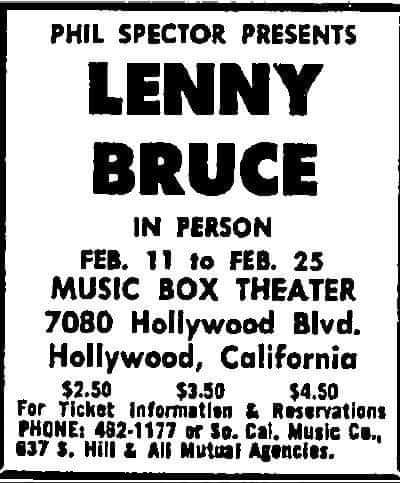
“In 1966 I saw a show Phil booked for Lenny at The Music Box Theater in Hollywood. Lenny was in a down period. Richard was a big fan of Lenny and I later said to him, ‘don’t try and be a crusader like Lenny Bruce. Be a comedian.’”
Lenny Bruce made a big impression on writer Paul Krassner, publisher of the satirical magazine The Realist since 1958.
In the mid-nineties Krassner Simon & Schuster published his autobiography Confessions of a Raving Unconfined Nut. Krassner’s literary career began at Mad magazine and writing for The Steve Allen Show. Paul also edited Bruce’s autobiography How to Talk Dirty and Influence People published by Playboy Press in 1965.
In 2016 the book was re-published by Da Capo Press in paperback edition, with a Preface by Lewis Black and a Foreword from Howard Reich.
During 2004 I interviewed Krassner.
“Groucho Marx once called me Lenny Bruce’s successor. It’s like you are part of a myth and handed some kind of torch,” mused Krassner.
“The audience are your peers, not your inferiors. And a lot of performers treat them like that. When Lenny Bruce would meet people, he wouldn’t do shtick. He would ask questions and learn. And them sometimes that would become part of his act; the dialogue that ensued. Lenny’s exact words were: ‘I am part of everything I indict.’
“He made it a point to try to never get a laugh because of a four-letter word. He’d be doing a character and for that aptness of character, he would use the language or he would analyze the language. Many comics today get their laughs with profanity, on the beat,” he continued.
“I was just at the Montreal Comedy Festival. 350 stand-up comics and the janitor had to come up on-stage to sweep the dick jokes off the stage. But there were a few that shone out in the midst of it.
“I learned a great deal from Lenny. When I first started performing, I was billed as Paul Maul, and he told me to use my real name. I learned compassion from him. He would take things from the point of view of the villain, you know, and carry it to the ultimate. He had empathy for all points of view. It didn’t necessarily get laughs, but he became a communicator, not just a comedian,” reinforced Krassner.
“When I first met him in 1959, Lenny would come out with a newspaper headline, or he’d play ‘Spanish Harlem’ from a record when he came on stage. He would do ‘show and tell’ things like that. Later on, it happened to be his legal briefs that he would be doing. I started off with an envelope of press clippings and I would just go off on that. And after a while, I dropped the clippings.
“Phil Ochs and I became friends. He’s one of those people who are still with me. On occasion, I’ll hear Lenny say, ‘Don’t tell that joke, it’s a cheap shot.’ Or I’ll go to an afternoon movie alone, and Ochs will have a reaction to the film.”
On Ochs’ Rehearsals for Retirement 1969 LP, “Doesn't Lenny Live Here Anymore?" eulogies Bruce.
Phil Spector is the co-writer with Jerry Leiber of “Spanish Harlem.” A favorite song of Senator Robert F. Kennedy, who sang it live with footballer Roosevelt Grier on guitar during his 1968 Democratic Presidential campaign. Phil once played a game of pool with Kennedy at The Factory Club.
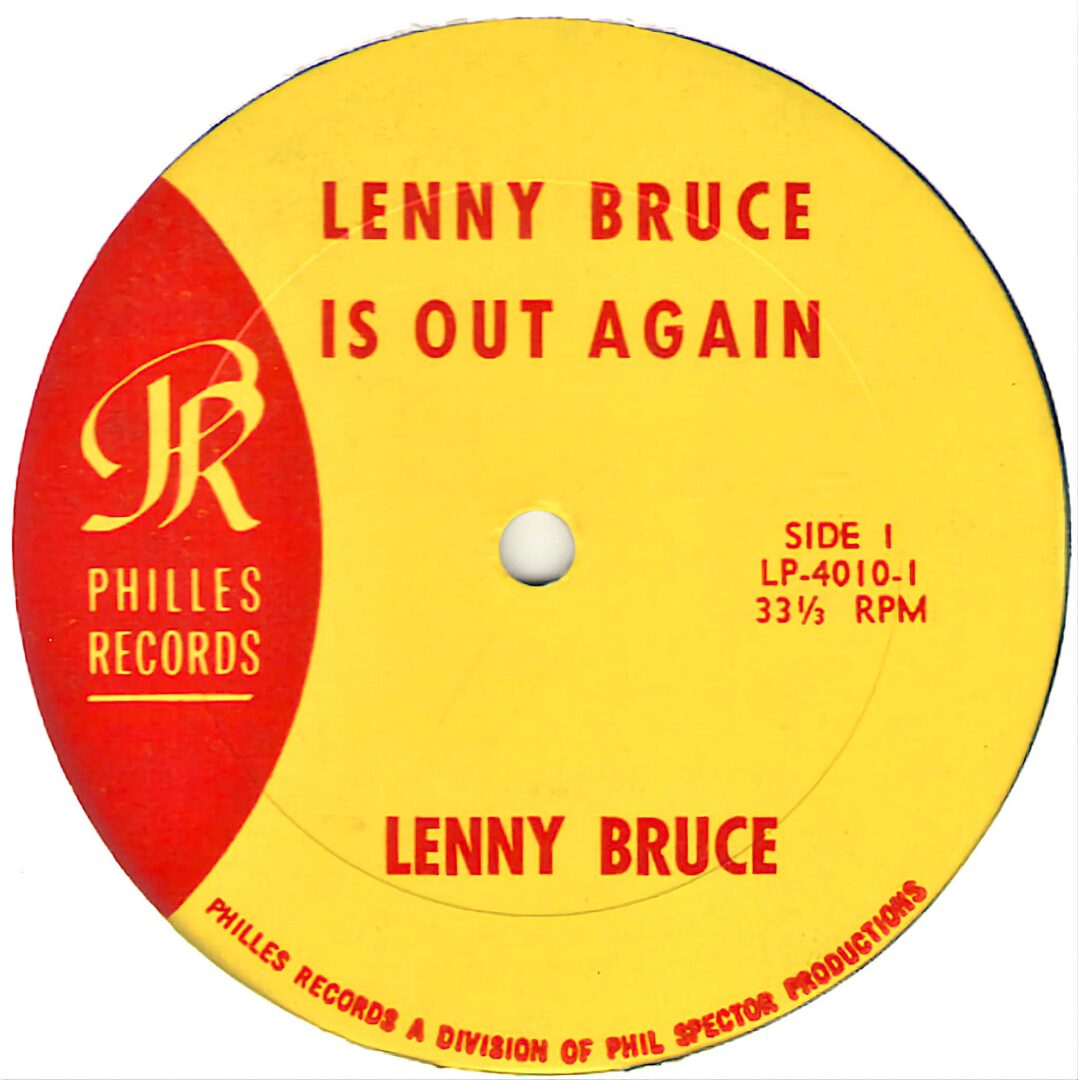
In the mid-seventies, Spector released an LP on his Warner/Spector label The Law, Language and Lenny Bruce. It was recorded the night before Bruce’s death.
Jerry Wexler, the former Atlantic Records executive and record producer, provided the liner notes to The Law, The Language and Lenny Bruce.
“Phil was born on Christmas Day in 1940,” posed writer and novelist Daniel Weizmann, who authored A History of Rock. “But I see him as the first truly post-Holocaust American Jew. He refused to grovel and play the Borscht Belt guy, the entertainment guy. And yet he had one foot in that old world grandiosity. His music was for the new utopian free-spirited teenagers, but it also contained the secret mania of having grown up with the shadow of genocide and the bomb. He meant business.
“In a way, he is the link between Lenny Bruce and Bob Dylan. Once Phil planted the seed, the sixties just had to happen.”
In a 1976 interview I did with Fairfax High graduate Spector for Melody Maker inside his Beverly Hills mansion, we discussed Lenny Bruce. Spector's heroes include Malcolm X, Bruce, Paul Robeson and Muhammad Ali.
“My graduating theme was ‘Daring to Be Different,” Phil announced. “The moment I dared to, they called me different. I always thought I knew what the kids wanted to hear. They were frustrated, uptight. I would day no different from me when I was in school. I had a rebellious attitude. I was for the underdog. I was concerned that they were as misunderstood as I was.
“Lenny Bruce is a star but they won’t bring him back like they did with Chaplain. Lenny was my brother,” he emphasized. “He was one of the greatest people who ever lived. One of the greatest philosophers who ever lived. I was fortunate enough to know great people to be inspired to do things.
“I refer back to Lenny a lot. I believe he played a great part in my life. You know, he was misjudged, mistreated and misunderstood. To say he died for Deep Throat is bull. Lenny was murdered!”
Drummer Hal Blaine was booked on Spector’s production of Ike & Tina Turner’s “River Deep, Mountain High” at Gold Star recording studio. In the mid-fifties, as Harold Simon Belsky, he did gigs with Bruce in San Bernardino at a club called The Magic Carpet.
Keyboardist and arranger Don Randi, and author of You’ve Heard These Hands, was also on Spector’s “River Deep, Mountain High” date.
Randi had opened for Lenny Bruce in the fifties in Los Angeles at the Cloister nightclub on Sunset Boulevard and camped out in the wings watching the action. Randi had grown up in the Catskills and seen all the great traditional comedians who headlined in the mountain rooms.
In his book, Randi writes, “The audience was a large group of ladies sitting at tables from a Hadassah [Jewish women’s society]. I don’t know why they chose to have their social event at a Lenny Bruce show. I don’t think any of them laughed at the raunchy material. They might have been shocked or didn’t really understand his material. But the guys and I were in stiches laughing so hard.”
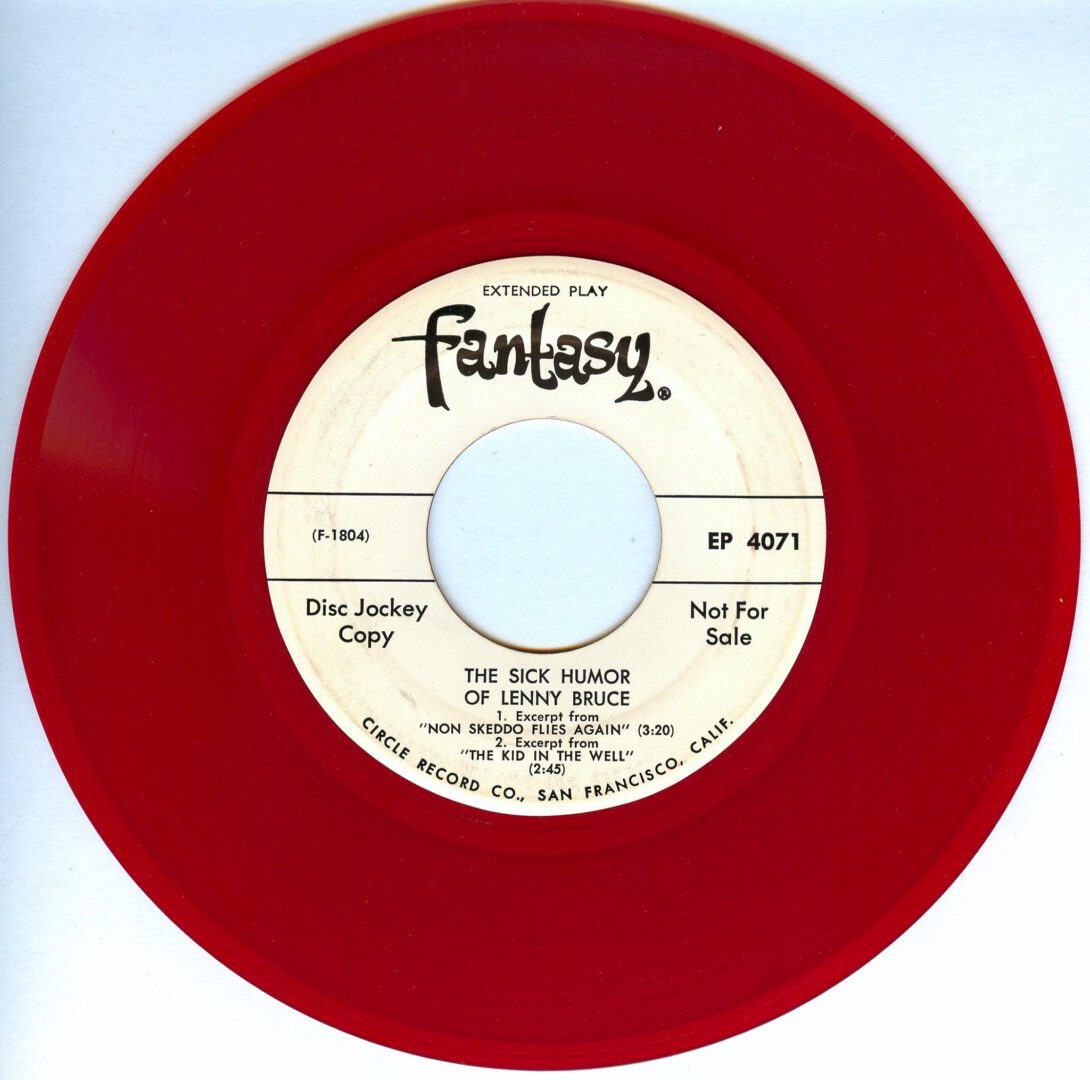
A few years earlier, Randi had been employed as a stock boy at California Records Distribution. The company was distributing the Contemporary, World Pacific, Prestige, Riverside, and Blue Note labels and handled the Fantasy Records catalog, who often pressed their records on clear red vinyl. Randi was already a Lenny Bruce fan and loved Bruce’s catalog on Fantasy.
“Fantasy was my label,” Randi explained to me at a 2015 engineering awards function in Culver City at the Sony Pictures Studios.
“His records made me laugh. I loved the ‘Religions, Inc.’ story. As a young guy with CRD, I took Lenny Bruce on a day-long promo tour, driving owner Jack Lewerke’s Austin Healey convertible, schlepping Lenny to radio stations and then to record stores. I took him to 105.1 FM radio station and a couple of record stores. He was a good-looking guy. The girls went gaga over him. He was very cool and a chick magnet.
“I wrote a commercial for Zeidler and Zeidler, a men’s clothing store that Lenny read the copy to my underscore. They never used it. I used to have coffee with his mom, Sally Marr at Schwab’s drugstore on the Sunset Strip in the sixties. Lenny was ahead of time for his style of comedy. True genius.”
"I readily confess to spending - much opposed to wasting - beyond my fair share of time beneath headphones with Monty Python and even more word-wisely the Firesign Theatre when I should have been studying through high school," offers Canadian "eh"-student Gary Pig Gold.
"Yet it was in the throes of Zappa collecting back then that I first came across a 1969 Bizarre/Reprise release called The Berkeley Concert, a posthumously released recording from December of '65 by someone I'd heard of - via his obvious disciple George Carlin - but up until that day had never actually heard.
"Then, a good decade-and-a-half later at the dawn of what we may now call the Video Age, I came into possession of (via some mysterious far-off P.O. box) a VHS tape called The Lenny Bruce Performance Film ...which came complete with an 'opening featurette' animation of the man's classic 'Thank You Mask Man' to boot. Again, I was - quite eagerly and happily so - delivered another bout of mental whiplash care of this absolute master of the meticulous.
"Of course, in every single year since and counting, I have made it a point to avail myself of each and every interview, biography (Albert Goldman's is highly recommended), newspaper clipping, magazine profile, audio and/or video recording and sometimes even re-creation (yes, including Dustin's) that I can of the man and his mindful art, as I like to call it. I consider this all more than necessary food for thoughts, from a giant who was even more prescient, as it turns out, than he was delightfully 'perverse.' Long may he swear."
Frank Zappa and his one-time manager Herb Cohenformed Straight Records and released Lenny Bruce The Berkeley Concert and Lord Buckley’s A Most Immaculately Hip Aristocrat, a compilation of unissued tapes.
Buckley had an avid cult following of jazz and rock musicians, hippies, beatniks, and FM radio deejays. Todd Rundgren named his early band the Nazz after a Buckley monologue.
In 1977, George Harrison’s hit single, Crackerbox Palace” was inspired by Buckley’s home in the Hollywood Hills. Buckley was heard the ABC-TV nationally syndicated Beany and Cecil animated television series created by Bob Clampett when he was the voice of “Go Man Van Gough.”
“What I love about Zappa is the way he connects to the pre-Beatle world of American bohemianism,” observed essayist Daniel Weizmann.
“Even long after he became the reluctant king of hippiedom, Zappa always struck me as a beatnik at heart, with that same Mad [magazine] trickster spirit of Lenny Bruce, Russ Meyer, early Bukowski, Venice cats like Lawrence Lipton and Stuart Z. Perkoff, and the whole crosshatch of subcultures that were just under the surface in Cali ’59 to ’63—bikers, surfers, poets, bongo-heads all pulling for exotica, for erotica, for something else—‘the left behinds of the Great So-ci-e-ty!’ (Cue the kazoos!) Case in point: In early ’65, Zappa got busted by a vice squad undercover officer for agreeing to produce a ‘sexually suggestive reel-to-reel’ for a stag party.”
(Harvey Kubernik is the author of 20 books, including 2009’s Canyon Of Dreams: The Magic And The Music Of Laurel Canyon, 2014’s Turn Up The Radio! Rock, Pop and Roll In Los Angeles 1956-1972, 2015's Every Body Knows: Leonard Cohen, 2016's Heart of Gold Neil Young and 2017's 1967: A Complete Rock Music History of the Summer of Love.
Sterling/Barnes and Noble in 2018 published Harvey and Kenneth Kubernik’s The Story Of The Band: From Big Pink To The Last Waltz. In 2021 they wrote Jimi Hendrix: Voodoo Child for Sterling/Barnes and Noble.
Otherworld Cottage Industries in 2020 published Harvey’s Docs That Rock, Music That Matters. His Screen Gems: (Pop Music Documentaries and Rock ‘n’ Roll TV Scenes) was published on February 6, 2026 by BearManor Media.
Harvey spoke at the special hearings in 2006 initiated by the Library of Congress held in Hollywood, California, discussing archiving practices and audiotape preservation.
In 2017, he appeared at the Rock & Roll Hall of Fame in Cleveland, Ohio, in its heralded Distinguished Speakers Series, and as a panelist where he discussed the forty-fifth anniversary of The Last Waltz at the Grammy Museum in Los Angeles in 2023.
During 2025, Kubernik was interviewed in the Siobhan Logue-written and -directed documentary The Sound of Protest,airing on the Apple TVOD TV broadcasting service. The film also features Smokey Robinson, Hozier, Skin (Skunk Anansie), Two-Tone's Jerry Dammers, Angélique Kidjo, Holly Johnson, David McAlmont, Rhiannon Giddens, and more.
Harvey was an interview subject along with Iggy Pop, the Beach Boys’ Bruce Johnston, Love’s Johnny Echols, the Bangles' Susanna Hoffs, Victoria, Debbi Peterson, and founding members of the Seeds for director/producer Neil Norman’s documentary The Seeds: Pushin' Too Hard. In summer 2026, the GNP Crescendo company will release it on DVD/Blu-ray.
Kubernik is a featured interview in the Alex Rotaru directed documentary Elvis, Rocky and Me: The Carol Connors Story that premiered in January 2026 at the 37th Palm Springs International Film Festival. She was Elvis Presley’s lover, and Rocky Balboa’s lyricist. The twice Academy Award nominated songwriter’s career is captured in interviews with friends Dionne Warwick, Dianne Warren, Bill Conti, Talia Shire, David Shire, Barbi Benton, Mike Tyson and Irwin Winkler. Her songwriting credits include the Rip Chords 1964 hit “Hey Little Cobra,” and Billy Preston & Syreeta Wright duet “With You I’m Born Again.” During 1977, Carol Connors co-wrote “Gonna Fly Now (Theme from Rocky”).
Performance contract and club marquee photo courtesy of GNP Crescendo Records.
Records and news paper clipping courtesy of Gary Pig Gold Archives