KISS Destroyer: The Definitive Visual History: Making And Touring The Legendary Album, Official And Authorized Book Set For October;
KISS Unmasked Live Show Three-Day Kiss Army Event November 14-16 at Virgin Hotels Las Vegas
Celebrating its 50th anniversary, KISS’s Destroyer was originally released in 1976 and is considered to be one of the quintessential KISS albums. It is the band's first album to sell one million copies in its first year and holds the title of being their all-time best-selling studio album.
To mark the milestone, KISS has released limited edition vinyl pressings of "Destroyer." These include a purple liquid-filled vinyl and a metallic gold and purple fire vinyl. The metallic edition comes in an embossed jacket with gold ink details and includes a poster, while the liquid-filled vinyl features a die-cut circle on the back cover to showcase the liquid inside. Both editions highlight classic tracks like “Detroit Rock City,” “Shout It Out Loud,” “Beth,” and “God of Thunder”
Alongside the vinyl, KISS has launched a Destroyer 50th anniversary merchandise line. Items include a Destroyer jacket with an embroidered KISS logo, pullover sweatshirts, raglan-sleeved shirts, belts, and T-shirts featuring the album cover. Many of these items are exclusive to KISS Army members, with limited quantities available shopkissonline.com+1.
Publisher Insight Editions has set an October 27 release date for KISS Destroyer: The Definitive Visual History: Making And Touring The Legendary Album, Official And Authorized. The book was written by author Ken Sharp along with KISS co-founders Paul Stanley and Gene Simmons.
A press release describes the product:
“In 1976, Gene, Paul, Ace, and Peter stomped their platform heels into the mainstream with Destroyer, which catapulted them to superstardom. This official, authorized retrospective takes you behind the scenes at the recording sessions and backstage at the mind-blowing tour that followed, offering eye-opening insights into Marlon Brando’s significance on the direction of the album, tensions in the sound studio, the destruction of Paul Stanley’s favorite guitar, creating the costumes, and the cover artwork, the photo shoots to promote the record, a dare that led to the birth of the KISS Army, David Bowie’s influence on the stage design, the band’s hijinks on tour, their encounters with Karen Carpenter, Margaret Hamilton, Paul Lynde, other stars of the day . . . and more!
“The book features interviews with more than 50 people, including exclusive new interviews with Paul Stanley, Gene Simmons, and producer Bob Ezrin, who reveal all the sex, drugs, and rock ’n’ roll that went into making the record. It comes jam-packed with deep dives on all the songs—including demos that didn’t make the final cut and who titled “Beth”—and contains hundreds of photos, some never before published. Comprehensive tour information covers dates, venues, and key performances, and a complete timeline of recording and promoting the seminal album features world affairs and other cultural events, putting the band’s milestones in meaningful context.
“For the recording of Destroyer, Bob Ezrin was brought in as KISS's new producer, helping the band reach new levels, both sonically and creatively. The album also showed the band's growth as musicians and songwriters, experimenting with new sounds which came in the form of the softer side of songs like "Do You Love Me?" and songs heavy with orchestral arrangements, including "Great Expectations" and their Billboard No. 7 hit single "Beth." Following the breakthrough success of 1975's No. 9 Billboard charting Alive!, Destroyer was the KISS album that brought them to the forefront of the mainstream and transformed them into global rock icons. For its anniversary, UMe celebrates this album's legacy with a staggering amount of bonus material.”
“Destroyer was pivotal for us, a real a raise-the-bar moment,” lead singer Paul Stanley reflected in an interview with Ultimate Classic Rock. “And interestingly, it wasn’t initially met and embraced in the way we had hoped because, let’s face it, it didn’t sound like Kiss Alive! But over time it became a part of who we are and who we’re perceived to be, and the songs just transcend, perhaps, the initial resistance to the sonics or the instrumentation.” He continued, “We had never used pianos, and I don’t mean as frills on a song, but we actually fortified guitars with pianos to make the chords bigger. And I think some people were thrown by all of that. But ultimately, more songs from Destroyer over the years have been in our shows and in the set than any others.”
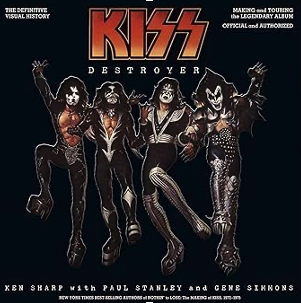
Music journalist and author Ken Sharp, who penned the liner notes for Nothing To Lose: The Making of KISS 1972-1975, described Destroyer in an email.
“Destroyer is the album where KISS's sound turned from grainy black and white into full-blown Cinemascope, hard rock guitars mixed with pianos, strings, calliope, bells, and atmospheric sound effects to create a dazzling fantasia of sound and textures. Decades on, Destroyer is regarded as KISS's most ambitious and accomplished release.”
A recent email on the KissOnline.com website revealed the group will perform an unmasked live show as part of the three-day Kiss Army Storms Vegas event, celebrating the fan club's 50th anniversary. The event is scheduled to take place Nov. 14-16 at Virgin Hotels Las Vegas. Besides the Kiss Unmasked performance, the e-mail mentioned that a full schedule of activities will be announced soon, and that fans can expect "a special live performance from former Kiss member Bruce Kulick, along with other special guests, activities, exclusive experiences, and more.”
Paul Stanley of KISS is a lifelong Otis Redding fan. “Try a Little Tenderness” is one of his favorite records. In 2021, his side project, Paul Stanley’s Stone Station, recorded the album Now and Then, displaying the Star Child’s soul side.
On February 18, 1974, Casablanca Records held a party where KISS played live at the Century Plaza Hotel ballroom in Century City. I remember being introduced to Stanley, and we talked about Otis Redding, Solomon Burke, Philly soul, and the wonderful recordings Thom Bell produced. Stanley also mentioned he saw Love at the Fillmore East in New York as a teenager.
In August 2024, when I encountered Stanley at a grocery store in Sherman Oaks in the San Fernando Valley, he raved again about Redding.
“I was lucky enough to see Otis Redding and the Bar-Kays in the summer of 1967 in New York. He was part of the Rheingold Music Festival [on August 18]. Jimi Hendrix and the Monkees played there, too. I was fifteen and paid a dollar for my ticket. I went to see Bo Diddley, but he had some legal problems and couldn’t perform at the show. “Then Otis Redding came out with the full band and horns. The power and the urgency in his voice—I was thrilled! Right then, I knew I was witnessing something. I saw the difference between great and greatness.”
On that February 18, 1974, Casablanca Records held a party, I watched with Justin Pierce of The Hollywood Press, deejay Rodney Bingenheimer and met The Fugitive actor, David Janssen.
I remember thinking, “Here is a band whose first LP and career will either be over in 15 months or they’ll be with us for 50 years.” It was a loud, defiant showcase, and the food was incredible. Casablanca label head Neil Bogart sure knew how to throw a party.
For the February 15, 1975 issue of the now-defunct UK music weekly Melody Maker, I interviewed Paul Stanley, Peter Criss, and Gene Simmons of KISS.
Kiss: Kiss and Tell Melody Maker, 15 February, 1975
"We sold out two houses in Detroit at 12,000 each and were the biggest thing to hit the city since the Beatles. People were charging the stage; throwing jewelry at us, pills and everything else you could hope to imagine," reflected Kiss member Paul Stanley with just a hint of conceit.
In fact, the group does have a lot to be proud of, for within the span of about a year, the once obscure boys from New York City have attained a phenomenally loyal following both state side as well as in Japan.
"It wasn't too long ago when we were in the audience and paying. The whole premise of Kiss was that when you're paying to see us, we feel we owe you everything. It's an exciting brand of rock and roll that comes off as pure entertainment. And if you want the music, you can always listen to our albums."
The whole Kiss story started back in '73 when record company executive Neil Bogart was starting a new label called Casablanca. Bogart had been the man responsible for signing a majority of important acts in the sixties to his Buddah label, but he now felt it was time to broaden his perspective and look into the seventies.
Stereotype
Paul remembers: "We were basically a city band playing dances all over New York. It was the classical rock 'n' roll stereotype. And then Neil discovered us, and after listening to our demos, he asked us to be his first release on Casablanca. He promised us enough things to put together the exact kind of show we always hoped for.
"It was actually like a dream come true. With his assistance, we've been able to conceive what we feel is probably one of the most viable uses of theatrics. Our purpose was, and still is, to enhance the music rather than be pretentious."
Indeed, the whole Kiss consciousness is an awesome sight. Their show opens with the lighting of their huge KISS sign that can be seen throughout the arena. Then the band appears amid an onslaught of energy and thrust. The four piece outfit is each clad in a leather jumpsuit highlighted by Kabuki-like makeup utilizing heavy traces of black, silver, and red against a white base.
Bassist Gene Simmons looks at their approach from a unique perspective. "The band that first knocked me out was the Beatles. Up until then, one wasn't aware of the visual presence a group could have. Each had the same haircut, dressed the same, and if you saw one of them walking down the street, you knew that he belonged to that group. And that concept knocked me out, especially the fact that there was no frontman and each member was a quarter of the whole.
"People have told us that they see similarities in Kiss. Each one of us is so visual that we don't need a frontman. In previous bands we've been in, it was each one of us who stood out. Now it's a case where four people have gotten together as a cohesive and incredibly tight unit. It's also an added plus for the people in the audience."
Bizarre
With the Kiss image being so particularly intriguing and striking, one question everyone wanted to know was where the band got the idea for the bizarre use of heavy makeup. Stanley cautiously ponders the thought, "We've often been accused of being pretentious, but in actuality our concept of what we're doing is an effort to shy away from pretentiousness. The thing we do is very surface, for there are no built-in subtleties in our music or what we do on stage. We feel our whole image is based on the use of imagination.
"I think black leather is very tough and exciting. I'd much prefer something macho rather than coming on in pink satin. There isn't any attempt other than trying to perfect a stage act. It's a very positive trip. There's nothing negative about our show. Just go to a concert and see the kids dance in the aisles, singing along with us.
"We are, in essence, with the audience, for we feel we represent the looseness that everybody can identify with. When people look at us, they say, 'That's what's inside me.' They understand that's not what they look like, but rather what they feel like. "I think we are an extension of everything that happened before us. We're children of the last generation of rock. All my idols, the Stones, Who, Move, and the Kinks had a profound influence on my outlook on the world. When I first saw Peter of the Who, I knew that excitement could be attained, and we've tried to live up to that sort of archetypal image."
Drummer Peter Criss looks at it from a different angle: "I was always into Phil Spector, the Ronettes, early Stones, as well as early Motown with Marvin Gaye, the Four Tops, and all the other numerous talents. Therefore, all our influences owe to a melting pot, and what you get out is not blatantly derivative of any one area. At times, we have tinges of a lot of quality music that has gone down before us. In this age, it's extremely difficult to be original, if not impossible. What you can hope for is to have the right influences predominate throughout your work."
Rollicking
With their brash and assailing brand of rollicking rock, Kiss has admirably been able to succeed with almost any group they've been billed with.
Bogart, who signed the group, has been the one man credited with signing such diverse acts as Question Mark & The Mysterians, Terry Knight & The Pack, 1910 Fruitgum Company, Curtis Mayfield, Melanie, and the Isley Brothers, as well as being influential in bringing the English Charisma label to the US for distribution when he was president of Buddah.
His opinion of the band is flattering to say the least: "I've never been into hard rock until recently. But I can honestly say that Kiss is the first band that I've devoted myself 100 per cent to. In fact, they're everything I've been looking for in a rock band. Their visual show features a drum set that levitates six feet in the air, a lead singer who blows fire out of his mouth, and their wonderful use of makeup is just a shatteringly satisfying experience. Even more important is the fact that they're probably one of the best rock 'n' roll bands I've ever heard in my life."
Another incredible aspect of the Kiss story is the gigantic support they've achieved in Japan.
"It's nice for a band, other than a Japanese group, to put out an album with Japanese liner notes. If for nothing else, it gives our fantastic fans in the Orient something different, as well as being aesthetically pleasing. All the photos on our second LP, titled Hotter Than Hell, were from a party we had, which was something right out of Satyricon, even featuring naked women in bird heads. We felt that the Japanese sense of artistry would get off on it, and we understand it's been received quite favorably."
At the moment, the future looks bright indeed for the boys from Gotham City, who are now planning an exhaustive tour of England, Europe, and Japan that they are looking forward to with a sense of apprehension, as well as expectation.
"We've often been thought of as an English band by many fans in the States, so it'll be interesting to see how we go over there. But just the satisfaction in knowing that we're now reaching young teenagers all the way through 27 year olds means a lot to us."
(Harvey Kubernik is the author of 21 books, including 2009’s Canyon Of Dreams: The Magic And The Music Of Laurel Canyon, 2014’s Turn Up The Radio! Rock, Pop and Roll In Los Angeles 1956-1972, 2015's EveryBody Knows: Leonard Cohen, 2016's Heart of Gold Neil Young and 2017's 1967: A Complete Rock Music History of the Summer of Love.
Sterling/Barnes and Noble in 2018 published Harvey and Kenneth Kubernik’s The Story Of The Band: From Big Pink To The Last Waltz. In 2021 they collaborated on Jimi Hendrix: Voodoo Child for Sterling/Barnes and Noble.
Otherworld Cottage Industries in 2020 published Harvey’s Docs That Rock, Music That Matters. His Screen Gems: (Pop Music Documentaries and Rock ‘n’ Roll TV Scenes) was published in February 2026 by BearManor Media. Kubernik is researching a multi-voice narrative study on the Beatles scheduled for a UK publisher with a planned summer 2027 publication date.
Harvey spoke at the special hearings in 2006 initiated by the Library of Congress held in Hollywood, California, discussing archiving practices and audiotape preservation.
In 2017, he appeared at the Rock & Roll Hall of Fame in Cleveland, Ohio, in its Distinguished Speakers Series and as a panelist discussing the forty-fifth anniversary of The Last Waltz at the Grammy Museum in Los Angeles in 2023. Kubernik attended the November 1976 concert.
Harvey was interviewed along with Iggy Pop, the Beach Boys’ Bruce Johnston, Love’s Johnny Echols, the Bangles' Susanna Hoffs, Victoria and Debbi Peterson, and members of the Seeds for director/producer Neil Norman’s documentary The Seeds: Pushin' Too Hard. In summer 2026, GNP Crescendo plans to release Norman’s film on DVD/Blu-ray). Author Miss Pamela Des Barres narrates).
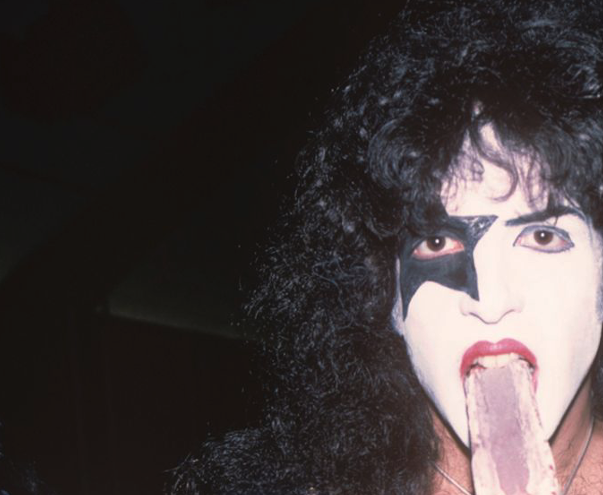
Photo of Paul Stanley by Brad Elterman