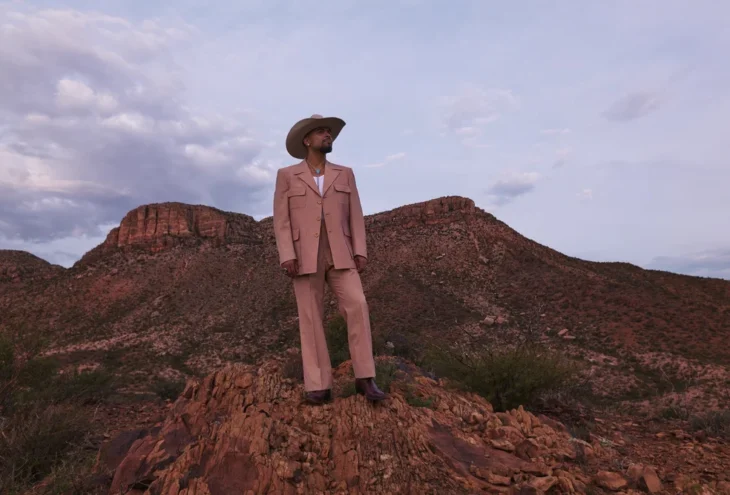
The Artist: Devon Gilfillian
The Origin: Synthesizing his instinctual ability to draw from the sonic worlds he has inhabited — first the soulful foundations of Philadelphia, and now the collaborative energy of Nashville — Devon Gilfillian has realigned his passion for emotional songwriting, weaving it into rich tapestries of sound. After years immersed in Music City’s artistic community, Gilfillian has leaned into a nuanced sophistication, retracing the harmonious currents of both places: the lush, textured grooves of the Philly Sound and the storied improvisational spirit of Nashville’s writers’ round.
From that intersection, Gilfillian has channeled his love for human presence within these musical scenes into a recording process that yields a neo-soul sound alchemized with the unvarnished energy of Americana rock and heartfelt R&B.
That ethos — a commitment to human connection, collaboration, and character — steered him into the studio for his forthcoming album, Time Will Tell, due June 26th via Concord Records. Inside the expansive tracking rooms of historic RCA Studio A, Gilfillian found the ideal setting to capture both analog warmth and the live energy he envisioned. Driven by the technical discipline and auditory richness of tape, Gilfillian and co-producer Jonathan Smalt recorded the bulk of the material live — with Neal H. Pogue (Outkast, Tyler, the Creator) serving as executive producer — allowing the natural chemistry of musicians performing together to mold the sound.
“We recorded everything to tape so we could bake in the performance,” Gilfillian explains, “and the human imperfections that make music magical.”
The Production: That commitment to capturing visceral energy while tracking quickly centered on one of the most elusive elements in any recording session — the drum sound. For Gilfillian and Smalt, shaping that foundational pulse became central to the album’s sonic identity. The cavernous dimensions of Studio A — with its famously high ceilings and vast live room — allowed the team to experiment with space, resonance, and microphone placement in search of the perfect balance between punch and atmosphere.
“We spent hours and hours testing drums,” he recalls. “We tracked the drums out in the big room, we tracked the drums in the smaller booth, we built a drum circle in the big room for ‘Keep On Moving.’ There were no limits to where we would put a drum.”
Once the live room and arrangements were dialed in, Gilfillian doubled down, further experimenting with sonic configurations employing varispeed to manipulate tape speed, sculpting the depth and tone of the drums in unexpected ways.
“We would track either just the drums — sometimes the whole band — and then speed the track up or slow it down to get a deeper wall of sound or tones that we loved,” he says. “In order to get the song in the proper key, we would have to do intense math and play to a very specific tempo to slow it or speed it to the right key. We got nerdy as hell, it was so fun.”
Other moments invited additional sonic exploration, particularly through Gilfillian’s guitar work. “I always feel safe when I have my Stratocaster and pedal board with all my crayons to color with,” he says. “There are so many possibilities with guitar pedals and different ways to inspire yourself just by hitting one button.”
If the production provided the sonic grandeur, the spirit of the session still allowed for moments of authentic spontaneity, requiring only a shared breath. “For the song ‘Time,’ we cut that all in one take — vocals, bass, and piano — and added strings in post,” he says. “The emotion was undeniable, so I knew we captured it.”
While these specialized intricacies were paramount, the performances revolved around musical collaboration, preparation, and instinct. Much of the heavy lifting had already happened during demo sessions and rehearsals, giving musicians in the studio the freedom to explore their parts organically and refine the music in real time. Gilfillian explains the process.
“In the demo [phase] you're truly discovering ‘who’ the song is and what it’s about — the bones and the meat. In the recording process, you’ve had time to imagine the world the song lives in — dressing that song up in the right exact outfit, putting a cape on it, and sending it out into the world.”
Ultimately, even amidst the studio tracking tricks, the songs never lost their grounded, soulful core. Gilfillian traces the origins of tracks like “Glad to Be Here,” which carries the fragility of a brush with loss after his dad’s health scare — a reminder of how quickly a room can go quiet.
“Most times it starts with a chord progression on the guitar that I love; that’s how ‘Glad to Be Here’ started. That chord progression then led to me singing: the melody and lyric came together. I then tapped into my emotions, thinking about my dad and how grateful I am that he’s still here and alive.”
This balance — methodical exploration paired with human feeling — echoes Gilfillian’s guiding philosophy throughout the recording process, reflecting his journey from the rhythmic soul of Philly to the harmonic precision of Nashville. He cultivated conditions where authenticity could thrive. Across every track, from meticulous drum setups to spontaneous guitar flourishes, Gilfillian’s process blends discipline with freedom, tradition with experimentation, and heart with the craft.
“Naturally, I am going to bend genres because I am inspired by so much music. Some is more raw, and some is more polished and beautiful. I love it all — and there’s a place for everything.”
Photo Credit: Travys Owen