
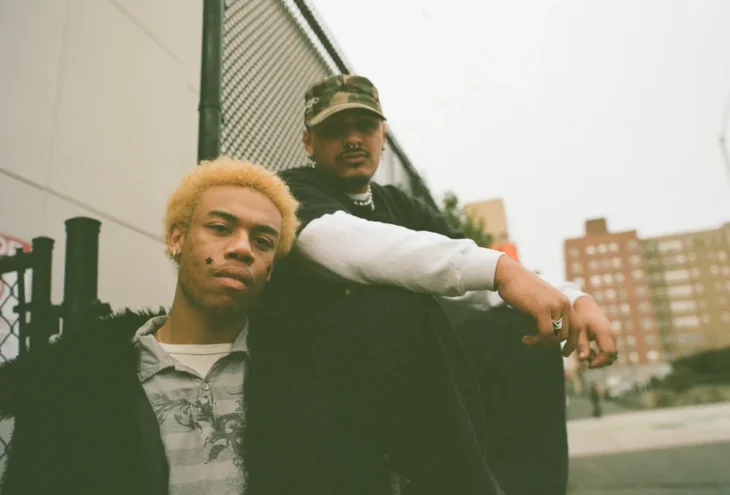
The Members: Eli Edwards and Xayvien "Xay" Young; electronics, songwriting, and composition
Additional instrumentation: Nathan Cornell, guitar; Conner R. Frankel, drums
Producers: casi
Executive Producer: Ben Zaidi
Mixing: Ben Zaidi, Samuel Rossen
Mastering: Samuel Rossen
The Origin: Crossing paths in Spanaway, a suburb outside of the Tacoma, Washington area, Eli Edwards and Xayvien “Xay” Young connected through that effortless childhood lens, with an “I think we are going to be friends” kind of vibe. Over the next few years, as they grew, their connection moved beyond the casual hangouts of youth and evolved into a phase-locked loop, where a shared passion for rhythm, lyricism, and the music production process became the ultimate priority.
When physical distance separated the duo — with Edwards, who also plays bass for the critically acclaimed indie-rock band Enumclaw, relocating to Los Angeles and Young staying in the Pacific Northwest to sharpen his sonic edge — the signal remained strong. The two continued collaborating remotely by trading beats, backing tracks, voice memos, and song stems composed in various home studio setups, with both artists navigating the creative current.
Yet while these digital transmissions kept the duo’s musical momentum alive, it was whenever Edwards returned to the Evergreen State for in-person studio sessions with Young that the strong inkling to move forward with their idiosyncratic smashing of hip-hop, hardcore punk, and nu metal — all smoothed over with a melodic, emo-tinted veneer— surged.
Now, with both once again calling Spanaway home, Edwards and Young are continuing to seek and destroy forced genre-blending under the moniker casi, consumed by the simple desire to create music entirely on their own terms. Building upon the fundamental frequency of lifelong friendship, the duo offers a transparent look into their production process where their lyrical bite is balanced with digital experimentation and physical instrumentation.
The Production: Stepping into any recording environment, embracing in-situ innovation alongside white-knuckle patience becomes a universal prerequisite throughout the tracking process. This is equally true in high-end studios navigating hardware failures on Neve and SSL boards, or in home studio configurations fighting digital software glitches. Mapping out interim fix-it-fast solutions during unexpected downtime is a true test of artists and their adaptability, yet these frantic pivots can often bring forth something beautiful.
For casi, incorporating these volatile, unpredictable situations with impromptu workarounds was a vital part of their experimental and artistic process. By actively leaning into accidents and limitations, they established a baseline of resourcefulness, seamlessly weaving elements from perceived mismatched genres and styles into a cohesive identity. A dual triumph: first, a testament to their innate collaborative alignment, and second, their pure, unfiltered ingenuity.
Edwards explains, “A lot of innovation in music comes from accidents. As an example, for our EP, EVERBODY’S SECRET, we initially thought we were making a full-on punk album because we’re playing guitar and it’s loud and it's punk, right? But in doing so, we accidentally made a second, or third sound, just because we were using the tools we had –whatever we had in front of us.” He explains further. “If we were recording a song with a bunch of guitars on it and we didn’t have a bass in front of us, we thought, ‘we'll just use an 808,’ and that change in that moment would change the sound.”
This commitment to using whatever was within arm’s reach allowed casi to instantly pivot whenever inspiration struck during the songwriting and demoing phase. Because the music lived natively within them, the workflow progressed unhindered, bypassing technical roadblocks. This instinct to create using only the immediate environment is echoed by Young. “There were times when we didn’t have a MIDI or even a DAW, we would just do a quick audio loop on our phones and then try to revamp it when possible. So, it's definitely a lot of spontaneity, a lot of accidents, and a lot of saying, ‘we don't have this, but we have this, let’s make something,’ you know?”
The structural template forged during those intense writing blocks fully crystallized when the duo traveled to Los Angeles to finalize the record with their longtime friend and producer, Ben Zaidi. Before heading out, casi believed they had a completed album. However, they soon realized that learning to adapt to limited, bare-bones gear in their early stages had actually primed them for a different kind of flexibility: a willingness to embrace outside input and let new creative voices shape their sound.
“It had a completely different vibe at first,” Edwards recalls. “It was such a computer album—like a machine trying its best to sound analog. But when we brought it to Ben, he encouraged us to make it sound more alive. So, we went through and replaced pretty much every drum with our homie Connor playing live, and layered in additional guitars, bass, and a few other physical textures. Ben gave the project a coat of paint that added polish and pulled it away from a purely digital space. It gave the record what it needed.”
This transition from software-based parameters to live instrumentation quickly became their permanent creative philosophy. “It's probably going to be our formula going forward,” Edwards notes. “Coming from playing in bands, it is a little trippy sometimes to think, ‘We made a whole song on our computer, and then we learn to play it for real.’ It changes a little bit because of that, and that's probably the best part about this thing.”
In addition to implementing on-the-spot innovation within the digital realm and the more traditional recording studios, casi faced the daunting challenge of translating those “in-the-box” studio creations into a compelling live performance. Engineering a live sound that felt diverse, expansive, and completely unforced was a steep learning curve, but one they willingly took on.
“It’s been a journey. I feel like that's been the second art form in itself,” Xay explains. “Originally, we went on a West Coast tour with Tears of Joy and Princess Pulpit, and we were alternating on guitar, playing along to backing tracks. Touring alongside other acts really showed us where our performance was lacking and where it needed to be filled out."
This realization brought a healthy dose of artistic hesitation. For artists operating in an alternative hip-hop vein, attempting to port digital sounds into a traditional rock band format often yields clunky, forced results.
“Right from the jump, there was a recurring thought in my mind: ‘This is dope, but how the hell are we going to do this live?’” Edwards admits. “If a track on the record is heavy on 808s, super-compression, and fake hi-hats and snares, trying to put that in front of a real drummer is just going to take away from the original energy.”
Ultimately, the only way to figure out what to keep in the computer and what to pull out into the physical world was to just experiment. Edwards concludes, “I have to say that if we were allergic to playing backing tracks, it probably wouldn't work. Instead, we found a way to create a cool mix of both worlds. It makes sense live, but it was definitely a journey to get there.”
The mainstay keeping this live translation from spinning out of control was a shared obsession with rhythm. No matter how abstract a track became, drums served as the duo’s central grounding point — a unifying through-line across all their songs.
“It’s 100% drums,” says Edwards. “I feel like it's always drums. We both know how to play them to varying degrees. Whether it's playing on a physical kit and chopping it up later, sequencing on an analog drum machine, or pulling from the drum kits that I've collected for making beats all these years — rhythm is everything.” Young agrees, noting that drums are the undeniable backbone of their identity.
The definitive validation of their artistic journey wasn’t merely getting the record out into the digital and physical world, but seeing it come alive, in full, on stage. That proof arrived on a Friday night in Spanaway, Washington. Celebrating the release of their self-titled album in a local venue that rarely saw more than a few dozen patrons, the duo walked onto the stage to see a fully packed, sweat-soaked house -their musicality had hit home.
“I don't think there's anything more fulfilling in my life so far than playing the album release show in Spanaway,” Edwards says, looking back. “People were singing lyrics to the deep cuts, and kids who have never been to a show before were just wandering in. That is the part that makes me the proudest.”
“I second that,” Xay adds. “I was on the verge of tears so many times because it was so cool seeing literally the whole city come out for us. It was so beautiful.”
This intangible magic of simply loving to the art of arranging music is exactly what casi set out to achieve when they first started following their creative compass. They never tried to force a pristine sound or manufacture a superficial genre trend; they followed an unshakeable, lifelong love for crafting music. By embracing their limitations rather than fighting them, that artistic spark grew stronger. In the end, their music won because it remained completely unforced — serving as an inspiration for anyone searching for that same sense of artistic release.
Photo Credit: Colin Matsui