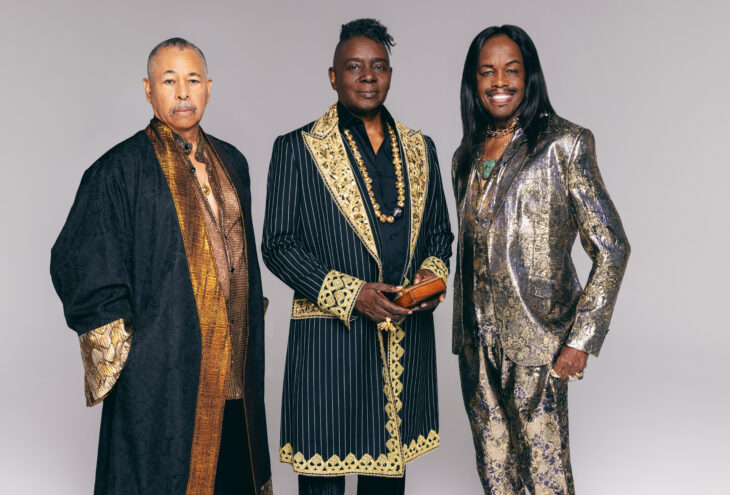
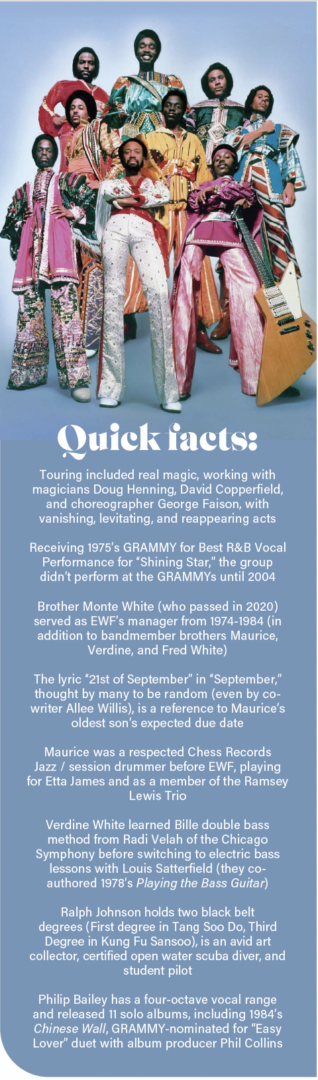
Having formed in 1969, the Chicago-born genre-blending band Earth, Wind & Fire has released 21 studio albums, plus a string of singles and a large number of compilations. But for a short break between 1984 and ’87, they’ve remained a creative force over those 57 years. With 100 million album sales worldwide, eight number ones across their albums, and eight songs Double Platinum-certified and in the Top 10, perhaps most unique is the positivity and palpable transcendence enshrined in their lyricism and genre-defying sound.
Meeting people exactly where they are, they invite listeners on a journey to upliftment and inspiration, with the strength of incomparable musicianship and genuine groove to believably impart a true sense of joy. While they were the first Black act to simultaneously top the Billboard album and singles charts (with “Shining Star”), their sound defies race, age, nationality, and genre, and the ongoing impact and unshakeable love that shines through Earth, Wind & Fire’s music remains undeniable.
Incorporating elements of funk, soul, jazz, gospel, Latin, Afro-pop, disco, and rock, themes of positive spirituality, and Vegas-level stagecraft (decades before it became a regular part of the touring landscape), EWF is known for their dynamic sound and passionate performances, both of which changed music forever. Inspiring artists from Michael Jackson, Stevie Wonder, Prince, and Lionel Richie to Kanye West, Justin Timberlake, Alicia Keys, H.E.R., Flea, and many more, skillsets born from serious jazz chops—and a sense of grounding rooted in deep spirituality—deliver a levity of sound and production rarely seen today.
Their unique combination of African rhythms, punchy brass, phenomenal vocals, and unwavering energy continues to add influence, including a resurgence of sampling and collaborations with contemporary hip-hop artists (including Nas, Wu-Tang Clan, and Wyclef Jean). To spotlight the profound significance of their work, producer-drummer Ahmir “Questlove” Thompson produced and directed documentary Earth, Wind & Fire (To Be Celestial vs. That’s The Weight of the World).
MC spoke via Zoom with Ralph Johnson, Verdine White, and Philip Bailey about the movie and their career, and all three were great company. White was engaging, and excited about the rollout of the film, and Johnson was clearly enjoying this stage of the adventure, basking in the time afforded to reminisce about all that has transpired. Bailey had an incredible sense of humor and quick wit.
We told the trio of pioneers that we enjoyed the movie intensely and asked for their thoughts. “I’ve seen the rough cut and was very happy,” says Johnson. “Questlove knows exactly what he’s doing.”
“The way it was put together, the way Quest captured us—our music, our humanity, our manhood—the growth from the beginning to now, I was proud of it, very happy,” adds White.
It makes sense that they enjoyed the film—Questlove has done an impeccable job of telling their story respectfully, while keeping an eye on the details. It’s loving without being fawning, and that’s a tough tightrope to walk. Naturally, the movie digs deep into the band’s beginnings, though we wanted to dig deeper still. Johnson talks about seeing the triple drumkit at a James Brown show, his first concert.
“I saw that and said, ‘Aww man, what a setup,’ you know?” he says. “But I always wanted to be a musician. It was just in me to do, so I kept at it, kept pursuing it, and things worked out.”
Johnson doesn’t think that Brown provided the impetus for late EWF player Fred White doubling up the drums later.
“No, I don’t think so,” he says. “Maurice [White] was going for a bigger sound, so we went for a two-drummer thing, which worked out nicely—as you can hear on the Gratitude album. I just think he wanted to broaden the sound.”
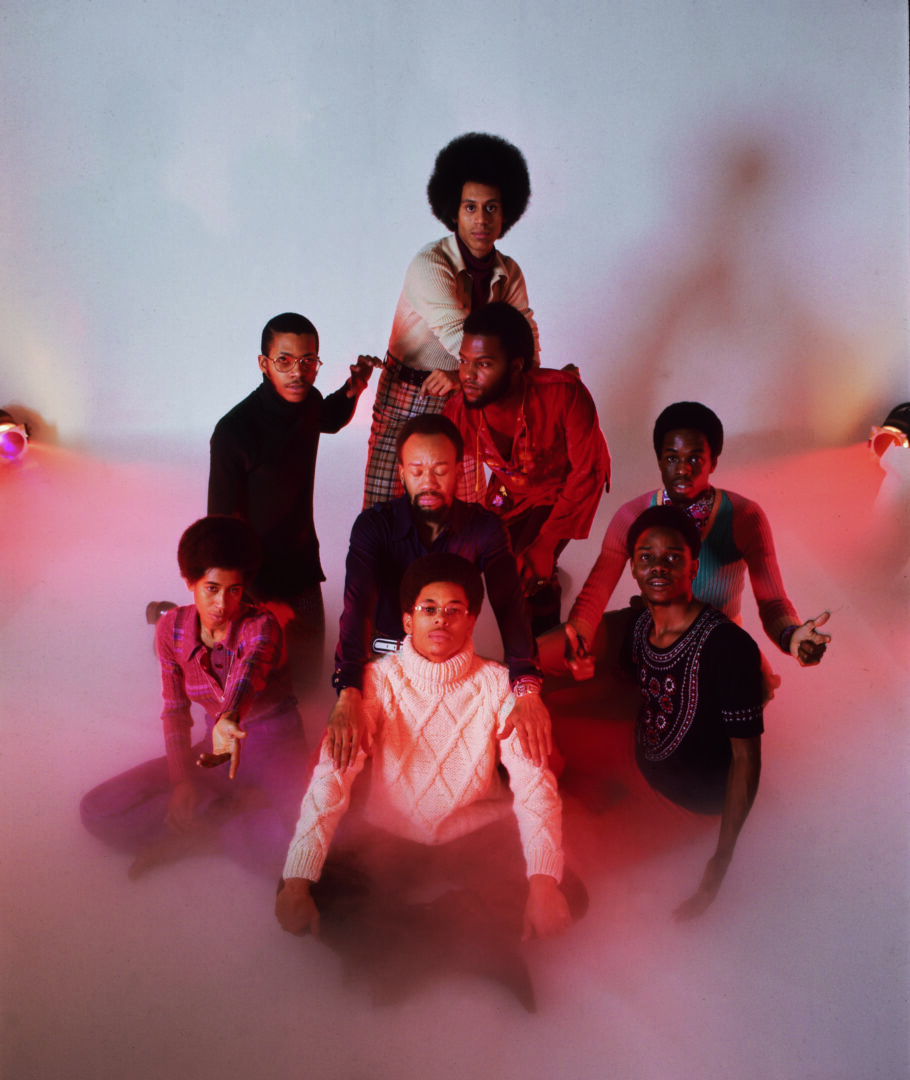
Verdine White is one of music’s biggest characters. From his infectious smile to his undeniable stage presence, not to mention his exemplary bass playing, the man is a one-off. He’s also, of course, the brother of sadly deceased band leader Maurice White.
“We’re from a large family and there was nothing but music played all around every day, but when I went to orchestra class and saw that big upright bass, that bass spoke to me and I was hooked,” White says. “I slept with that bass. That bass was mine, you know? Chicago’s a rough city sometimes, and I used to take the bass on the bus. Everybody would be nice to me with the bass, so it was really great.”
“My mom said I was singing before I was talking,” adds Bailey. “Strangely enough, there’s never been any other light in my consciousness. I’ve always followed it—it’s always been in my trajectory. I just thought everybody knew what they wanted to do in life. I’ve also always had this radio going in my head and I thought everybody did. It’s just who I am.”
Bailey opened for EWF as a member of Denver’s Friends & Love in 1971, before officially joining as the co-lead singer in 1972.
“We didn’t know that this is the great Earth, Wind & Fire,” he says. “We were all just kids. Every experience at that age is grand because you haven’t done anything. It was a grand experience meeting Verdine, and Maurice smelled like coconut oil, had a big cowboy hat on, and bell bottoms. The memories are vivid and memorable. We have a great story, and I’m glad Quest captured it.”
From the beginning, EWF was geared towards success. “You had chosen your place, and you just wanted to be great at what you did—and then you had nine of those kinds of mindsets going after this one thing, so I think that makes a difference, you know?” says Johnson.
“It was destiny,” says Bailey. “This whole thing is bigger than somebody deciding this or that. It’s way bigger than that. Maurice’s vision was enlightened and we were chosen. Fifty-something years later, we’re still chosen ones to take on the legacy. The band’s been together now 30 years longer than Maurice was there, and we’re still selling out houses. This documentary is a great time we’re able to experience and really revel in it.”
“The audience is gonna learn a lot,” adds White. “Some things we were learning too when I saw the rough cut. It really hit all the right spots. Quest did a fantastic job. Being a great musician and producer himself, it really helped having someone who is in music that we could discuss it with.”
Despite their collective ambition and desire to succeed, the members of EWF couldn’t have predicted just how monumental and influential the band would become.
“You cannot know on the front end, when something is in its embryonic stages, how big it’s going to be,” says Johnson. “It is not really up to you. All you can do is put your very best into it and hope that it’s received well and on a broad scale. You go for the ride and hope everything turns out okay.”
Committed to a disciplined, health-conscious lifestyle, Maurice White was a strict vegetarian, abstained completely from drugs and alcohol, and followed a deep spiritual practice that involved meditation, yoga, and philosophical study. That said, Bailey doesn’t believe that Maurice’s push for clean living helped the band to any great degree. “I wouldn’t put that much on it,” he says.
“I definitely like some ribs, adds Johnson. “But some granola helped, yes.”
In March 1972, at the Uptown Theater in Philadelphia, the crowd began booing the band. Maurice quietly moved to the floor, sitting cross-legged in a yoga pose, with the rest of the band silently joining him. Sitting in total silence for almost 10 minutes, the crowd was thrown off. Maurice brought the music back with his Kalimba, as the band joined in piece by piece. It was an unusual, daring move for a popular band at a time when meditation was yet to fully enter the public’s consciousness.
“Well, no doubt that was a bold move,” says Johnson. “For Maurice to say, ‘Okay, look, here’s what we’re going to do. Go out here, sit on the stage in Lotus position, and we’re gonna look at the audience.’ Who does that? Bands don’t do that. But we did it, and somehow it worked out. Fifty-plus years later, something worked. I was thinking, ‘Okay, I’m gonna sit here and hold his pose until Maurice says, "head for your instruments," or "let’s strike up the band."'"
Still, there was no doubt that the band was going to play.
“Oh, there was never any doubt,” says Johnson. “It’s just a matter of him counting it off and saying, ‘Okay, here we go.’”
We put it to the guys that we don’t know if anyone’s ever done anything like that before, or since. As Goethe said, “Boldness has genius, power, and magic in it.”
“Well, it was definitely magic that night—and we were in Lotus position,” says White.
One particular gig with George Clinton’s Funkadelic in 1972 at the D.C. Armory in Washington D.C. changed the way that EWF saw funk. Johnson describes the show as, “the one we try to forget” with a laugh.
“We were on the same bill but weren’t in the same lane,” says Johnson. “We weren’t looking down on them for smoking dope, that just wasn’t something we were doing. They funked us out. We went back to the drawing board, learned to get funky, came back and started to write different songs, so that was a good experience.”
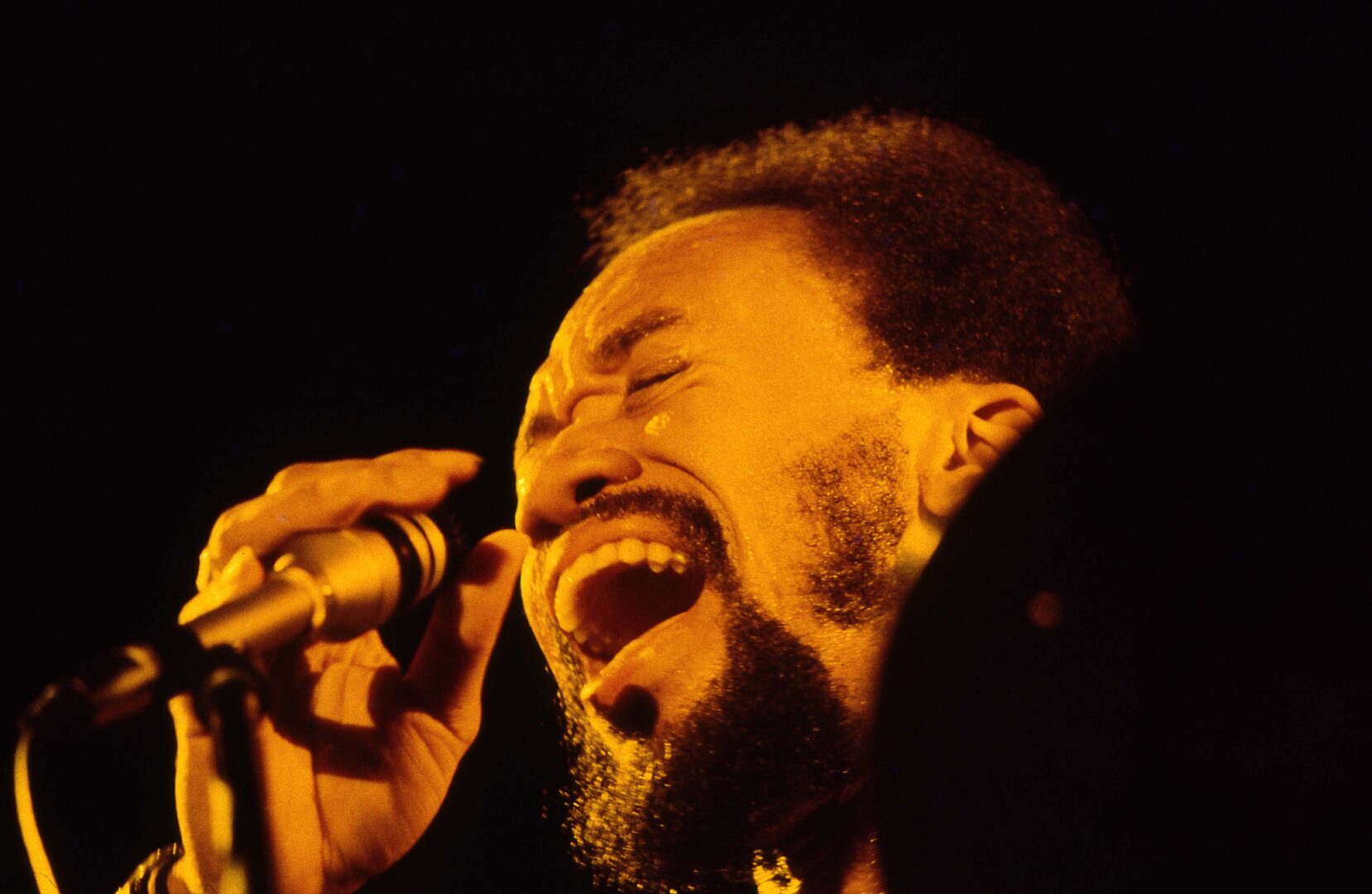
In 1973, the band traveled to the Caribou Ranch Mountain Studio to get away as a group without distraction to record their fifth studio album, Open Our Eyes (released March 1974 and reaching No. 1 on Billboard Top Soul (R&B) Albums, No. 15 on the Top Pop Albums chart, and Certified Platinum by the RIAA), which included hit singles “Mighty Mighty” and “Devotion.” They returned in late 1974 for a three-week residence, recording GRAMMY-winning album That’s the Way of the World, which includedGRAMMY Hall of Fame inducted song,“Shining Star.”
“We still talk about that every time we see George,” adds Johnson.
“Caribou Ranch was a time of high creativity,” says Bailey. “It was nice to be able to get away and record, just be with the band with no outside distractions. Those albums we did at Caribou were really great.”
“Yeah—Open Our Eyes and That’s The Way of the World—it was a beautiful experience being up in the mountains,” adds White. “We had a chance to get away, really tune in. [We’d] watch movies every night.”
“I don’t know exactly how many weeks we were there, but we did all our tracks and some of the vocals,” says Bailey.
Around this time, Maurice White put more focus on the live shows, and everything shifted.
“We were in there grinding it out, as they say today,” says White. “We were putting our all into creativity, wardrobe, sound, and we were together every day.”
With a sharp eye on every small detail, Johnson was moved to the front of the stage, partly for the purposes of symmetry, to balance things out.
“We had two drummers, so I could afford to come off the drums and do something different,” Johnson says. “I was back there having a ball doing the drum thing and George Faison says, ‘Ralph, Come off the drums. Stand right here next to Maurice.’ That’s how I got out front. I never went back.”

Fast forward to April 6, 1974, and EWF is at the California Jam. Importantly, they were the only band of color on the bill, something what White describes as “huge,” though Johnson admits that he forgot that particular fact.
“We came on number two,” says White. “Seals and Crofts came on as number one—and it was on ABC.”
“It sure was,” adds Johnson. “At that time, ABC was doing a thing called In Concert, whereas NBC had Midnight Special. It was just a matter of Maurice going up and counting it off; we would do the rest.”
“On the Gratitude album, open it up in the middle—that’s the California Jam,” says White.
Bailey says that EWF always just wanted to be the best band that they could be.
“Following the heart of the music,” he says. “We weren’t into, ‘Okay, let’s change the culture.’ We were just trying to make good music that rocked our heart and soul and that hopefully other people would like, and they did.”
We ask the trio if there are any memories from their incredible career that stand out.
“If you had asked me maybe 10 years ago, I could give you one,” says White. “But now there’s so many. In a long and very heartfelt career, there’s so many wonderful memories.”
Johnson says that the whole thing has been a fun ride.
“We’ve done so much over the last 50-something years,” says Bailey. “These past couple of weeks were a special time to celebrate and visit our past on the silver screen. We’re going to collaborate with the Roots at the Tribeca Film Festival, then go on the road with Lionel for a couple months, so we got a busy schedule. We’re having fun. We’ve been doing this for 30 years, we tour every year, and we’re always working.”
Verdine’s brother Maurice led the band until his passing in 2016. The three men have no doubt that he would be proud of where EWF is a decade later.
“Absolutely—no doubt in my mind,” says Johnson. “To see what it evolved into, are you kidding? He would love it.”
“He would say—’No shit!’—that’s what he would say,” adds Bailey.
All three say that their partners, a stable home life, has been vitally important.
“You don’t want to come home off a tour and find everything’s gone, she’s moved out, the car’s gone and your dog is dead,” says Johnson. “I’ve been married coming up on 47 years, and I wouldn’t trade my wife for anything in the world. We’re a team and we work together to make things happen.”
At this point in their career, Bailey says that there is no longer any pressure, and the guys are having a lot of fun.
“We don’t have a need for psychological support,” he says. “We’ve been doing this for a long, long time. We have our lives on the road—as well as home—very comfortable, and we know what’s gonna happen. We’re just enjoying it and elated we’re still doing it on a very high level, still having fun. Now that the documentary is out, people are gonna learn a lot more about the vision, and the band and its history. It’s just all good.”
“We’re living a dream as they say,” says White.
“At this point, we’re able to stop and smell the roses,” adds Johnson.
“Yes, and drink the coffee,” says White.
The biggest surprise, they say, is that EWF has lasted as long as it has.
“When you get into something like this, you don’t know how long it’s gonna last,” says Johnson. “To see it last 50-plus years is surprising. It really is.”
When it comes to the best advice that they’ve received, Johnson refers to Tony Award-winner Pearl Bailey (from 1968’s Hello, Dolly! and recipient of 1988’s Presidential Medal of Freedom).
“The great Pearl Bailey, who was married to the great Louie Bellson—one of the greatest drummers of all time—once told me that ‘all the stars are in the sky,’” he says. “I’ve always carried that with me. That helps you keep your feet on the ground.”
“My dad said just keep working, keep your feet on the ground, stay humble,” says White.
We ended the interview by asking what gets each of them out of bed in the morning. Bailey and White say “God” and “Love” respectively.
Adds Johnson, “God gets me up every morning—and once I get vertical, I can make the rest happen.”
Earth, Wind & Fire’s work is technically complex but embedded in feeling, and they are broadly respected as a group epitomizing the meaning of a musician’s musician (Miles Davis, Quincy Jones, and Dionne Warwick all cited EWF as their favorite band).
Five decades later, accolades include six GRAMMY Awards (18 nominations), four American Music Awards, a Recording Academy Lifetime Achievement Award (plus Heritage and Lifetime honors from ASCAP and BET), and two GRAMMY Hall of Fame-inducted recordings (“That’s the Way of the World” and “Shining Star”). With a star on the Hollywood Walk of Fame, Soul Train Legend Award, NARAS Signature Governor’s Award, Kennedy Center Honors in 2019, and induction into the Rock and Roll Hall of Fame, Vocal Group Hall of Fame, and the NAACP Image Award Hall of Fame, EWF’s tour with Lionel Richie recently wrapped but solo dates continue through the fall.
Meanwhile, with a debut at the June Tribeca Film Festival, the Questlove project—Earth, Wind & Fire (To Be Celestial vs. That’s The Weight of the World)—holds a rare 100 percent approval rating on Rotten Tomatoes (at the time of writing), and is available for direct streaming on HBO Max, Hulu, and Prime Video.
Earth, Wind & Fire's Greatest Hits collection is out now.
Photos by Jabiro Jaco