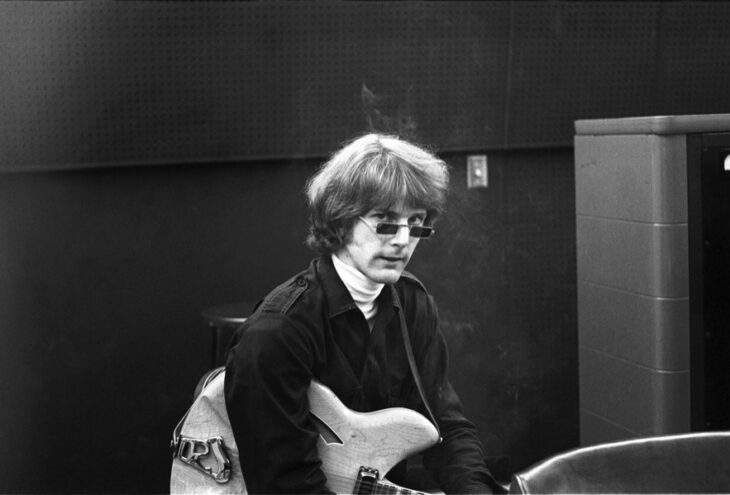
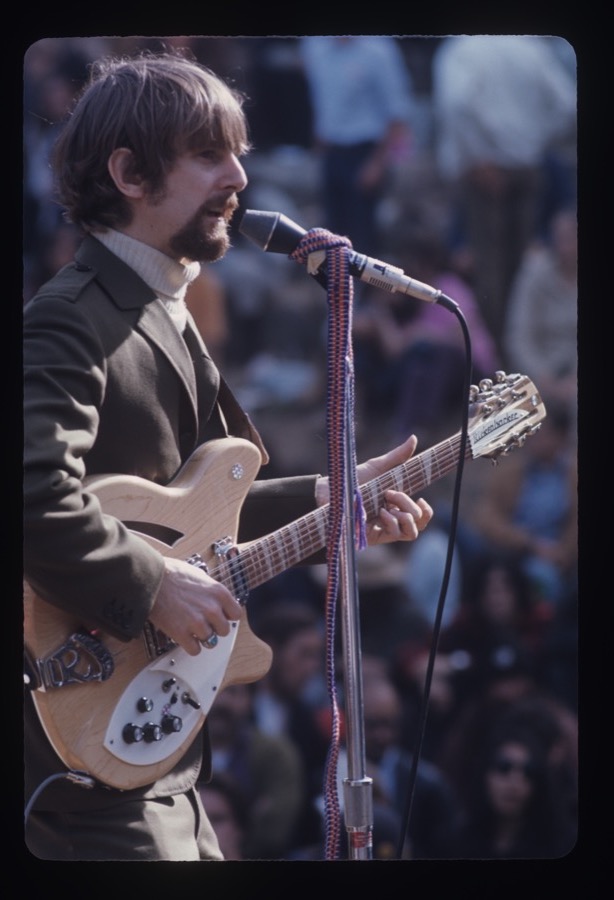
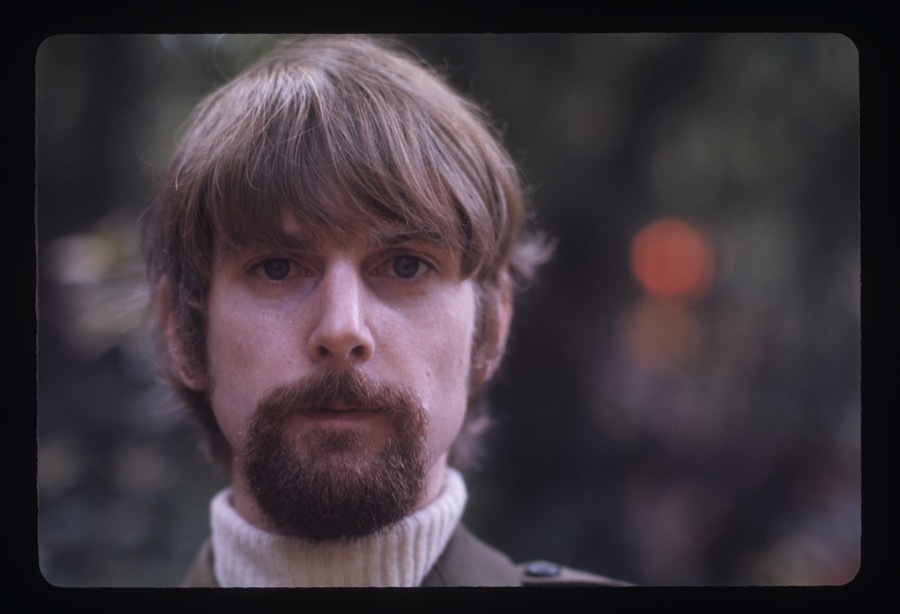
Photo above by Jim Dickson, courtesy of Gary Strobl at the Henry Diltz Archives
Roger McGuinn, the visionary co-founder and lead guitarist of The Byrds, returns to stages in 2026 with the crystalline chime of his 12‑string Rickenbacker and the rich storytelling that helped define folk-rock.
This tour celebrates McGuinn’s enduring craft rather than a trendy comeback, spotlighting the songs, history, and guitar tones that continue to resonate. Fans can expect a career-spanning set that feels both intimate and authoritative—an artist revisiting the maps he drew for others to follow.
What makes 2026 special is McGuinn’s ongoing commitment to reimagining his catalog: fresh arrangements, newly unearthed stories behind beloved tunes, and a living link to the birth of folk-rock. Anticipation is high because every show functions as a master class in songcraft, tradition, and the evolution of American music.
| Date & Time | Venue | Location | Tickets |
| Sat, Sep 12 – 7:30 PM | Unknown Venue | Lobero Theatre at The Lobero – Complex | Get Tickets |
| Wed, Sep 30 – 7:30 PM | Unknown Venue | Edmonds Center for the Arts | Get Tickets |
| Tue, Oct 6 – 7:30 PM | Unknown Venue | Tower Theatre Bend | Get Tickets |
| Sat, Oct 10 – 8:00 PM | Unknown Venue | The Center for the Arts (Grass Valley) | Get Tickets |
| Tue, Oct 13 – 7:00 PM | Unknown Venue | The Theater at Sunset Center – Complex | Get Tickets |
| Sat, Oct 17 – 2:00 PM | Unknown Venue | Forbes Hall at Clark Center for the Performing Arts – Complex |
Harvey Kubernik and Roger McGuinn Interview:
Q: Your 12-string Rickenbacker guitar sound integrated into the Byrds’ music since 1964 is acknowledged as one of the most influential guitar roles in recorded rock ‘n’ roll history, alongside other pioneers like Chuck Berry and Jimi Hendrix. How did this guitar enter your life?
A: I still use it. But it wasn’t part of my arsenal back in the folk days ‘cause it hadn’t been invented yet. F.C. Hall came up with the idea in the early Sixties, and I asked him, ‘Why did he do it?” And he said ‘For folk music.’ He didn’t realize that no self-respecting folk singer would be caught dead with an electric guitar at that time. So, he created the genre by creating an instrument by misunderstanding the folk mentality since they didn’t like electric guitars, in fact they hated them. And so he made this folk electric guitar which was perfect for what I was doing. I did apply my banjo rolling techniques to the Rickenbacker when I got it. I changed my whole picking style. I used to use a thumb pick and two finger picks.
In the Byrds I had to play lead lines with a flat pick so I started combining the two styles by having a flat pick between my thumb and fore fingers and moving the finger picks down one to middle and ring finger and then doing those banjo rolls like that. That’s how I did my arpeggios in the Byrds like ‘Turn Turn Turn,’ the jingle jangle sound. In the Byrds we used a lot of electronic compression on the Rickenbacker and it gave it a sustain that it didn’t have as a natural instrument. That was a really important thing.
Q: The Columbia studio had staff engineers. I know you recorded with Ray Gerhard.
A: A funny, ironic story about how that came about, Ray Gerhard was the engineer at Columbia Records when the Byrds started recording. And at the time Columbia was a middle of the road record label, and they were scared of rock ‘n’ roll. So, Ray, to protect his precious equipment would put limiters on everything, compression, and double compress it for the Rickenbacker, and that is what gave it the wonderful sound. When I heard the sound for the first time, I could not believe we had done it. It knocked me out. At the time I was on the band track with the ‘Wrecking Crew’ guys, and that was fun, and we did the vocals, and it was all different parts. But when it all came together on the playback it was bigger than the sum of its parts. I couldn’t believe we had done it. It sounded so creamy, rich, big and full.
Well, I did engineer my vocal, but it wasn’t to match the Rickenbacker but to get between John Lennon and Bob Dylan’s vocal. I wanted to try and hit that niche there between the two of them. With the Byrds we over dubbed with the Rickenbacker, like the lead break on “Eight Miles High” and “Turn! Turn! Turn!” They were not done with the band track. We just did a rhythm track and I would go in and do the leads until I got it right.
Q: The Byrds’ unique vocal blend?
A: We sang together well. I give the credit to Crosby. He was brilliant at devising these harmony parts that were not strict third, fourth or fifth improvisational combination of the three. That’s what makes the Byrds’ harmonies. Most people think it’s three-part harmony, and its two-part harmony. Very seldom was there a third part on our harmonies.
Q: “My Back Pages,” the Byrds’ cover song from Bob Dylan heard on Younger Than Yesterday, was recorded in the first week of December in 1966, and garnered a lot of radio airplay in the Summer of Love in 1967. Why did you get to record it? You had done many Dylan songs in your repertoire.
A: I was driving my Porsche up La Cienega, and got around to Sunset, and Jim Dickson, our former producer and manager, he had been fired by the Byrds, shortly before that, he still liked us, or some of us, and he pulled up in his Porsche, and signaled for me to roll my window down. “Hey Jim. You ought to record Dylan’s “My Back Pages.” I said, “OK. Thanks.” The light changed, I drove back up into Laurel Canyon, and pulled out the Dylan album that had “My Back Pages” and learned it.
I then took it to the studio and showed it to the guys. And Crosby hated it because he was mostly upset because he wasn’t getting his own songs on the album, and the reason why he left the band. There was a riff in the band, and he wasn’t getting as many as some of us. So anyway, I liked “My Back Pages” and don’t remember any resistance from anybody else in the band. Just David. And he was just mad because he wasn’t getting his songs. And it was a hit and a good tune. I’m really happy with it.
It was Dickson’s suggestion and I hadn’t thought of it as a song for the Byrds repertoire. I liked the wisdom of the song and it’s a very insightful song on the thing that happens when you think you’re so knowledgeable and wise when you are real young. And then when you get a little older you realize what you didn’t know.
Dylan’s stuff is brilliant. I coined the term that he was the “Shakespeare of Our Time.” It was like knowing Shakespeare here. Dylan was carrying on Kerouac and Ginsberg. The baton had been passed. I remember Ginsberg said I think we’re in good hands. We did “Chimes of Freedom” at Monterey Pop. I loved the imagery. You can’t pin it down as a peace song, or whatever, but it’s got overtones of that. It’s brilliant. I just identified with it and could relate to it.
Q: I caught the Byrds performing Dylan’s “All I Really Want to Do” at a Shindig! taping.
A: I love “All I Really Want to Do.” It’s kind of a simple little love song, you know, but it’s got a really sarcastic whimsical attitude. He doesn’t want to be hassled. He just wants to be friends. We changed the arrangement from the 3/4 time to a 4/4 time. We became his “unofficial, official” band for his stuff. I remember when Sonny & Cher got the hit with “All I Really Want to Do,” Dylan went, “Oh man, you let me down…” Normally, a writer would be happy to get a hit with his own songs. Who cares who did it? He was on our side.
Q: I really dug the colored sunglasses you wore on Shindig!
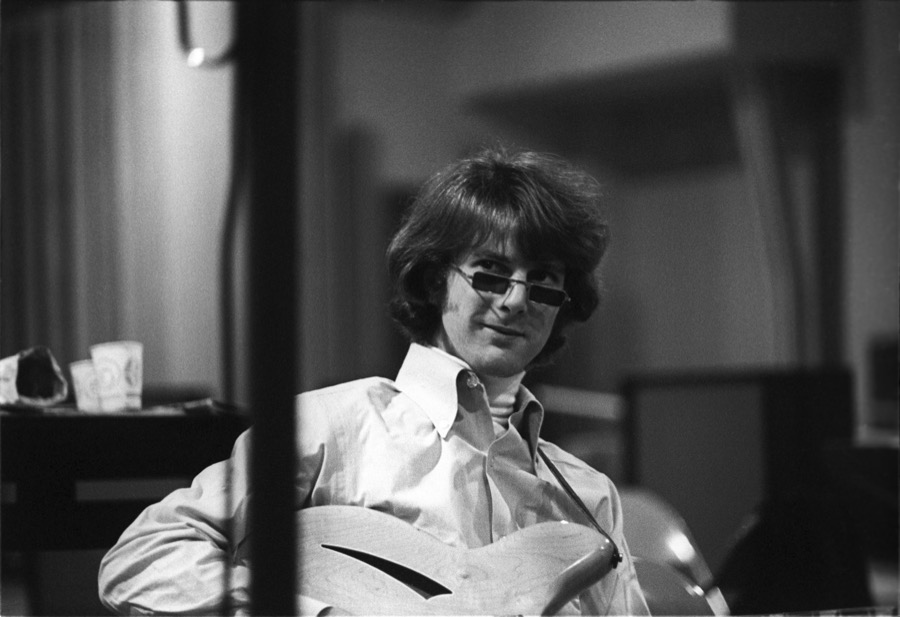
A: I saw John Sebastian in Greenwich Village, and I said, ‘Wow. Cool shades.’ And he said, “Yeah!” Somebody from Jim Kweskin’s Jug Band had just given it to him. John said, “Here, try them on. Look up at the streetlight and move your head back and forth. It’s really groovy, man.” I tried them on. I was nearsighted.
Later, in Hollywood, I went to a clothing shop on Sunset Strip, De Voss, and got these little wire frames and took them to the eye doctor and had him put in cobalt blue rectangular lenses.
TV producer Jack Good saw me, and said, “Wow. What a great gimmick. Everybody needs a gimmick. You gotta wear those all the time. Day and night.” I had been taking them off, like to do TV, or whatever. Just wearing them around. He encouraged me to wear them for everything. Onstage and offstage. So, I did. And it worked, and it became a bit of a fashion style.
Q: The world of sudden fame and the adulation aspect of it, during 1965-1967, but I remember if someone from the Byrds went to a record shop, a clothing store, or a food joint, it was big news the next morning in high school.
A: Yeah, there was a minute there, after the success of both “Mr. Tambourine Man” and “Turn! Turn! Turn!” where I could go out and go to restaurants, be approached, and followed home. Like little girls would follow you home, which is kinda flattering on one hand but…(laughs). It never got to the stage where (Bob) Dylan talks about in his book Chronicles, where people are up on the roof and trying to get in. It didn’t get that crazy but it got pretty crazy. They would tackle me from the gig to the limousine, and try and get something. They stole my Byrds glasses.
Q: The Byrds in 1965 went to England touring the country.
A: There were brilliant moments on the first trip over to England in 1965. We met the Beatles and the Rolling Stones. We had met the Stones before, but we got to hang out together in England. We met a lot of people and hung out at a lot of parties. Paul McCartney gave me a ride in his Austin Martin at a night at a club, The Scotch and St. James.
It was amazing. George Harrison and I went over our first guitar licks and talked about them and compared notes. Stuff like that. It was incredible. The audiences then in 1965 were basically little girls. And they were screaming and liking it. But the press ate us up because we were billed as ‘America’s Answer to the Beatles.’ And it was like a football game to them. It was a competitive thing, and they couldn’t let us get away with that, which is understandable. And the fact was that we were a green band. Michael Clarke was very inexperienced as a drummer.
I remember at the Blasé Club Chris Hillman was so nervous that he broke a bass string, which is really hard to do. (laughs). He did! We weren’t firing on all cylinders there. It wasn’t musically that great. And we got some awful reviews. Then, I got the flu, and Michael wanted to quit. It was kind of a nightmare.
On the good side we hung out with the Beatles and the Stones then. In 1967 when we came back again, we did a fan club event at the Chalk Farm Roundhouse that I remember. That was fun. At the end of the tour, the Byrds played a surprise gig at Blasé which Paul McCartney attended.
Q: What were you doing in 1967, and in the Summer of Love?
A: I was in the Byrds. Our Younger Than Yesterday LP produced by Gary Usher was mostly recorded in late 1966, and released in January ‘67. “So You Want To Be A rock ‘n’ Roll Star” as a single came out in January and in March. “My Back Pages” followed. “Lady Friend” and later “Goin’ Back” were also released that year. In June we performed at the Monterey International Pop Festival. I was on the Board of Directors. In August Columbia, released a Byrds Greatest Hits album.
Later that year we recorded the album The Notorious Byrd Brothers. It was a whirlwind, because we had to do two albums a year for Columbia Records, and then we went on the road between those. Gary usher was wonderful, a very creative guy. I really enjoyed our (previous) producer Terry Melcher, but Gary had some tricks up his sleeve that Terry didn’t have. More technological stuff. Terry was more like nuts and bolts, get the sound, the big AM radio sound. And, Gary was more alternative and into experimenting with, like getting the phase shifter for “Old John Robertson,” and the doors slamming. Things like that.
Chris and I knocked that off “So You Want To Be A Rock ‘n’ Roll Star” in very late 1966 at his house. It really wasn’t about the Monkees. We were looking at a teen magazine, and noticing the big turnover in the rock business, and kinda chuckling about it, you know, a guy was on the cover that we’d never seen before and we knew he was gonna be gone next issue. A funny little song. People didn’t know how to take it. We just meant it as a satire. We got along well and we wrote well. Actually, Crosby and I wrote well too for a while together when we were writing, and so did Gene and I. We had some good times writing songs.
Chris Hillman played us “Have You Seen Her Face” in the studio and we cut it. We weren’t into making demos back then. Demos came along in the ‘80s. (laughs). Chris Hillman is a very gifted musician. The way he transitioned from mandolin to bass was amazing in a very short. I don’t know if he was completely influenced by McCartney but he had this melodic thing, I guess more from being a lead player. He incorporated a lot of leads into his bass playing.
David Crosby and I on our early stuff I guess like when we had “The Airport Song,” and the first things, I enjoyed the direction that was sort of a jazzy. He’s an incredible singer for harmonies and he’s written some wonderful songs as well. A good songwriter. I also really appreciated his rhythm guitar work. I thought he had a great command of the rhythm part of it. And also finding interesting chords and progressions. He was the one who in “Renaissance Fair” and “Tribal Gathering” very jazzy and found the off the beaten track chord changes that were really cool.
Q: What was the best record you heard in 1967?
A: Might have been John Coltrane’s Africa Brass. We were on the road, and I had bought a Phillips Cassette Recorder in London, and it was such a new invention at the time there were no pre-recorded cassettes on the market. But I had a couple of blanks that I picked up. And we stopped somewhere in the mid-west, Crosby knew somebody there, so we went over to this guy’s house, and he had the latest Ravi Shankar and Africa Brass. And, so, I guess this is music piracy, but I dubbed Africa Brass on one side of the cassette and Ravi Shankar on the other. And we strapped the cassette player to a Fender amp on the bus and we just kept turning the cassette over and over and listened to that thing for a month on the road.
We loved that music, which influenced “Eight Miles High” later. The break on “Eight Miles High” was a deliberate attempt to emulate Coltrane, like sort of a tribute to him, if you will. We had heard Ravi Shankar earlier. I had a physical response to that Coltrane album the first time I heard it. It felt like a white hot poker was searing through my chest. It cut deep into me and it was a little painful. But I loved it. It just opened up some areas in my heart and head that I hadn’t known about. I think what I loved about Africa Brass was the improvisation of course, but his attitude comes through. A forceful, rebellious attitude. Like rock ’n’ roll. It really knocked me out.
Q: In 1967 the Byrds released a single of the Goffin/King composition, “Goin’ Back” in the UK that was a hit before in the UK by Dusty Springfield.
A: Gary Usher got the tune and brought it to us in the studio and played it for us as a demo. I didn’t know of Carole King, even though I had worked in the Brill Building earlier on. And, I had never heard of the Goffin/King songwriting team. But I loved the tune and thought it was really good. Gary explained that these were “Tin Pan Alley” writers who had just kind of taken a sabbatical and come back and revamped their style to be more contemporary, like we were doing. So, it really fit well I thought. We learned it and put a kind of dreamy quality into it.
Q: Tell me about record producer Gary Usher.
A: There were only a few producers around at that time. Like Phil Spector and the Brill Building people on the West Coast, along with the Beach Boys and the Wrecking Crew. Gary was amazing when he was doing this. He was a 'tech head' for the time. Very innovative. We had done this phase-shifting he had done with two tape machines. And he took that idea, which was moving the machines closer together, after recording them spread out, and then one would phase shift, and move them and make a 16 track out of them. I was loving it. He was great. Gary and I were kindred spirits and very creative. Gary was the shining light in that whole thing.
Q: I first heard your name as Jim McGuinn and not Roger. In 1964, along with the other Byrds, and many local teenagers, I saw A Hard Day’s Night at the Carthay Circle Theater in Los Angeles. Maybe it was on Hollywood Blvd. at the PIX Theater. I know what an impression that movie made on the band and your subsequent musical direction. It was a moment where you further embraced the Rickenbacker 12 string guitar and Crosby then got a Gretsch guitar. But for a couple of years, you were always Jim or Jimmy to guys like multi-instrumentalists Randy Sterling and Chris Darrow. And then in 1967, a name change, where you became Roger McGuinn. I later learned you became involved in Subud, a spiritual practice in quieting the mind.
A: I had been flirting with a name change from Greenwich Village. I got interested it in New York and sort of followed through in LA. By 1967 I was into it, whole hog. Legally, I only changed my middle name. My first name is still James. If someone wrote a check to Jim McGuinn, I could still cash it. (laughs). I switched my middle name. It was Joseph and I switched it to Roger and started using Roger as a first name. There was a Subud house in downtown LA on Hope Street and the Beach Boys used to hang out there. I remember that. Then, Brian (Wilson) formed his own chapter at his house during his ‘sandbox phase.
Q: Not to dwell on the drug trip, but when did marijuana and LSD first show in your musical community?
A: I saw weed in the Village. Absolutely. Alcohol was definitely a square thing to do. Only the tourists drank alcohol. Like, you’d be at the Gaslight, and you would hear, “This tourist came in and asked for a martini.” And, everyone would laugh. “Are you kidding?” I tried my first acid in 1961 in San Francisco when it was totally legal. It was from the Sandoz labs. It was great. I loved it. I noticed all the colors that were intense and everything was kinda dreamy. We were living in a commune in the Mission District. A bunch of us were living in a house. It was a wild scene. It was fun. Later taking acid in L.A. we’d be walking around. Crosby and I took acid and we’d walk around and I remember going to Will Wright’s Ice Cream Parlour on Santa Monica Blvd. Oh man, that brings back some memories.
Q: I could really use a scoop right now of the Will Wright’s peppermint ice cream! David Crosby left the Byrds in 1967 after a group decision to fire him, based on his stage antics at the ’67 Monterey International Pop Festival.
A: David talking about the Kennedy assassination. ‘Renaissance Fair’ our opener that I wrote with David was the perfect song for the festival. We had just recorded it. It was another new song. We were doing new material, and not relaying on our hit records. ‘Hey Joe (Where You Gonna Go)’ was in the set, and it was Crosby’s favourite song, and he always had this feeling that he knew the song before it was a hit. The Leaves and Love I think did it before the Byrds. But Crosby knew the song way before them. So, he always felt cheated on that. I like ‘Lady Friend’ one of his songs. I didn’t know David was going to sit in with Buffalo Springfield, and that wasn’t really a big deal.
What was happening was that we were not happy with each other, like a marriage breaking up. He was really upset because we didn’t do his song ‘Triad.’ That was the big bone. He wanted to be the lead singer of the Byrds, you know, the head Byrd. That wasn’t happening. To his satisfaction we were sharing vocals equally.
At Monterey I was trying to be a trooper, like Bobby Darin taught me, and try and soldier on and do it. ‘He Was a Friend of Mine.” I was surprised by David’s Kennedy rant on stage. I mean, first of all, I wasn’t sure I agreed with it. The myth-busters do a fairly extensive analysis of the whole thing and it looks like it could have been one bullet, ya know. So, I don’t know. My feeling was that it was not professional and my only concern. An inappropriate moment.
We did Chris’s ‘Have You Seen Her Face’ and Dylan’s ‘Chimes of Freedom,’ that we did earlier at Ciro’s, and to this day it’s still in my own repertoire. I think it’s a great song. I love the poetry and imagery of it, you know, and it has some political feeling but it is ambiguous. You can read whatever you want into it.
Hugh Masekela had played on our record of ‘So You Want to Be A Rock ‘N’ Roll Star,’ and I had toured with Miriam Makeba. So, I knew who he was. It was always wonderful to play with someone of Hugh’s caliber on the session and at Monterey, where he joined us on trumpet along with Big Black the percussionist. What a thrill. The song was a satirical jab at how they make teen idols. That was what it was all about.
At the Monterey International Pop Festival I discovered electronic music there. Paul Beaver had a booth at Monterey and I saw my first Moog and resolved to get one. And I got one as soon as I got back to L.A. The funny thing is this $9,000.00 instrument then, $50,000.00 in today’s money, didn’t have an owner’s manual. And Bob Moog felt that if you didn’t know how it worked you didn’t deserve to have one. (laughs). That was a funny thing.
Q: I think guitarist Clarence White, who played on the Byrds’ Sweetheart of the Rodeo an overlooked hero in the birth and development of country rock. He did a bluegrass touch coupled with a rock ‘n’ roll beat on “Time Between Us” from your 1966 Younger Than Yesterday LP. He also played on your The Notorious Byrd Brothers LP. And, going back to 1965 folkish/country Byrds’ offerings of “Oh! Susannah” and “Satisfied Mind,” a Porter Wagoner song, and the beat and country feel of your own playing and song structure of “Mr. Spaceman.” So, you and Chris Hillman certainly didn’t need to be introduced, let alone steered to country music by Gram Parsons.
A: I agree with you. I was a fan of country music and we were dabbling in country rock before Gram came in. And even ‘Mr. Spaceman’ has a country beat to it. I mean, it’s a silly sci-fi song but it’s got a country, Buck Owens approach kind of song. We were dabbling in that and something we did for fun, and the only difference when Gram came along is that we decided to do an entire album of it and do nothing but that so. That was the difference. And I think it was because Chris had an ally. That’s what he feels. He found an ally in Gram. And the two of them kind of swung it over to that at the time.
Absolutely. There was unity. We used to play poker every day. I mean we were buddies who would sit around, drink beer and play poker. And when we were off in L.A. We’d ride motorcycles together. I mean, we were having a good time. It wasn’t like there was this weird animosity. There was very little of that going on. It was a friendly band. Maybe too much fun. We enjoyed it. ‘Lazy Days’ is a cool song Gram wrote. They’re all good songs and we have to give Gram credit for bringing a lot of them to the sessions. Gram brought in a batch of songs. “Hickory Wind,” William Bell’s “You Don’t Miss Your Water,” and The Louvin Brothers’ “The Christian Life.”
We all got along great with the musicians in Nashville and stayed at this Ramada Inn and played poker all day until the sessions at night and had a ball. We were country boys. We got into it. I mean, we had cowboy hats and boots. I loved it. A very enjoyable experience. We were just role- playing. Even Gram. He wasn’t that kind of kid. He was a folkie, he was a preppie, basically. Gram got turned on Elvis when he was 10 years old, and that changed his life and he wanted to be a rock star, which he eventually became. He then got into country he got into Buck Owens and he got into Waylon and Willie. I think what he really wanted to do was get rid of me an get a steel guitar player.
Q: The musicianship and influence of guitarist Clarence White, who joined a later edition of the Byrds. His B-string bender instrument was ahead of everybody.
A: Oh, man, yea. Incredible. Unfortunately, it’s so true, ya know. I don’t know how… Maybe it’s the tragedy that surrounded Gram although Clarence’s death was tragic as well, but it wasn’t self-induced. (White was killed by a drunk driver as he loaded equipment into a van in the Southern California area).
I don’t know it’s hard to say. Clarence was a brilliant musician. I mean, it was like working with (Jimi) Hendrix. He was just a triple A plus musician and over the line every time. I see this imagery line, and some musicians come up to it and they just hit it and everything is fine. It’s in tune, and it’s in time. But Clarence was way over. He’d just fly over the line.
(Harvey Kubernik is the author of 21 books, including 2009’s Canyon Of Dreams: The Magic And The Music Of Laurel Canyon, 2014’s Turn Up The Radio! Rock, Pop and Roll In Los Angeles 1956-1972, 2015's Every Body Knows: Leonard Cohen, 2016's Heart of Gold Neil Young and 2017's 1967: A Complete Rock Music History of the Summer of Love. Sterling/Barnes and Noble in 2018 published Harvey and Kenneth Kubernik’s The Story Of The Band: From Big Pink To The Last Waltz. In 2021 the duo wrote Jimi Hendrix: Voodoo Child for Sterling/Barnes and Noble.
Otherworld Cottage Industries in 2020 published Harvey’s Docs That Rock, Music That Matters. His Screen Gems: (Pop Music Documentaries and Rock ‘n’ Roll TV Scenes) was published in February 2026 by Bear ManorMedia. Kubernik is currently researching a book on the Beatles for a UK publisher with a fall 2027 publication date.
Harvey wrote the liner notes to CD re-releases of Carole King’s Tapestry, The Essential Carole King, Allen Ginsberg’s Kaddish, Elvis Presley The ’68 Comeback Special, The Ramones’ End of the Century and Big Brother & the Holding Company Captured Live at The Monterey International Pop Festival.
During 2006 Kubernik appeared at the special hearings by The Library of Congress in Hollywood, California, discussing archiving practices and audiotape preservation. In 2017 he lectured at the Rock and Roll Hall of Fame in Cleveland, Ohio, in their Distinguished Speakers Series. Amidst 2023, Harvey spoke at The Grammy Museum in Los Angeles discussing director Martin Scorsese's The Last Waltz music documentary.
Kubernik was interviewed for the August 2025 documentary, The Sound of Protest being broadcast on the TVOD Apple TV broadcasting service. https://tv.apple.com › us › movie › the-sound-of-protest. Director Siobhan Logue’s endeavor features Smokey Robinson, Hozier, Skin (Skunk Anansie), Two-Tone's Jerry Dammers, Angélique Kidjo, Nina Simone, Holly Johnson, David McAlmont, Rhiannon Giddens, and many more).