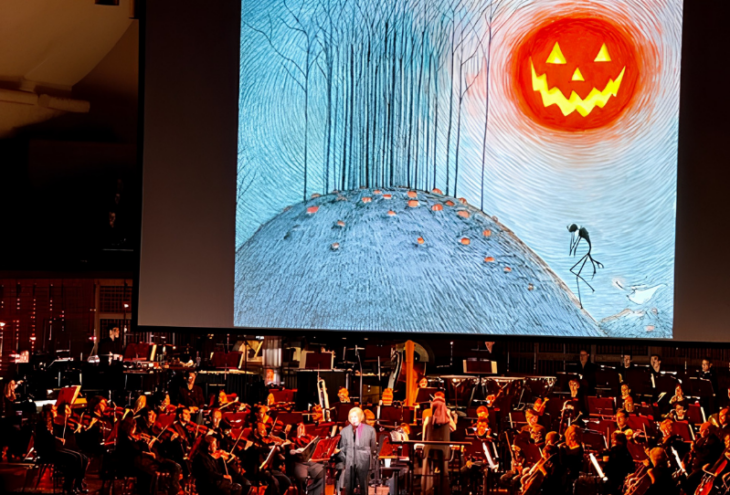
There are live shows, and then there’s what Danny Elfman is doing right now—a high-wire act that swings between orchestral film scores and industrial rock without ever losing its footing. Following his set at Sick New World Festival, the production team behind the performance revealed just how much technical precision it takes to make that kind of genre-hopping feel seamless, not chaotic.
At the center of the operation is Front of House engineer Ryan John, who is tasked with wrangling a staggering 121 inputs into something that feels cohesive. Elfman’s set doesn’t allow for breathers or resets—“It is one song straight into the next song—there is no downtime,” John explained. “We go from industrial metal to Batman to Oingo Boingo tracks.” That kind of pacing eliminates the luxury of traditional orchestral mic techniques. Instead, every instrument must be captured with precision and immediacy, leading John to rely heavily on the Neumann MCM 114 to keep everything tight and present.
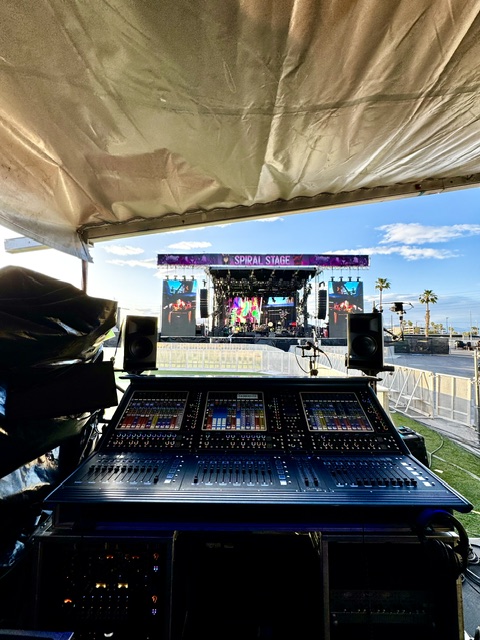
The challenge becomes even more intense in a festival environment, especially one as sonically aggressive as Sick New World, where acts like System of a Down are delivering punishing volume levels nearby. With a backing band that includes players tied to Nine Inch Nails—notably Robin Finck and Josh Freese—stage bleed isn’t just a nuisance, it’s a constant threat to clarity. John’s approach hinges on the MCM system’s cardioid pickup pattern, which avoids the rear sensitivity issues that come with hypercardioid mics. As he put it, “Hypercardioid mics have a lobe directly behind them that picks up sound… those rear lobes point straight at the drum kit. With the MCM KK 14, the biggest portion of the rejection pattern is 180 degrees from the instrument—exactly where the drummer and guitar amps are. It allowed me to pull up the cellos without my snare sound changing significantly. It gave me back my creative control.”
That level of isolation becomes essential when the show itself is constantly shifting environments—not just musically, but acoustically. In a traditional concert hall, John notes that the mix might lean heavily on the room itself, sometimes up to 70 percent ambient sound. On a dry, open-air festival stage, that equation flips entirely. “When you are in a position of mixing something like the 1989 Batman film score live, it's probably 50% reverb and 50% live input. In a traditional symphony hall, that ratio is actually even higher—probably 70% the room and 30% the instrument. But then, of course, when we transition into the industrial metal songs, everything gets a lot tighter, dropping to about 20% reverb and 80% live instrument,” he said, adding that the direct capture of the Neumann system allows him to make those shifts instantly “without the mix turning into mud.”
Beyond sound quality, there’s also the matter of efficiency. Managing a 121-input show would typically mean long setup times and endless troubleshooting, but John’s team has streamlined the process to a surprising degree. By using a consistent capsule across multiple instruments, they can execute a full line check in just 17 minutes. “Because we trust the capsule, all we need to do is confirm signal,” John explained, describing a process where technicians walk the stage playing pink noise through a Bluetooth speaker. The uniformity means fewer variables, faster adjustments, and less guesswork—an approach that feels closer to a systems check than a traditional soundcheck.
That same reliability extends to the physical build of the gear, which has to survive wildly different environments. One night might take place in a pristine concert hall, the next in a dusty outdoor festival lot. According to John, the MCM system has proven itself in both extremes: “They are polar opposites: a beautiful symphony hall and a dusty field across from casinos. But the MCM clips are made of metal; they are robust. We have dropped them off stages and stepped on them—and they just kept working.”
All of this technical groundwork culminates in a finale where every input on stage is open simultaneously, a moment that could easily collapse into noise but instead lands with startling clarity. “The string sound tends to blow the audience away,” John said. “They often don’t believe it’s real—they think it must be a backing track because they can’t imagine getting that much detail over a band playing that loud.” It’s a reaction that underscores the larger goal of the production: not just to blend orchestral and industrial elements, but to prove that they can coexist at full intensity without sacrificing authenticity.