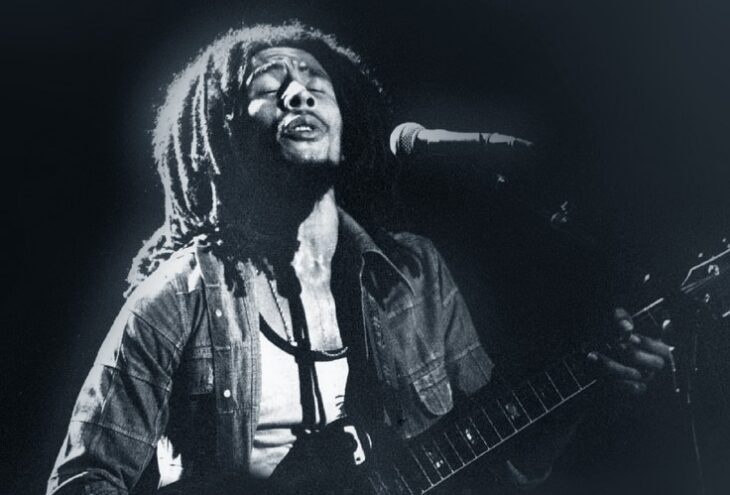
Robert Nesta Marley was born February 6, 1945 in Nine Mile, Saint Ann, a colony of Jamaica.
He left the physical world May 11, 1981 in Miami, Florida.
In 2023, L.A.’s Ovation Hollywood on Hollywood Boulevard hosted the first US residency for the multi-room Bob Marley One Love Experience. Visitors saw Marley’s entire Rock & Roll Hall of Fame archive at the exhibition, alongside previously unseen photos, rare memorabilia, concert videos, guitars, lyric sheets, sneakers, a Marley-branded jukebox, and Marley-themed artwork inspired by the star. One area celebrated the Marley family legacy and philanthropy.
Currently happening in Las Vegas, Nevada is a bold new celebration of Bob Marley’s life, music, and legacy premiered July 18th 2024 in Las Vegas. Bob Marley Hope Road, an immersive entertainment experience years in the making, officially opened at Mandalay Bay Resort and Casino.
Developed in collaboration with Cedella Marley, Ziggy Marley, Primary Wave Music, and the award-winning production company Five Currents, Hope Road invites audiences to walk in Bob’s footsteps and feel the power of his music and his powerful message in a completely new way.
A news release from Kirvin Doak Communications handing PR for Bob Marley Hope Road, outlined the production which is divided into two distinct offerings, each delivering a unique expression of Marley’s enduring impact:
‘“This show is a profound celebration of my father’s legacy,’ says Executive Producer Cedella Marley. ‘We invite everyone to feel the rhythm and the message, and connect to the spirit of ‘One Love’ through this extraordinary experience.’
“Larry Mestel, founder and CEO of Primary Wave Music, said, ‘Bob Marley’s music is more than just sound—it’s a movement, a message and a source of unity that has transcended generations. Marley’s legacy continues to shape music, culture and social change, and through this one-of-a-kind production, we honor the power of his voice and the impact he continues to have on the world.’
“Travis Lunn, Mandalay Bay’s president & COO, said, ‘Mandalay Bay is leading the way with a new wave of immersive entertainment, and we’re excited to introduce Bob Marley Hope Road as our latest experience. In collaboration with Five Currents and Primary Wave Music, this is a great opportunity to celebrate Bob Marley’s legacy and provide our guests with an innovative production they will enjoy.’
“Whether you’re a lifelong fan or discovering Marley’s music for the first time, Bob Marley Hope Road promises an unforgettable encounter with the heart and soul of reggae.
“Bob Marley Hope Road features dynamic live performances, engaging storytelling and multi-sensory elements. More than just a tribute, this production redefines entertainment in Las Vegas with a first-of-its-kind dual experience unlike anything currently on the Strip; blending interactive storytelling by day and an electrifying live show by night. For more information visit HopeRoad.com.”
If you are in Southern California at the Universal City Walk there is a Bob Marley restaurant displaying Marley memorabilia in an island-inspired setting. The signature Caribbean dishes on the menu include Jerk Chicken, Oxtail Stew, Jerk Cauliflower and Curried Goat with sides like plantains, rice and peas, with yucca fries.
In 1969, radio airplay of Jimmy Cliff’s “Wonderful World, Beautiful People” and “The Israelites” from Desmond Dekker & the Aces, along with “Hold Me Tight,” a 1968 hit single by Johnny Nash, and Millie Small’s earlier smash “My Boy Lollypop” in 1964, exposed ska and reggae from Jamaica to Southern California and Stateside.
Nash’s “I Can See Clearly Now” in 1972 reached number one on the US Billboard and Cash Box charts. Island Records’ Chris Blackwell, label owner and A&R man, had signed a handful of reggae artists to bring the messages from Jamaica to a global audience through distribution deals for Island, and associated imprints like Mango, with major labels including Columbia and Capitol.
Steffens’ Reggae Beat (1979) radio series originated at KCRW-FM in Santa Monica, California, and was eventually syndicated to 130 stations worldwide. The L.A. Weekly called it the city's most popular non-commercial program. (After ten years, during which he raised more than two million dollars as the anchor for the listener-sponsored station's annual fund drives, management unceremoniously ousted him and the program.)
Three years after Marley died in 1981 of a rare melanoma at just 36 years old, Steffens began lecturing internationally with a multimedia presentation dubbed The Life of Bob Marley, including talks at the Library of Congress, the Smithsonian, and the Rock & Roll Hall of Fame.
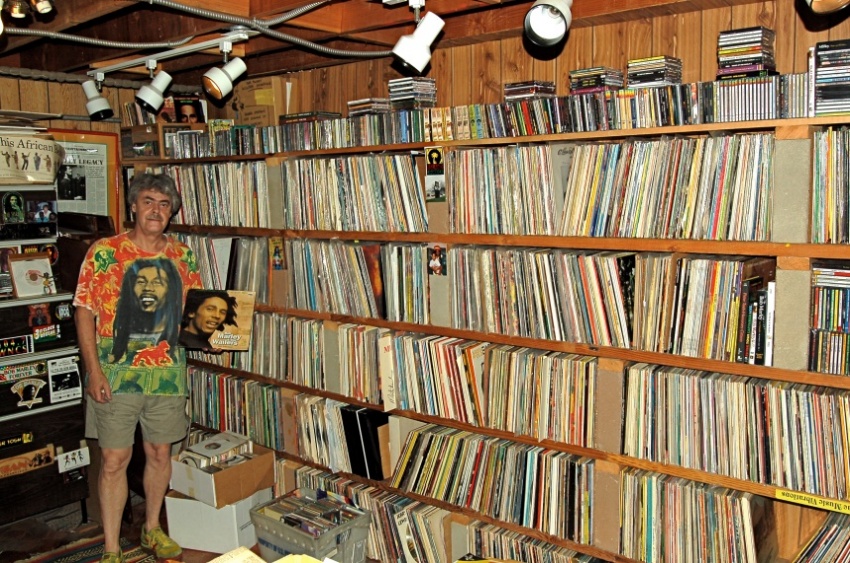
Roger Steffens, with a small section of his reggae archives. Photo courtesy Roger Steffens.
Based in Los Angeles, Steffens was also a national promotions director for reggae and African music at Island Records and handled reggae promotion for Elektra Records in the early 1980s when Steel Pulse was on the label.
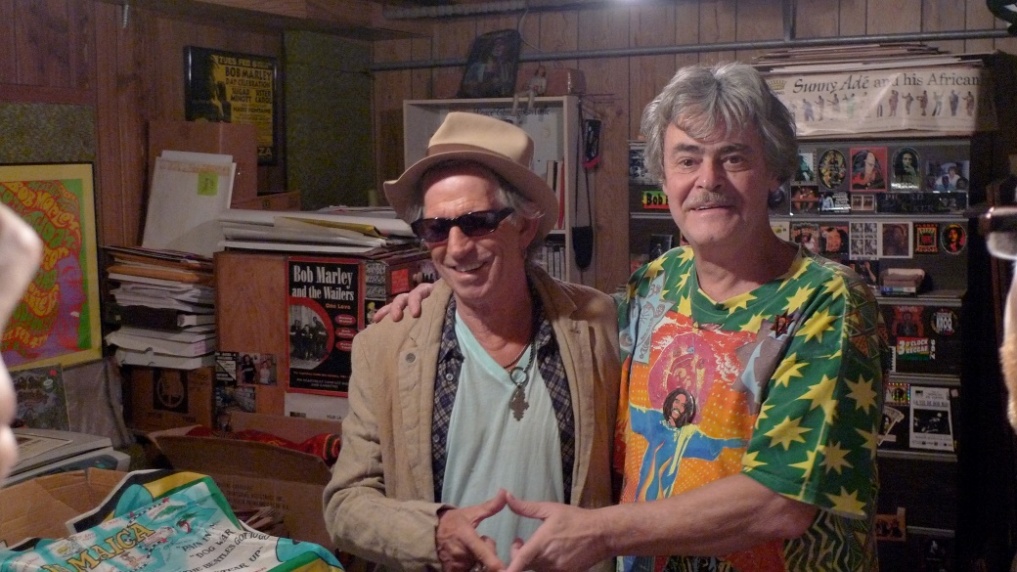
Keith Richards and Roger Steffens. Photo courtesy of Roger Steffens.
“The very best Marley documentary came out years ago, too, by an extraordinary music documentarian named Jeremy Marre. It’s called Soul Rebel (1986), and it’s the first film about Bob made outside the aegis of his family, so a lot of people who were never willing to speak publicly before about Bob finally came forward to tell their tales.
“In recent years, the Netflix documentary ReMastered: Who Shot the Sheriff? (2018), which tells the true story of what happened after the December 1976 assassination attempt on Marley’s life, is a brilliant telling of the same period covered by the recent Bob Marley: One Love (2024) motion picture.
“There is also Stepping Razor: Red X (1992), about the music and murder of Bob’s former partner in the Wailers, Peter Tosh, which incorporates Tosh’s own recorded diary and recreated scenes of his final hour.”
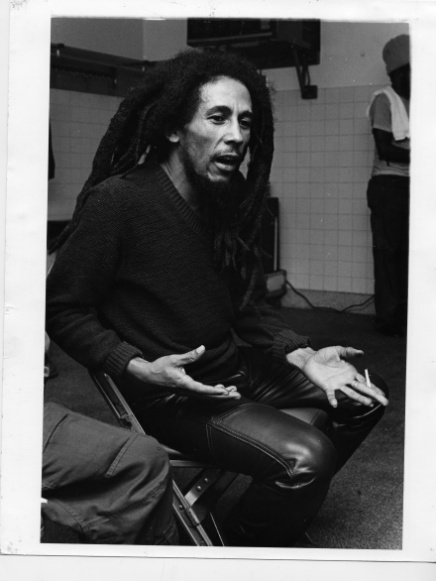
Bob Marley. Photo by Roger Steffens. Courtesy of the Roger Steffens reggae archives.
I first met James Cushing in 1968 in Westwood Village at the headquarters for Senator Eugene McCarthy’s US presidential run. It was around the time I first learned about reggae music. In 1971, Cushing started attending the University of California, Santa Cruz and by 1973 was earning a reputation as Northern California’s “Pied Piper of reggae.”
“April 1973: All US troops are ‘fully withdrawn’ from Vietnam, abortion is legal, the trial of the Watergate burglars is front page news, and in New York, the one hundred and ten-story World Trade Center has just opened,” Dr. James Cushing emailed in July 2021.
“In ultra-mellow Santa Cruz, serial murderer Ed Kemper, who has killed and mutilated three people known to me personally, has just turned himself in to police, and the sense of relief on campus is as tangible as the bark on the redwood trees. I’m a sophomore at College V (now Porter College), living with my girlfriend in B-dorm, where pot is fifteen dollars an ounce, LSD is two dollars a hit, and everyone’s young and sexually active.
“You can tell, because everyone’s stereo is playing something new and provocative like last month’s Pink Floyd release, Dark Side of the Moon, or the brand-new one by this new English guy, David Bowie, Aladdin Sane. I’m writing record and concert reviews for the campus paper, The City on a Hill Press, and Capitol Records in Hollywood has been generous enough to put me on their rock mailing list, so I get all their new releases, like Pink Floyd, and people come to my dorm room to check them out.
“Well, Dark Side of the Moon was cool, but Capitol was distributing Chris Blackwell’s Island imprint and sent campus critics another LP that season by a new group called the Wailers—Catch A Fire, it was called, with a clever hinged cover resembling a Zippo lighter, and music that nobody in that building had ever heard before.
“The players were all Black, but their sound wasn’t soul or funk in the Motown/Stax/James Brown/Aretha sense, and it wasn’t anything like Jimi or Sly and the Family Stone. The bass and guitars and drums were all plenty loud, but it wasn’t rock, either.
“The word ‘reggae’ was used in Capitol promotional material, but I didn’t know how to pronounce it—soft ‘g’ or hard —and at the level that mattered most, that was all right. Marley’s sound was just the thing we needed after weeks of local terror and political uncertainty: something sexy and relaxing, thoughtful and physical, totally new and totally cool.
“For most of that quarter, mid-April to mid-June 1973, Catch A Fire was the number one party album in my part of B-dorm, with ‘Kinky Reggae’ the one that got everyone moving. I believe that place on the timeline qualifies us as the first reggae-heads in Santa Cruz. Residents of that floor in that building that quarter will likely remember these parties well. Stir it up, midnight ravers!”
On the day Duke Ellington died, May 24, 1974, I saw Johnny Nash in the lobby of Columbia Records on Sunset Boulevard. He was enjoying commercial success following “I Can See Clearly Now.”
Nash nodded when I mentioned “Some of Your Lovin,’” a song he co-wrote with record producer Phil Spector in 1961 when he was signed to ABC-Paramount Records.
As Johnny entered the elevator, I wished I had told him how much I liked his tune “What Kind of Love Is This.” Joey Dee and the Starliters had cut it for the Columbia picture Two Tickets to Paris (1962).
I witnessed Bob Marley and the Wailers in concert eight times from 1975 to 1979. The first was on July 13, 1975, at the Roxy Theatre in West Hollywood. I interviewed the group once in 1976 for Melody Maker. Our rendezvous was held in such a ganja smoke-filled room at the Island Records office on Sunset Boulevard that I forgot to press the “record” button on my cassette machine!
John Lennon and Yoko Ono attended the Wailers’ May 16, 1976, Roxy show. The couple sat near me. I thanked John for introducing me to the reggae and bluebeat music he touted in music publications and radio interviews. He grinned and offered a friendly handshake.
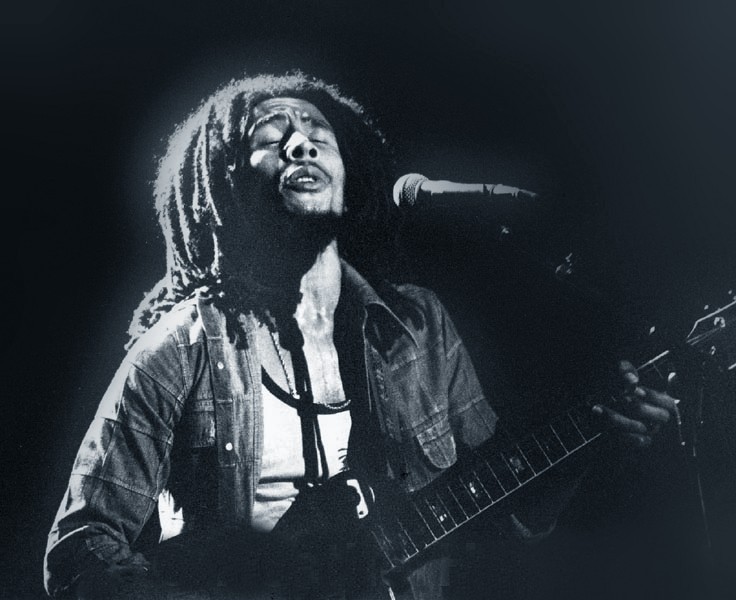
Bob Marley. Photo by Heather Harris.
On July 22, 1978, I was invited to cover Marley and the group at the Starlight Bowl amphitheater in Burbank. A few music reporters were given tickets and all-access backstage passes.
I watched the concert from the wings, standing the whole evening with Mick Jagger, holding his daughter Jade in his arms. Mick still managed to pass some ganja to our circle that included Peter Tosh, who was opening the next day for the Rolling Stones at Anaheim Stadium.
Before the transformative evening concluded, a very sweaty Bob Marley ran over to our area at the venue and just past me on his way to talk to Peter, who then joined him for a surprise appearance during “Get Up, Stand Up.”
Tosh later told Roger Steffens, “Mi slap Bob’s hand and him say, ‘Bwoi, de Pope feel dat one!’”
Three days later, Pope John Paul I died.
In May 1973, the Wailers (before they resumed using their earlier name, Bob Marley and the Wailers) played at the Speakeasy club in London, England. Reggae fan Keith Richards was in attendance. Drummer Jim Keltner had told me about driving around England with Richards during 1970-1972 to pick up reggae records at a shop in Ladbroke Grove, like Gregory Isaacs’ “Extra Classic” and the Itals’ “In a Dis Ya Time.” The Rolling Stones later covered a reggae tune by Eric Donaldson, “Cherry Oh Baby,” on their Black And Blue LP, released in 1976.
In 2024, the Stones debuted a new rum brand called Crossfire Hurricane, a premium blend of rums from Jamaica, Barbados, and the Dominican Republic. The band explained, “The Caribbean’s boisterous energy and music took hold of the group over the decades,” adding that Jagger and Richards, “often locate themselves on the islands when the band is off the road.”
The Stones recorded Goats Head Soup in Kingston in 1972 at Dynamic Sound Studios. In a 1999 interview in my book, This is Rebel Music (2004), Richards extolled the sounds from Jamaica and the island’s culture.
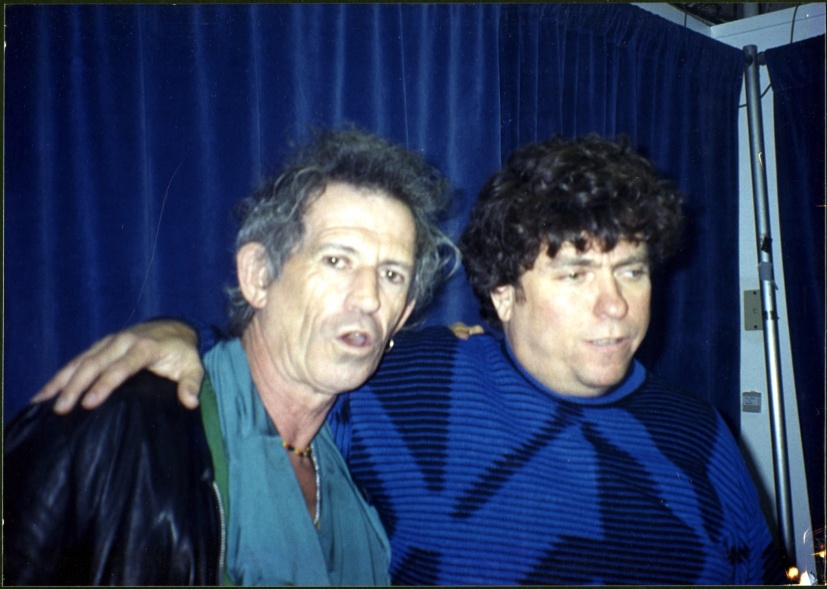
Keith Richards and Harvey Kubernik. Photo by Bob Sherman. Courtesy of the Harvey Kubernik archives.
“I think because it’s timeless music. I call it ‘marrow music.’ Not even bone music. It strikes to the marrow. It’s like a faint echo. . . The body responds to it, and I don’t know why. You asked me earlier about Goats Head Soup. I was only really learning about Jamaica then and when you’re making records, you’re pretty much myopic. It was only really after recording Goats Head Soup and staying in Jamaica for several months, which was when I bumped into the Wingless Angels on the beach. We got talking and playing.
“In certain ways, Jamaica doesn’t change that much. There’s a very solid rhythm to life there, and they seem to be able to adapt to even incoming technologies that speed the rest of the world up. What I really love about Jamaica is that they have a rhythm all their own and everybody, including yourself—after a few days you can’t get out of step, man, you know.”
Richards mentioned the Wingless Angels, a Jamaican Rastafari reggae group in Steer Town that he met and recorded, executive-producing an album issued on his own Mindless Records imprint in 1995.
In the aforementioned ReMastered: Who Shot the Sheriff? Netflix original documentary, released on October 12, 2018, director Kief Davidson explores the violent political suppression of the roots reggae movement in Jamaica through an investigation into Jamaican politics and the CIA’s involvement in targeting Marley. Jimmy Cliff, Roger Steffens, Wayne Jobson, Cindy Breakspeare, and Carl Colby are interviewed.
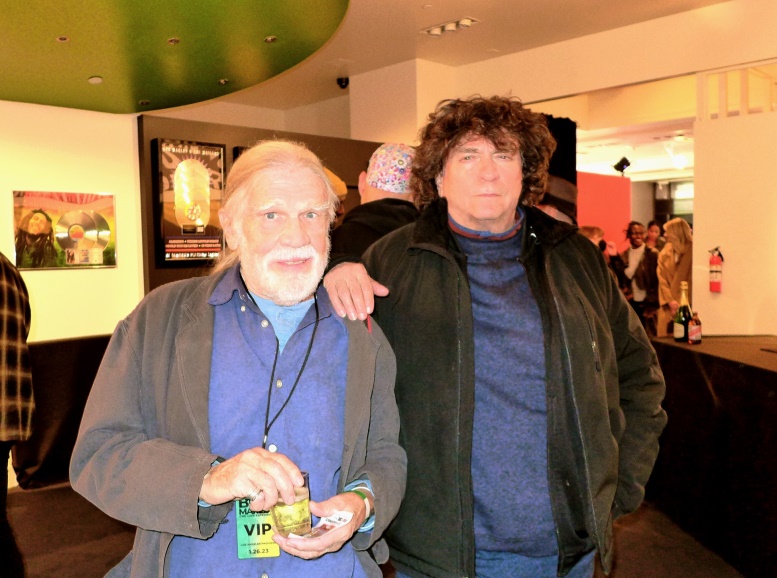
Henry Diltz and Harvey Kubernik at the Bob Marley One Love Experience exhibition. Photo by Heather Harris.
(Harvey Kubernik is the author of 20 books, including 2009’s Canyon Of Dreams: The Magic And The Music Of Laurel Canyon, 2014’s Turn Up The Radio! Rock, Pop and Roll In Los Angeles 1956-1972, 2015's Every Body Knows: Leonard Cohen, 2016's Heart of Gold Neil Young and 2017's 1967: A Complete Rock Music History of the Summer of Love.
Sterling/Barnes and Noble in 2018 published Harvey and Kenneth Kubernik’s The Story Of The Band: From Big Pink To The Last Waltz. In 2021 they wrote Jimi Hendrix: Voodoo Child for Sterling/Barnes and Noble.
Otherworld Cottage Industries in 2020 published Harvey’s Docs That Rock, Music That Matters. His Screen Gems: (Pop Music Documentaries and Rock ‘n’ Roll TV Scenes) will be published in mid-February 2026 by BearManor Media.
Harvey spoke at the special hearings in 2006 initiated by the Library of Congress held in Hollywood, California, discussing archiving practices and audiotape preservation.
In 2017, he appeared at the Rock & Roll Hall of Fame in Cleveland, Ohio, in its Distinguished Speakers Series and as a panelist discussing the forty-fifth anniversary of The Last Waltz at the Grammy Museum in Los Angeles in 2023).